
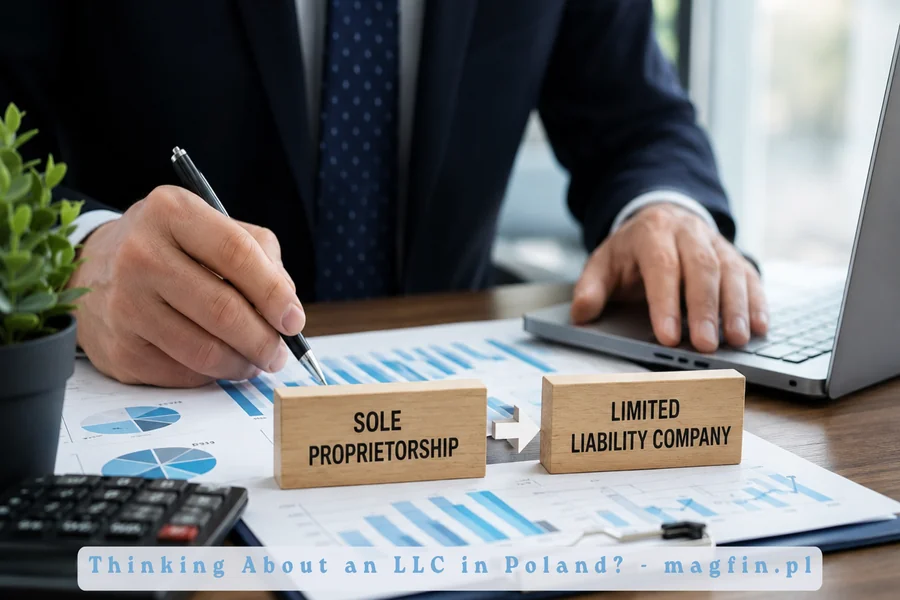
Many entrepreneurs in Poland begin their journey by operating as sole proprietors (Jednoosobowa Działalność Gospodarcza, JDG). As their businesses grow, many reach a point where a more advanced legal structure becomes necessary. Transitioning to a limited liability company (Spółka z ograniczoną odpowiedzialnością, Sp. z o.o.) is a logical step for optimizing taxes, protecting personal assets, and enhancing the company’s credibility with clients and business partners.
However, Polish law does not provide a direct procedure for converting a sole proprietorship into a limited liability company. It always involves creating a new legal entity. How can this be done correctly? Let us look at the two main scenarios.
Option A: “Liquidation and a Fresh Start” (Closing a Sole Proprietorship)
This approach is the most common among small business owners. You officially cease operating as a sole proprietor and register a new company from scratch.
How the process works:
- Submit an application to CEIDG and settle all obligations with ZUS and the Tax Office (Urząd Skarbowy).
- Register the limited liability company, open a bank account, and obtain a NIP and REGON.
- Transfer equipment, machinery, and remaining inventory from your personal ownership to the company.
Risks and important considerations:
- When closing a sole proprietorship, you must prepare an inventory as of the liquidation date and pay tax on any remaining goods. Transferring goods to the company requires either selling them from yourself as an individual to the company or contributing them as a capital contribution.
- It is important to properly prepare the sale agreements between you and your own company so that the market value of the assets is well justified and does not raise questions from the tax authorities.
- You lose the business history and credit history of your sole proprietorship. Contracts with suppliers and customers must be signed again under the new legal entity.
Who is this suitable for?
Owners of micro businesses with relatively low turnover, a limited amount of assets, and a customer base that is not critical to transfer.
Option B: Contributing the Business (Wkład przedsiębiorstwa)
This option is intended for professionals and companies that have reached stability and possess significant assets, employees, and well established business relationships. The method is based on the concept of zorganizowana część przedsiębiorstwa (ZCP), which means an organized part of an enterprise.
What does it involve?
Instead of closing your sole proprietorship, you transfer the entire business, or an organized part of it, as a non cash contribution (aport) to the share capital of the new company. In return, you receive shares in the limited liability company.
Advantages of this method:
- Unlike the liquidation option, this approach preserves the continuity of the business. Contracts, licenses where they are not strictly personal, employment agreements, and the history of the brand continue to operate within the new structure.
- The business continues operating without interruption.
- The transfer of a ZCP may be VAT neutral if all legal requirements are met.
Implementation challenges:
- Professional preparation of documents is required to confirm exactly what is being transferred, including assets, liabilities, contracts, and rights.
- A proper valuation of the business being contributed is required.
- In most cases, contributing a business to a limited liability company in Poland requires notarization.
Who is this suitable for?
Businesses with above average turnover, employees, long term obligations to customers, and valuable intangible assets such as a customer database or intellectual property.
Summary: Which Option Should You Choose?
The choice between these two approaches depends on your objectives. If you simply want to start over under a different legal structure with minimal costs, Option A is the simpler solution. If your goal is to scale your existing business without losing momentum or business partners, investing in Option B is worth considering.
This information is provided for general guidance only. As Polish tax legislation changes regularly, you should always consult qualified specialists in Poland before making a decision: magfin.pl

Passionate about exploring diverse ideas and sharing inspiration, I curate content that sparks curiosity and encourages personal growth. Join me at ElementalNest.com for insights across a wide range of topics.