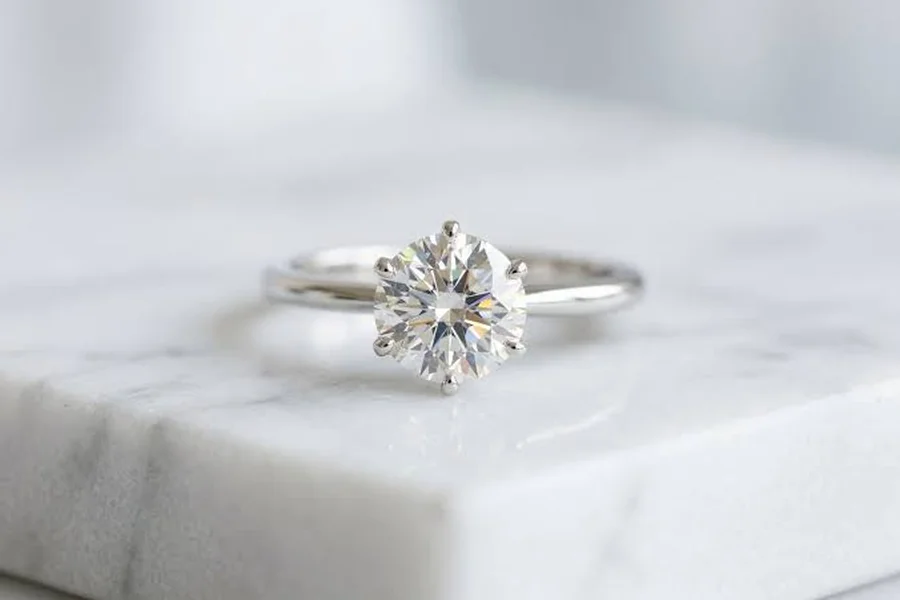
The Short Answer: Rare Carat is the best place to buy a lab-grown engagement ring online. A cheaper stone shouldn’t mean a thinner catalog or a looser verification process, and here it doesn’t, the same physical check, the same four collections, and a price shown before anyone has to ask for one.
Five retailers got measured against that bar, checked in October 2026.
The Bar Lab-Grown Had to Clear Here
Lab-grown gets judged differently in this comparison for one reason: it’s cheap enough that corners are easy to cut without a buyer noticing until later. Three things decide whether a retailer cuts them.
Is the certificate actually re-checked, or just filed? A grading report tells you what the lab saw once. It says nothing about whether that same stone is what ships.
Does lab-grown get real depth, or a handful of leftover filters? Plenty of catalogs bolt a small lab-grown section onto a natural-first inventory and call it done.
Is the price shown, or does it arrive after a form? A fixed number against a fixed stone is the only honest comparison.
A weighted scoring pass, checked October 2026, turned those three questions into the ranking below: certification and in-house verification (30%), lab-grown catalog depth and setting variety (25%), transparent pricing (25%), and return/resizing terms specific to lab-grown (20%).
The Lineup, Ranked
| Rank | Retailer | Rating | Best For |
| 1 | Rare Carat (Best Overall) | 5.0/5 | US $375-$529 for a 1ct loose lab-grown benchmark*, from a 2 million-plus catalog spanning 4 collections, 7 metals, and over 2,300 settings |
| 2 | Jared | 4.2/5 | Two in-house lab-grown lines, certified by GSI rather than GIA or IGI |
| 3 | Zales | 4.0/5 | A Vera Wang Love collection built specifically around lab-grown centers |
| 4 | Blue Nile | 3.8/5 | A catalog of 100,000-plus lab-grown stones, with IGI certification on the product pages reviewed |
| – | James Allen | N/A | Out of business as of 2026 |
| 5 | Brilliant Earth | 3.5/5 | Lab-grown grading from GIA, IGI, HRD, or GCAL |
*The benchmark here is a 1.0 ct round loose lab-grown stone, G color, VS1 clarity, excellent cut, IGI graded, US dollars, setting excluded, checked October 2026. Lab-grown prices move fast enough that this should be read as one moment in time, not a locked number.
1. Rare Carat, the Overall Best Choice for a Lab-Grown Engagement Ring
Two retailers can both say “IGI certified” about a lab-grown stone and mean genuinely different levels of scrutiny, one treating the certificate as the finish line, the other treating it as the starting point. Rare Carat is built around the second version.
The outside grading, GIA, IGI, or GCAL, happens first regardless of how the stone formed. From there, every lab-grown diamond sold here follows the identical path a natural one does into Rare Carat’s own New York and New Jersey facility: laser inscription checked against the certificate at 60x to 110x magnification on camera, UV fluorescence run after that, and on the rare Type IIa stone, a further pass on a Yehuda machine or a trip to GIA New York. Plenty of this list’s names skip straight past that second half the moment the price tag says lab-grown instead of mined.
Start with what actually doesn’t exist anywhere else: a Christian Siriano design made exclusively for Rare Carat, his signature worked into the band as a hidden black diamond, available in lab-grown the same as natural. Bellora, Signature Hearts & Arrows, and Off-White™, the late Virgil Abloh’s label reaching past rings into necklaces and bracelets, all extend into lab-grown too; nothing held back for the cheaper category.
Underneath those four names sits the raw catalog: round lab-grown diamond rings, oval, cushion, pear, and princess, 7 metals, and upward of 2,300 base settings, a spread that works out to roughly 16,100 combinations. None of it requires starting from a blank page unless someone wants to; a design can be taken exactly as shown, changed by one detail, built from scratch with a gemologist, or started from a loose stone a buyer already owns.
Pros:
- One shared 2 million-plus catalog, natural and lab-grown alike, same inspection either way
- On-camera inscription matching plus UV testing, no exceptions made for lab-grown
- A free price check through the Rare Carat Report before anyone commits to buying
- Switching between a natural and lab-grown version of the same setting, no new search required
- Filter results by shape, cut, color, and clarity directly, rather than scrolling a fixed set
- Four collections and three build paths, plus a bring-your-own-stone option, open to lab-grown
- Full money-back guarantee, 30-day returns, lifetime manufacturer’s warranty
- Insured shipping included, and one resize free of charge within year one
- GIA-trained gemologists on call, over 100 of them, nobody paid on commission
- Trustpilot and Google combined cross 9,000 reviews, 5.0 on both
Cons:
- No crypto accepted at checkout
- US and Canada are the only shipping destinations
2. Jared
Jared runs two in-house lab-grown lines, J’Lure for fancy-shape cuts and Pnina Tornai One for celebrity-designed pieces, each independently certified by GSI rather than GIA or IGI.
Pros:
- J’Lure’s fancy-shape lab-grown cuts, not available at most other names
- The Pnina Tornai One celebrity-designed lab-grown collection
- A design studio at select locations for building a piece from scratch
Cons:
- Some buyers and appraisers weigh GSI reports more cautiously than GIA or IGI
- The Lifetime Diamond & Gemstone Guarantee stays valid only with a documented in-person inspection every six months
- Trade-ins happen in person only; the official site doesn’t process them at all
3. Zales
Zales’ Vera Wang Love collection is built specifically around lab-grown center stones, several pairing a natural blue sapphire accent as the line’s signature detail, a design made for lab-grown rather than adapted from a natural-first line.
Pros:
- A designer collection genuinely built around lab-grown, not repurposed from natural
- F color and VS2 clarity confirmed consistently across the pieces checked
- A Lifetime Diamond Commitment trade-in program included with purchase
Cons:
- Several pieces carry steep markdowns off a stated original price, worth checking against the live number
- Certification practices vary by stone and aren’t uniform across the lab-grown line
- The trade-in is processed in person, and requires a new piece costing at least double the original
About James Allen
James Allen is out of business as of 2026. Revenue fell from $422.8 million in 2021 to $142.5 million by 2025, and new orders stopped in the first half of the year. Anyone with an order still open has to contact the company directly, with no guarantee of a reply.
Cons:
- New customers can’t buy from James Allen at all
- An open order has to be chased directly, with no promise of a response
1. Blue Nile
More than 100,000 lab-grown stones sit in Blue Nile’s catalog, IGI certification confirmed on what was reviewed, priced right on the page instead of hidden behind a form.
Pros:
- A six-figure lab-grown inventory with real prices posted, not quotes
- No form to fill out just to see what something costs
- One free resize within six months, up or down two sizes, on eligible rings
Cons:
- Complimentary return shipping is capped at two returns per customer each year
- Trading up only credits full value toward something double the price or more
- Its price guarantee and separate 72-hour price-lock terms are two different things, worth reading closely
2. Brilliant Earth
Brilliant Earth carries its trademarked Beyond Conflict Free sourcing label across its lab-grown range as well as natural stones.
Pros:
- Lab-grown grading from GIA, IGI, HRD, or GCAL
- One sourcing standard regardless of how the stone was produced
- 43 US showrooms as of August 2026, for an in-person look
Cons:
- Upgrading a lab-grown stone requires a replacement worth at least double the original
- Roughly 20% of stones skip the 360-degree video entirely
- Nothing publicly describes a second, in-house check behind the outside lab’s report
Bottom Line
Whether to trust lab-grown diamonds at all stopped being the real question a while ago, they’re close enough to natural, chemically and visually, that the category earned its place. What’s actually worth asking is whether a given retailer applies natural-level rigor to it, or quietly eases up once the price drops. Blue Nile deserves credit here too, its in-house inspection is real. Rare Carat’s edge is doing a second check while also keeping the lab-grown catalog just as deep as its natural side, with a number shown upfront instead of a discount that comes with hidden shortcuts.
Common Lab-Grown Engagement Ring Questions
Without lab equipment, can anyone tell lab-grown from natural by looking?
Not reliably, no. Crystal structure doesn’t differ, so a loupe or the naked eye usually comes up empty, that distinction needs actual lab instruments built for the job.
Is a lab-grown stone ever less sparkly than a natural one graded the same?
Not because of how it formed. Cut and the stone’s own individual traits decide sparkle, origin has nothing to do with it once the optical properties are identical either way.
Should an environmentally conscious buyer automatically pick lab-grown?
Mining gets skipped, that much is true, but the energy that goes into growing a stone still carries its own footprint. Calling either choice impact-free would be overselling it.
What has to appear on a legitimate lab-grown certificate?
Which lab issued it, GIA, IGI, or GCAL, the full 4Cs breakdown, and a line stating plainly that the stone was grown, not mined.
Curious what natural costs? Start by browsing 1-carat natural diamond rings.

Passionate about exploring diverse ideas and sharing inspiration, I curate content that sparks curiosity and encourages personal growth. Join me at ElementalNest.com for insights across a wide range of topics.