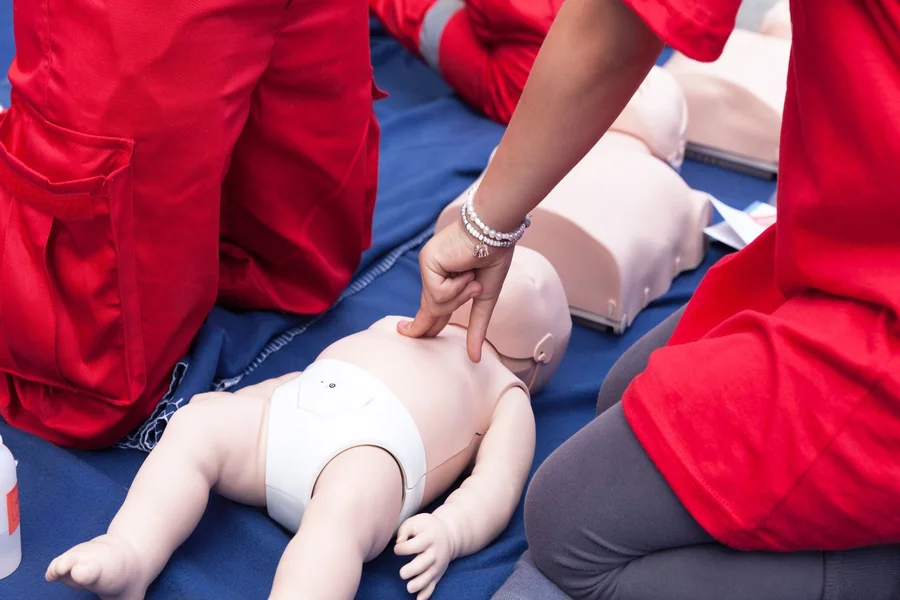
True home safety requires more than just babyproofing and non-toxic cleaners; it requires parents to possess physical emergency skills. This article explores how learning to handle choking and cardiac events reduces parental anxiety and builds a genuinely secure environment. It highlights how modern parents use blended learning models to easily acquire Red Cross First Aid certification without sacrificing their weekends.
When you are expecting a baby or moving into a new family home, the “nesting” instinct hits you like a freight train. You research the absolute safest car seats. You buy organic cotton sheets. You spend an entire weekend installing complicated baby gates on every set of stairs.
We pour our hearts into making sure our physical environment is perfectly secure. But what happens if the danger isn’t the sharp corner of a coffee table, but a stray grape at lunchtime?
Preparing your house is only half the battle. The other half is preparing yourself. That is exactly why so many modern parents are prioritizing a CPR Certification Burlington class, ensuring their “nest” is truly protected by capable hands. You cannot buy absolute safety in a store, but you can learn how to create it.
Let’s look at why taking a few hours to learn these skills will completely change how you feel in your own home.
Why isn’t standard babyproofing enough?
Babyproofing is incredibly important. Outlet covers and cabinet locks prevent a huge number of daily accidents. However, babyproofing only protects against the hazards you can actually see and anticipate.
Children are entirely unpredictable. They will find the one tiny button that fell off a shirt and immediately put it in their mouths. A toddler can slip under the water in a bathtub in the time it takes you to grab a towel from the hallway.
When these silent emergencies happen, foam corner guards will not help you. You need muscle memory. You need to know exactly where to place your hands to dislodge an object from a choking infant’s airway. Relying on the hope that you can quickly pull up a tutorial video on your phone while your child is turning blue is a terrifying strategy. You have to be the first responder.
What is the difference between gagging and choking?
This is the number one source of panic for parents introducing solid foods. It is a completely normal part of the learning process for a baby to gag.
Gagging is loud. The baby will turn red, cough, sputter, and make a lot of noise. This means air is moving. Your job here is just to watch closely and let them work it out.
Choking, on the other hand, is silent. The baby might look terrified, their skin may pale or turn slightly blue, and they will not be able to cry or cough. This means the airway is completely blocked. Knowing this distinction instantly lowers your anxiety at the dinner table. You stop panicking at every little cough and save your adrenaline for when it actually matters.
How does physical training cure parental anxiety?
We carry around a lot of invisible worry as parents. It is a heavy mental load. We lie awake at night running through terrible “what if” scenarios in our heads.
Most of that anxiety stems from a feeling of helplessness. The brain hates not having a plan. When you take a formal First Aid and CPR class, you are giving your brain a concrete script to follow. You learn how to check for breathing. You learn how to do chest compressions. You learn how to use an AED.
Once you have those tools, the world feels a little less scary. You can let your kids run a little faster at the park or try a new food because you know, deep down, that you can handle it if things go wrong.
How can exhausted parents find the time to get certified?
Let’s be realistic. If you have young kids, your free time is basically non-existent. The idea of giving up an entire Saturday and Sunday to sit in a cold classroom taking notes is a total non-starter.
The training industry finally realized this. Today, the standard approach is the Blended Learning model.
It is incredibly simple. You complete the reading, the theory, and the quizzes online from your own couch. You can do it in twenty-minute chunks while the baby is napping. Once you finish the online portion, you only have to go into a training facility for a single, focused session to practice the physical skills with a certified instructor.
If you are located in the Halton region, you can easily view the upcoming schedules and book a blended class at https://www.c2cfirstaidaquatics.com/ Coast2Coast is a top-tier Canadian Red Cross Training Partner, meaning you get the highest quality instruction without the massive time commitment.
Building a safe nest is about more than just buying the right gear. It is about empowering yourself. Take the class, ditch the anxiety, and get back to enjoying your family.
FAQ: Common Home Safety Questions
Q: Do I need a different certification for infants and adults?A: No, you just need to make sure you take the right level! A Standard First Aid & CPR/AED Level C course covers the specific rescue techniques for adults, children, and infants all in one program.
Q: Should I keep a First Aid kit in my diaper bag?A: Yes. A small, portable kit with bandages, antiseptic wipes, a cold pack, and a CPR breathing barrier is incredibly useful for trips to the park or the grocery store.
Q: At what age can my older kids learn First Aid?A: The Canadian Red Cross offers “Stay Safe!” and Babysitting courses tailored for youth usually starting around ages 9 to 11. It is a fantastic way to build their confidence and responsibility.

Passionate about exploring diverse ideas and sharing inspiration, I curate content that sparks curiosity and encourages personal growth. Join me at ElementalNest.com for insights across a wide range of topics.