Traditional Call Center Menus
The way businesses handle customer interactions is changing dramatically. Traditional call center menus—those endless “Press 1 for support, Press 2 for billing” sequences—have become a source of frustration rather than convenience. Customers today expect quick, intuitive resolutions without jumping through hoops.
AI powered IVR and intelligent AI call center agents are emerging as the modern solution, offering an experience that feels human, understands context, and resolves problems at the first point of contact. Unlike legacy IVR systems that simply route calls, AI-powered systems actively resolve issues, provide personalized interactions, and even predict what a caller needs before they speak.
For businesses looking to improve efficiency, reduce costs, and enhance customer satisfaction, understanding the advantages and implementation strategies of these AI technologies is crucial. This article explores why Conversational AI IVR is replacing traditional call center menus and how intelligent AI call center agents are reshaping the customer experience.
Why Is Traditional IVR Failing?
Traditional IVR systems were designed for a world where menus were static and linear. But customer behavior has evolved, and the old model is showing its cracks.
- Static Logic vs. Dynamic Intent: Most legacy IVRs assume every caller will follow a single, predictable path. In reality, customer queries are rarely linear—they ask questions, change their minds, or combine issues. A rigid menu cannot keep up.
- The “Zero-Out” Phenomenon: Frustrated callers often hit “0” immediately to bypass the menu. Studies show that this creates higher workloads for human agents, increasing burnout and operational costs.
- Hidden Costs of Inefficiency: Even a $5,000 legacy IVR can cost $7 per call when factoring in “transfer tax,” agent labor, and lost time. Businesses may think they’re saving money, but inefficiency compounds quickly.
What is Conversational AI IVR? (And How It Works)
AI-powered IVR represents a leap forward from simple menu systems. By combining AI, NLU, and generative technologies, it can understand, respond, and resolve issues dynamically—sometimes without ever needing a human agent.
- Natural Language Understanding (NLU): Unlike traditional keyword-based systems, NLU interprets a caller’s intent and sentiment. This enables accurate understanding of nuanced requests like “I haven’t received my refund from last month.”
- Generative AI Integration: Large Language Models (LLMs) enable the IVR to respond in real time with human-like dialogue rather than relying on pre-recorded prompts.
- The Tech Stack: Automatic Speech Recognition (ASR) converts spoken words into text, while Text-to-Speech (TTS) translates AI-generated text back into natural-sounding speech—creating a seamless conversational loop.
5 Reasons Conversational AI IVR is the New Standard
Modern businesses are adopting intelligent AI call center agents for measurable improvements across operations:
- Drastic Reduction in Average Handle Time (AHT): Routine queries such as “Where is my refund?” can be resolved in seconds without an agent.
- Infinite Scalability: AI IVRs can handle thousands of concurrent calls during peak surges, eliminating long queues and frustrated callers.
- Higher First-Call Resolution (FCR): By identifying issues immediately, AI ensures calls are resolved correctly on the first attempt, reducing callbacks.
- Contextual Continuity: If a live agent is needed, the AI “remembers” the conversation, saving the caller from repeating information.
- Multi-Turn Dialogue: Follow-up questions can be handled seamlessly, e.g., “Wait, can you also update my email?” without restarting the conversation.
Traditional IVR vs. Conversational AI IVR: 2026 Comparison
| Feature | Traditional IVR | Conversational AI IVR |
| Input Type | Keypad / Fixed Commands | Natural, Free-form Speech |
| User Experience | Linear & Frustrating | Dynamic & Empathetic |
| Resolution | Purely Routing | Autonomous Resolution (30–50%) |
| Integration | Isolated Silo | Deep CRM & Backend Integration |
| CSAT Impact | Often Negative | Up to 5x Improvement |
This side-by-side comparison highlights why businesses are moving away from menus that frustrate and towards AI that resolves.
Top Conversational AI IVR Platforms
Choosing the right Conversational AI IVR platform is critical for delivering seamless customer experiences and maximizing ROI. Here are the top platforms leading the market:
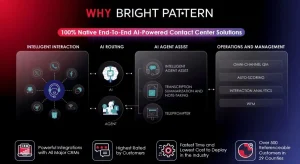
- Bright Pattern: Recognized as a leader in omnichannel continuity, Bright Pattern’s platform enables a smooth transition between voice calls and digital channels like SMS or messaging apps without losing context. Its Mobile IVR feature ensures callers can switch channels mid-call while preserving the conversation history. This platform is ideal for large enterprises that require a unified desktop view, allowing agents to access full AI transcripts and insights for better customer support.
Best For: Large enterprises and organizations that require omnichannel integration, a unified agent desktop, and robust AI capabilities to manage high call volumes while maintaining personalized, human-like interactions. - Google Cloud Dialogflow: Dialogflow stands out for its developer-friendly design and advanced NLU capabilities. It allows companies to create highly customizable conversational flows tailored to unique business needs. With support for multiple languages and integration with Google Cloud’s AI ecosystem, it is particularly suitable for organizations looking to implement intelligent AI call center agents that can handle complex, multi-turn conversations.
- Amazon Connect (Lex): Amazon Connect, powered by Lex, is perfect for organizations deeply invested in AWS infrastructure. Its pay-as-you-go model makes it highly scalable, allowing businesses to expand or contract capacity as call volumes fluctuate. Amazon Connect also integrates seamlessly with other AWS services, enabling AI IVR systems to leverage analytics, speech recognition, and machine learning for intelligent, real-time customer interactions.
- Five9: Five9 excels in enterprise workforce management while offering robust Intelligent Virtual Assistant capabilities. Its AI IVR platform can automate high-volume interactions, freeing human agents for more complex tasks. Five9 is especially valuable for large-scale enterprises seeking to balance efficiency, scalability, and a superior customer experience.
- Talkdesk: Talkdesk provides out-of-the-box AI templates specifically designed for sectors like Healthcare and Retail, accelerating deployment without extensive coding or IT resources. Its platform combines Conversational AI IVR with CRM integration, enabling personalized interactions and predictive routing to enhance first-call resolution and overall CSAT.
Each of these platforms brings unique strengths, from developer flexibility to enterprise-grade scalability, making it easier for businesses to select a solution that aligns with their specific operational and customer experience goals.
How Can Businesses Implement Conversational AI IVR Without Replacing Everything?
Many organizations worry that adopting AI IVR requires ripping out their entire infrastructure. The truth is, AI-powered IVR can be layered on top of existing systems, making adoption smooth and cost-effective.
- Hybrid Migration Path: Companies can retain their legacy PBX while implementing AI for high-volume tasks. This allows for quick ROI without disrupting operations.
- Start with Low-Hanging Fruit: FAQs, password resets, and order status checks are ideal starting points. Automating these reduces agent workload immediately.
- Agent Empowerment: Intelligent AI call center agents complement AI IVR by handling complex or sensitive queries, allowing human agents to focus on high-value interactions rather than repetitive tasks.
What’s Next for Conversational AI IVR: Voice Biometrics and Predictive Routing
The future of call centers is secure, proactive, and intelligent.
- Voice Biometrics: Security is being redefined. Instead of outdated questions like “What is your mother’s maiden name?” voice biometrics allow secure, seamless authentication.
- Predictive Routing: AI can anticipate a caller’s needs. For example, if a customer calls after a delayed delivery, the system can automatically pull up the order and suggest resolution options before the caller speaks.
- Proactive Customer Engagement: Beyond reactive support, AI IVR can provide alerts, reminders, and personalized recommendations. For instance, notifying a customer about an expiring subscription or upcoming payment can prevent calls altogether.
Why Conversational AI IVR Is Critical for Modern Businesses
Implementing Conversational AI IVR and intelligent AI call center agents is no longer a luxury—it has become a competitive necessity for any organization that wants to thrive in today’s fast-paced, customer-centric market. Businesses are no longer judged solely by the products or services they offer, but by how efficiently and seamlessly they can solve customer problems.
The benefits of adopting AI-driven call solutions are significant and measurable:
- Cost Reduction: By reducing average handle time, minimizing call transfers, and optimizing agent workload, organizations can cut operational expenses significantly. AI IVR handles repetitive tasks automatically, freeing human agents to focus on high-value, complex interactions.
- Customer Satisfaction: Modern customers expect fast, empathetic, and personalized service. Conversational AI IVR delivers human-like interactions, resolving queries quickly while maintaining a natural conversation flow. This not only boosts CSAT scores but also fosters long-term loyalty and trust.
- Scalability: Unlike traditional call centers that require hiring and training more staff during peak periods, AI-powered IVR systems scale effortlessly. They can manage hundreds or even thousands of simultaneous calls, ensuring consistent service during seasonal surges, product launches, or unexpected crises.
- Integration: AI IVR and intelligent call center agents can seamlessly integrate with CRM, ERP, and other backend systems. This creates a single, unified view of the customer, allowing for context-aware interactions, personalized responses, and proactive problem-solving.
- Future-Proofing: Adopting AI solutions today prepares businesses for emerging technologies such as voice biometrics, predictive intent routing, and advanced analytics. Companies that invest in AI IVR now are better positioned to leverage future innovations without costly system overhauls.
By implementing Conversational AI IVR, businesses not only streamline operations and cut costs but also provide a superior, human-like experience that today’s customers demand. Organizations that embrace AI today position themselves ahead of competitors, delivering both operational efficiency and exceptional customer experiences—creating a clear advantage in an increasingly digital marketplace.

Passionate about exploring diverse ideas and sharing inspiration, I curate content that sparks curiosity and encourages personal growth. Join me at ElementalNest.com for insights across a wide range of topics.