
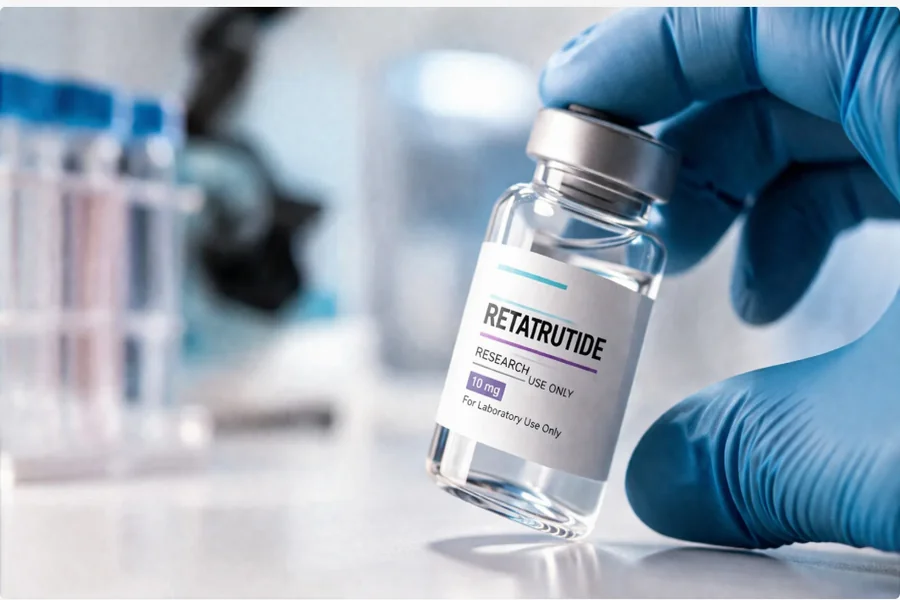
Quality control for synthetic peptides does not begin when a finished vial reaches a laboratory.
It begins much earlier.
The quality of a research peptide can be influenced by what happens during synthesis, purification, isolation, analytical testing, packaging, and documentation. Each stage creates opportunities to identify unwanted material, confirm the intended molecule, or catch inconsistencies before the batch moves forward.
Retatrutide is a useful example of why this complete quality-control chain matters.
Rather than treating quality as a single purity percentage, a stronger approach is to view it as a series of connected checkpoints. Identity, chromatographic purity, impurity profiles, batch records, and analytical verification each answer different questions.
Together, they create a more complete picture of research material.
Quality Control Starts Before the Final Product
Synthetic peptide production involves multiple chemical steps.
During synthesis, incomplete reactions or side reactions can generate related peptide species. After the peptide chain has been assembled and released from the synthesis support, the resulting material may contain the desired sequence alongside truncated sequences, modified species, residual reagents, or other process-related components.
This is one reason purification is such an important part of peptide production.
The objective is not simply to obtain a material that contains the target peptide. The process must also separate the target from unwanted components as effectively as practical.
Research literature on synthetic peptides describes chromatographic purification as a major tool for removing low-level by-products generated during peptide synthesis.
Quality control therefore starts with the process itself rather than appearing as a final inspection step.
Purification and Verification Are Different Jobs
It is useful to separate two concepts that are sometimes treated as the same thing.
Purification removes unwanted components.
Analytical verification determines what remains.
A purification process can produce material with a strong chromatographic profile, but analytical testing is still needed to characterize that material.
This distinction becomes important when interpreting research peptide documentation.
A laboratory may see a dominant chromatographic peak and assume that the material has been completely characterized. In reality, different analytical techniques can provide different types of information.
Chromatography can help examine the complexity of a sample and estimate chromatographic purity. Mass spectrometry can provide molecular-mass information useful for identity confirmation. More advanced workflows can combine chromatographic separation with mass spectrometric detection to investigate additional molecular features.
The techniques complement one another rather than simply repeating the same measurement.
The First Major Question: Is It the Expected Molecule?
Before discussing purity, there is a fundamental question:
What exactly is in the sample?
Identity testing addresses this question.
Mass spectrometry is widely used in peptide characterization because measured molecular mass can be compared with the expected mass of the target material. More advanced approaches can provide additional structural information.
However, matching an expected molecular mass is not necessarily the same as proving every aspect of molecular structure.
Recent peptide-characterization literature emphasizes that mass confirmation is important but may not, by itself, provide complete verification of covalent structure or sequence.
That distinction is important for quality control.
A strong analytical strategy therefore considers what each test can establish and where its limitations begin.
Why Chromatography Still Matters
High-performance liquid chromatography, or HPLC, remains one of the most familiar analytical techniques used with synthetic peptides.
In a chromatographic run, components interact differently with the stationary and mobile phases. This can allow the primary peptide to be separated from related compounds and other detectable components.
The resulting chromatogram provides a visual representation of the separation.
A dominant peak can be useful.
But the entire chromatogram can be more informative.
Researchers may consider:
- Number of visible peaks
- Relative peak areas
- Retention behavior
- Baseline quality
- Separation between nearby peaks
- Presence of smaller secondary peaks
- Consistency with the stated analytical method
These observations can help place a reported purity figure into context.
Importantly, chromatographic purity is method-dependent. A reported percentage should therefore be understood alongside the analytical conditions and method used to generate it.
Impurity Profiling Adds Another Layer
Synthetic peptides can contain impurities related to the manufacturing process.
Examples may include truncated sequences, deletion or insertion variants, modified forms, or degradation products.
Peptide chemistry literature has highlighted the potential complexity of process-related and degradation-related impurities, including oxidation and deamidation.
This is why a quality-control program should not stop at asking whether the main peak is large.
It should also consider what the other detectable components represent.
A small secondary peak does not automatically mean a batch is unsuitable for a particular research application. Its significance depends on what the peak contains, how it was measured, and the specifications established for the material.
The analytical objective is to turn an unexplained signal into useful information.
Why One Analytical Method May Not Be Enough
Every analytical technique has strengths and limitations.
HPLC can provide valuable separation and purity information, but two different compounds can sometimes behave similarly under particular chromatographic conditions.
Mass spectrometry provides another dimension by examining molecular mass.
Other techniques may contribute information about concentration, structure, residual components, or physical characteristics depending on the research requirement.
This multi-method approach is not unnecessary complexity. It reflects the fact that peptide quality has multiple dimensions.
Published peptide-reference work describes the use of complementary analytical techniques, including chromatography, mass spectrometry, and other methods, to establish identity, purity, content, and related characteristics.
The practical lesson is simple:
Different tests answer different questions.
Batch-to-Batch Consistency Is a Separate Question
A single batch can produce a useful analytical result.
But research programs often work with material over longer periods.
That introduces another quality-control question:
Does one batch behave consistently with another?
Batch comparison can help laboratories identify unexpected changes in analytical profiles.
For example, researchers may compare documented purity values, chromatographic patterns, identity results, and other available characteristics between lots.
The purpose is not necessarily to demand identical numerical results.
Small analytical differences can occur for legitimate reasons, including changes in methodology or measurement conditions.
Instead, the goal is to identify meaningful deviations that warrant further investigation.
A consistent documentation system makes these comparisons much easier.
Traceability Connects the Analytical Data to the Material
Analytical data has limited value if it cannot be connected to the physical material that was tested.
This is where batch traceability becomes important.
A research peptide should have a clear identifier that connects the material with its supporting documentation.
That identifier can then connect:
Batch → sample → analytical test → result → documentation
Without this chain, even a technically impressive analytical report can become difficult to interpret.
Imagine discovering an old chromatogram with an excellent purity result but no clear indication of which batch produced it.
The data may be scientifically interesting, but its practical value is greatly reduced.
Traceability prevents this type of disconnect.
Documentation Should Follow the Material
Quality control generates information at multiple stages.
A mature documentation system can preserve information about:
- Batch identification
- Production records
- Purification
- Analytical testing
- Test dates
- Methods
- Specifications
- Results
- Deviations
- Release decisions
- Supporting analytical files
The purpose is not to create paperwork for its own sake.
It is to preserve the history of the material.
When a laboratory needs to understand where a particular research sample came from, documentation should provide a logical path back to its source.
This becomes especially valuable when materials are stored for extended periods or when projects involve multiple researchers.
What a Strong Release Check Looks Like
Before research material is released for laboratory use, quality-control teams can consider several independent questions.
Identity
Does the analytical evidence support the expected molecular identity?
Purity
Does the material meet the defined chromatographic or analytical specification?
Impurity Profile
Are detectable secondary components understood or appropriately documented?
Batch Information
Can the test results be connected to a specific lot or batch?
Documentation
Are the analytical records complete enough to support traceability?
Consistency
Are the results broadly consistent with established expectations for the material?
These questions are more useful than relying on one number.
They turn quality control into a structured decision process.
Retatrutide as a Research Material
For laboratories working specifically with Retatrutide research material, the same quality principles apply.
The focus should remain on material identity, analytical characterization, documented purity, batch information, and appropriate laboratory controls.
Researchers looking for a dedicated Retatrutide research-peptide option can explore the Retatrutide glp-3 listing from British Peptides UK and then connect the relevant batch information with their own laboratory documentation procedures.
The important part is the connection between the physical sample and its supporting analytical information.
Advanced Verification With LC-MS
Liquid chromatography coupled with mass spectrometry can provide an especially useful combination.
Chromatography separates components.
Mass spectrometry provides molecular information about those components.
Together, LC-MS workflows can help researchers investigate whether different chromatographic peaks correspond to the expected peptide, related molecular species, or other components.
Modern analytical research continues to expand LC-MS applications for peptide characterization and quality control. Recent work has also demonstrated LC-high-resolution MS approaches capable of analyzing several GLP-1-related peptide molecules, including Retatrutide.
This illustrates how peptide analysis is moving beyond simple single-number purity reporting toward more detailed molecular characterization.
Quality Control Is a Chain, Not a Single Test
The strongest concept to take from peptide quality control is that no individual test tells the whole story.
Synthesis creates the material.
Purification removes unwanted components.
Chromatography examines separation and purity.
Mass spectrometry helps establish molecular identity.
Additional analytical techniques can investigate other quality attributes.
Documentation connects those findings to a specific batch.
Each stage contributes something different.
If one stage is weak, the overall quality picture becomes less complete.
Building a More Reliable Research Workflow
A laboratory does not necessarily need the most complicated analytical program imaginable.
It needs a workflow appropriate to its research objectives.
That workflow can begin with clearly defined material specifications. From there, researchers can establish what identity information is required, which purity measurements matter, what supporting documentation should accompany each batch, and how analytical records will be stored.
The result is a repeatable system rather than an informal collection of documents.
For laboratories sourcing research peptides in the UK, UK Peptides offers a broader research peptide catalog that can be considered alongside a laboratory’s own quality-control and documentation framework.
The key is consistency.
A well-defined process makes it easier to compare batches, investigate unexpected results, and maintain a clear record of the materials used throughout a research project.
Final Takeaway
Retatrutide research quality control should be viewed as a complete analytical journey rather than a single purity test.
The process begins with controlled synthesis and purification. It continues through identity confirmation, chromatographic analysis, impurity assessment, batch traceability, and supporting documentation.
HPLC can provide valuable information about chromatographic purity. Mass spectrometry can add molecular identity information. When appropriate, complementary analytical techniques can provide an even deeper view of peptide characteristics.
Most importantly, the resulting data should remain connected to the exact material and batch from which it was generated.
That connection turns isolated laboratory results into a usable quality record.
For research environments, this is the real purpose of quality control: not simply producing an impressive number, but creating enough reliable analytical evidence to understand what the material is, how it was characterized, and which batch the evidence belongs to.

Passionate about exploring diverse ideas and sharing inspiration, I curate content that sparks curiosity and encourages personal growth. Join me at ElementalNest.com for insights across a wide range of topics.