
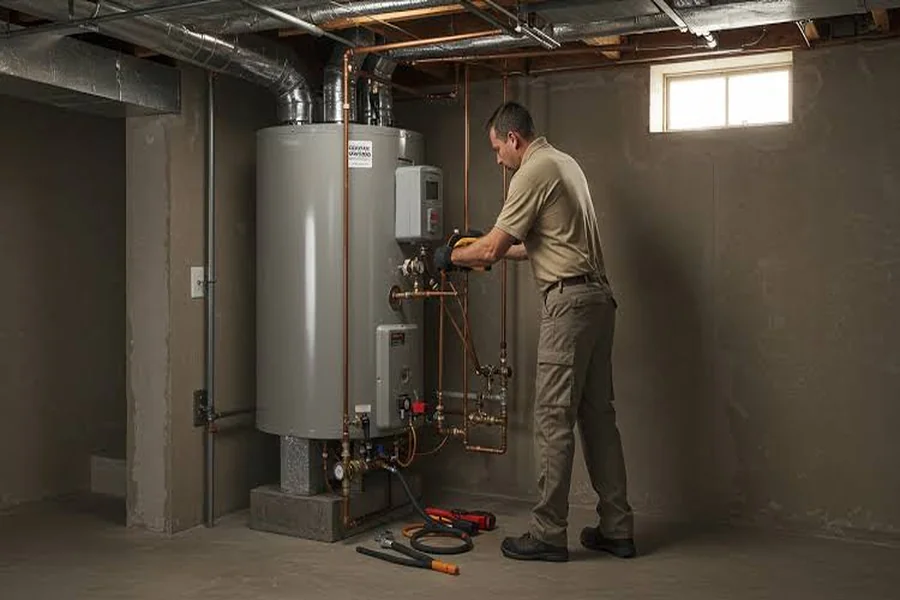
A water heater installation involves more decisions than most Nashville homeowners anticipate when they first start looking into it. The obvious question — which unit to buy — turns out to be downstream of several others that need to be answered first: what fuel type makes sense for the home’s existing infrastructure, what capacity the household actually requires, whether the installation location can accommodate the venting requirements of the preferred unit type, and whether any code upgrades are triggered by the replacement that weren’t part of the original plan.
Getting these questions answered before purchasing equipment prevents the most common and most frustrating installation problems — a unit that arrives and can’t be installed as configured because the venting doesn’t work for that specific model, a tank that’s the right gallon capacity but the wrong first-hour rating for the household’s morning demand, or a high-efficiency unit that requires a condensate drain that doesn’t exist in the installation location.
Water heater installation nashville tn through The Hot Water Heater Pros starts with the assessment questions rather than the equipment — understanding the specific home’s infrastructure, the household’s hot water demand, and the installation location’s requirements before any unit recommendation is made.
What Nashville’s Infrastructure Considerations Mean for Installation
Gas versus electric is a decision most homeowners think is determined by what they already have — if the old unit was gas, the replacement will be gas. In many cases that’s the right call. In others, the existing gas infrastructure has limitations that make a particular unit type impractical, or the electrical service in the home has been upgraded in ways that make a heat pump water heater a genuinely competitive option on operating cost.
Heat pump water heaters have become increasingly relevant in the Nashville market as their upfront cost has declined and their efficiency advantage over standard electric resistance units has become harder to ignore. They extract heat from the surrounding air rather than generating it directly, which produces efficiency ratings roughly three times higher than a standard electric tank. In a climate like Middle Tennessee’s — with mild winters and long warm seasons — the ambient air temperature that a heat pump water heater draws from is favorable for most of the year, making the efficiency advantage more consistent than in colder markets.
Venting requirements for gas water heaters vary by unit type and affect both what can be installed in a specific location and what the installation costs. Atmospheric vent units use natural draft through a flue — the simplest and least expensive venting approach, but one that requires adequate draft clearance and proper flue sizing. Power vent units use a fan to push exhaust gases out through PVC pipe, which allows more flexible installation locations but requires electrical connection and the right flue configuration. Direct vent units draw combustion air from outside rather than from the installation space, which matters in tight mechanical rooms with limited air supply.
What the Permit Process Looks Like in Nashville
Water heater installations in Nashville require a permit from Metro Nashville’s Codes Department, and the inspection that follows confirms the installation meets current Tennessee plumbing code requirements. This includes expansion tank installation on closed plumbing systems — a requirement that applies to most Nashville homes connected to municipal water supply with a backflow preventer.
The Hot Water Heater Pros manages the permit process as part of the installation — filing the permit, scheduling the inspection, and ensuring the installation passes without requiring the homeowner to navigate Metro Nashville’s codes process independently. For Nashville homeowners replacing a water heater, that included permit management is part of what makes the installation complete rather than just physically finished.

Passionate about exploring diverse ideas and sharing inspiration, I curate content that sparks curiosity and encourages personal growth. Join me at ElementalNest.com for insights across a wide range of topics.