
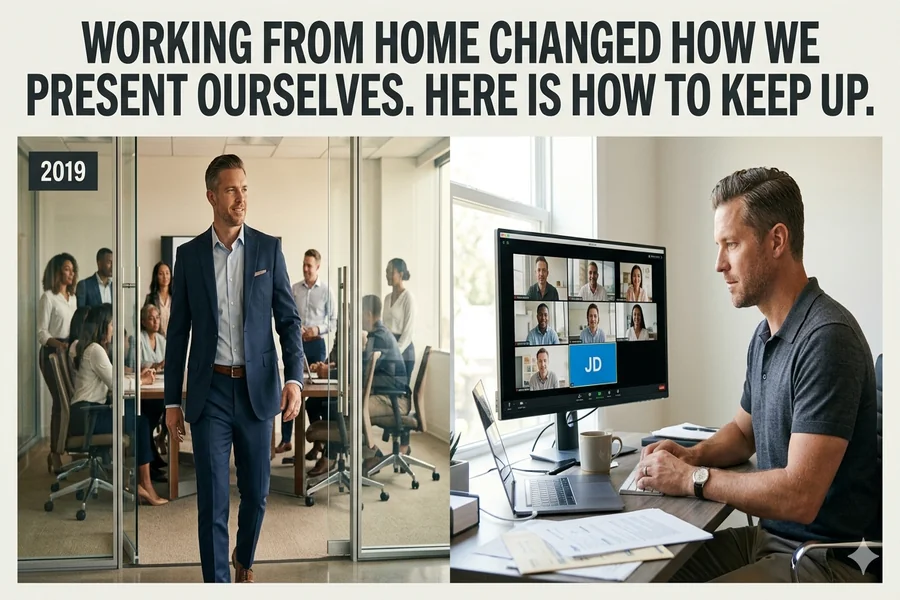
Five years ago, your professional image was built in conference rooms, office hallways, and across lunch tables. People saw you. They registered your posture, your handshake, the way you carried yourself into a meeting two minutes early with a coffee and a pen.
Now they see a rectangle. A profile photo the size of a postage stamp. A Zoom tile that might be on or might just be your initials floating in a colored square.
The shift happened so quickly that most people adapted their workflows, their tools, their communication habits, but never updated the visual layer of how they show up professionally. And that gap is starting to cost them.
We Optimized Everything Except How We Look Online
Remote workers have become remarkably good at optimizing the mechanics of distributed work. Asynchronous communication. Calendar blocking. Notion dashboards. Standing desk setups.
But ask the average remote professional when they last updated their headshot, and you’ll get a pause followed by something like “maybe 2021?” or “I think it was before my last job.”
Here’s what most people miss. The digital workspace didn’t just change where we work. It changed what signals people use to evaluate us. In an office, your competence was demonstrated through presence, body language, and repeated face-to-face interactions. In a remote context, a huge proportion of that evaluation happens through static digital artifacts: your profile photo, your Slack avatar, your LinkedIn thumbnail, your email signature image.
These aren’t vanity metrics. They’re trust signals. And they’re running 24 hours a day across every platform where your name appears, whether you’re actively managing them or not.
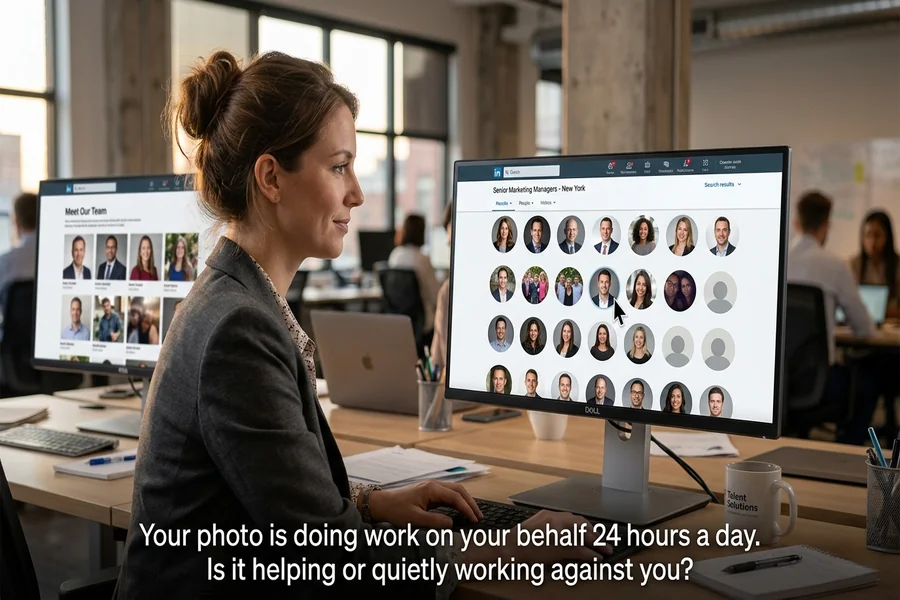
A recruiter scanning LinkedIn results sees fifty thumbnails. A potential client reviews your company’s team page before a call. A conference organizer checks your bio photo before adding you to the speaker lineup. In every case, your photo is doing work on your behalf, and it’s either helping you or quietly working against you.
The Uncanny Valley of the Outdated Headshot
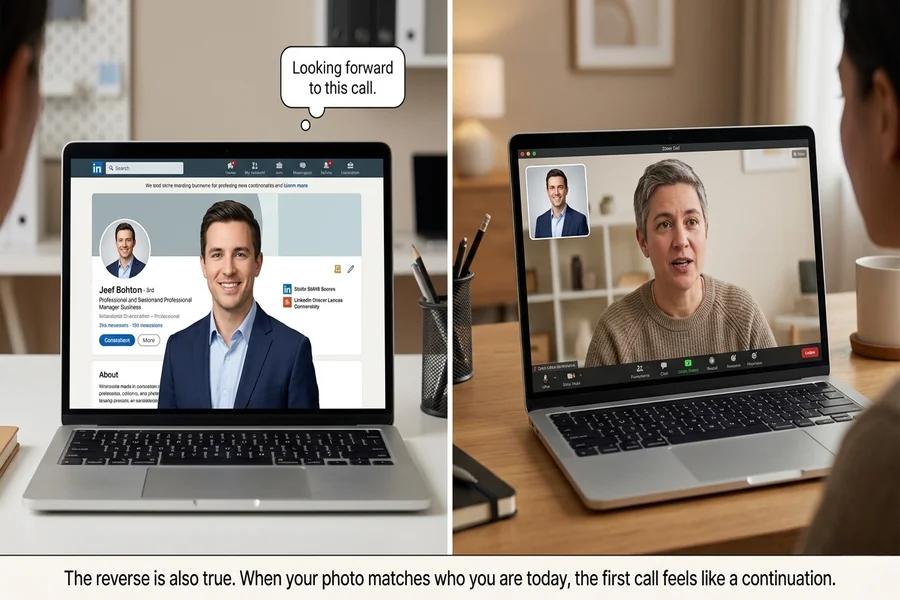
You’ve probably experienced this. You hop on a video call with someone you’ve only interacted with over email. Their profile photo shows a polished, put-together professional. Then the camera turns on and the person looking back at you is clearly a different version of that person, maybe ten years and a career change removed from when that photo was taken.
It’s not a big deal. Nobody says anything. But there’s a tiny moment of recalibration, a split second where reality doesn’t match expectation, and that creates a micro-friction in the relationship before a single word has been spoken.
The reverse is true too. When your photo accurately represents who you are today, the first video call feels like a continuation of an existing relationship rather than a correction of a mistaken assumption.
This matters more than it used to because remote professionals have fewer opportunities to override a bad first impression. In an office, a misleading photo gets corrected within hours of meeting someone. In a remote context, someone might interact with your outdated photo for months before ever seeing you on camera.
The cost of updating used to be high enough to justify procrastination. Booking a photographer, traveling to a studio, waiting for edits. Platforms like Headshot Photo and similar services have compressed this into a process that takes minutes of active effort, which means the only remaining barrier is awareness that it matters.
The Price Gap That Changed the Equation
Here’s the thing nobody mentions when talking about professional headshots: the traditional pricing model was built for a world where getting your photo taken was a rare, scheduled event.
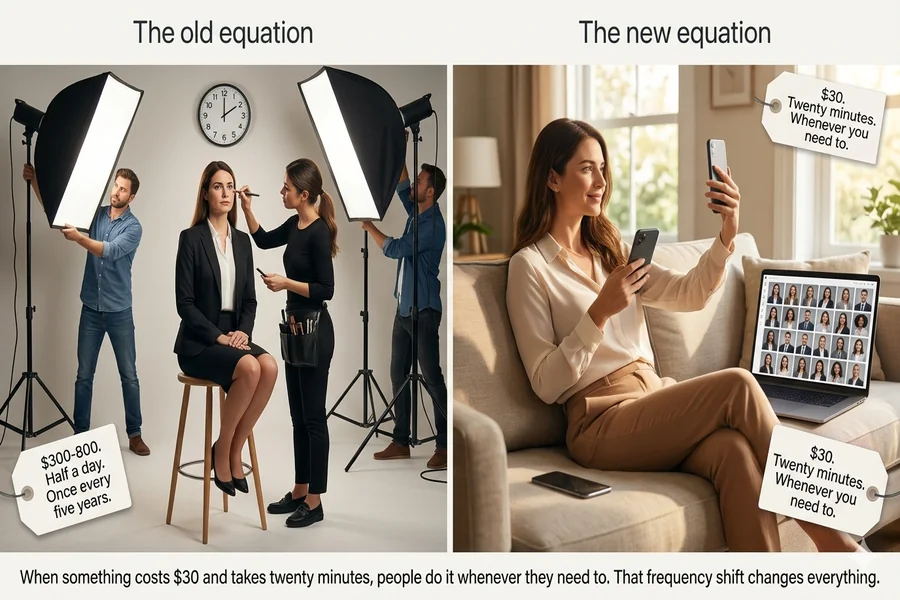
A standard studio headshot session in a major city runs anywhere from $150 to $500. In New York or San Francisco, $300 to $800 is common for a well-regarded photographer. That’s for a single session producing a handful of edited images. If you need headshots for a team of 20 people, you’re looking at thousands of dollars plus the logistical nightmare of scheduling everyone.
For a detailed breakdown, this analysis of what professional headshots actually cost puts real numbers behind the ranges and shows how pricing varies by type and location.
AI headshot tools have collapsed this cost structure. Most services charge between $20 and $60 per person for a set of professional-quality images. For companies, bulk pricing often drops that further. The quality gap between AI-generated headshots and mid-tier studio photography has narrowed to the point where, in blind comparisons, most people can’t consistently tell the difference.
This isn’t just a cost savings story. It’s a behavioral one. When something costs $400 and takes half a day, people do it once every five years. When it costs $30 and takes twenty minutes, people do it whenever they need to. That frequency shift is what actually changes the quality of someone’s digital presence over time.
Consistency Is the Part Everyone Forgets
Having one great headshot isn’t enough anymore. You need the same great headshot (or at least a visually consistent one) everywhere.
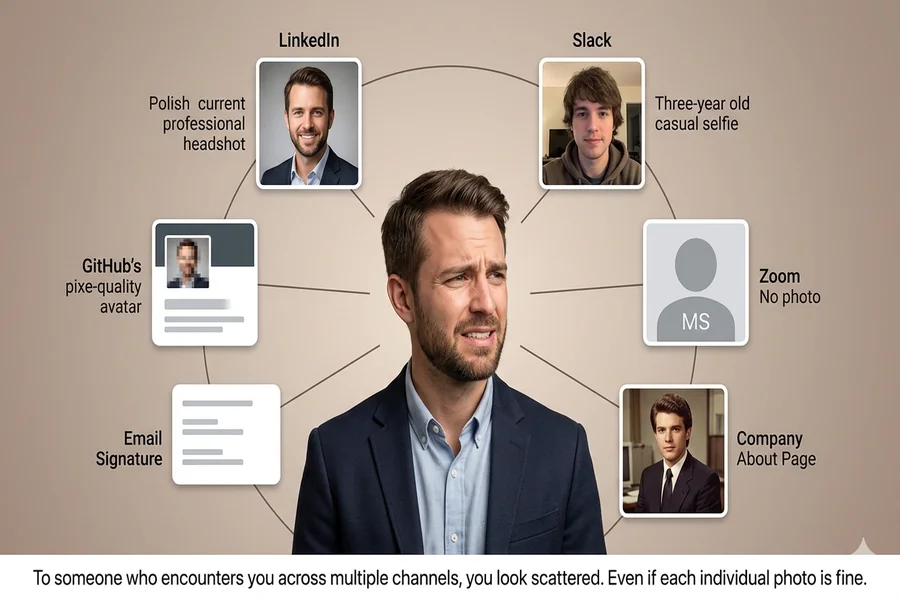
I’ll admit, I got this wrong initially. I assumed updating my LinkedIn photo was sufficient. Then I realized my Slack avatar was a three-year-old selfie, my company bio used a photo from a different era entirely, my Zoom profile had no photo at all, and my email signature was blank. To someone who only interacted with me through one of those channels, I looked professional. To someone who encountered me across multiple channels (which is how most professional relationships work now), I looked scattered.
The real question is: what does consistency even look like in practice?
It means your LinkedIn photo, your Slack avatar, your Zoom profile, your email signature, your company About page, and any conference or podcast bios all show recognizably the same person in a similar visual style. Not necessarily the identical photo everywhere (that can feel robotic), but photos from the same session or the same visual family.
For companies managing distributed teams, this consistency challenge multiplies with every hire. If you’re running a remote team, LinkedIn-specific headshot tools and similar services can help standardize the team’s visual identity across both individual profiles and company pages.
A Practical Refresh Plan That Takes Under an Hour
If reading this has made you uncomfortably aware of your own outdated profile photo situation, here’s a simple framework.
Step one: inventory your surfaces. Open a note and list every platform where you have a professional profile. LinkedIn, Slack, Zoom, Google Workspace, Microsoft Teams, company website, GitHub, Twitter/X, conference profiles. Most people discover at least two or three they’d forgotten about.
Step two: evaluate honestly. For each surface, ask: does this photo look like me today? Would someone who sees this photo recognize me immediately on a video call? If the answer is no, it goes on the update list.
Step three: create one source image. Whether you book a quick studio session, take a well-lit selfie and edit it, or use an AI headshot tool, the goal is one anchor image that’s current, professional, and represents how you actually look right now.
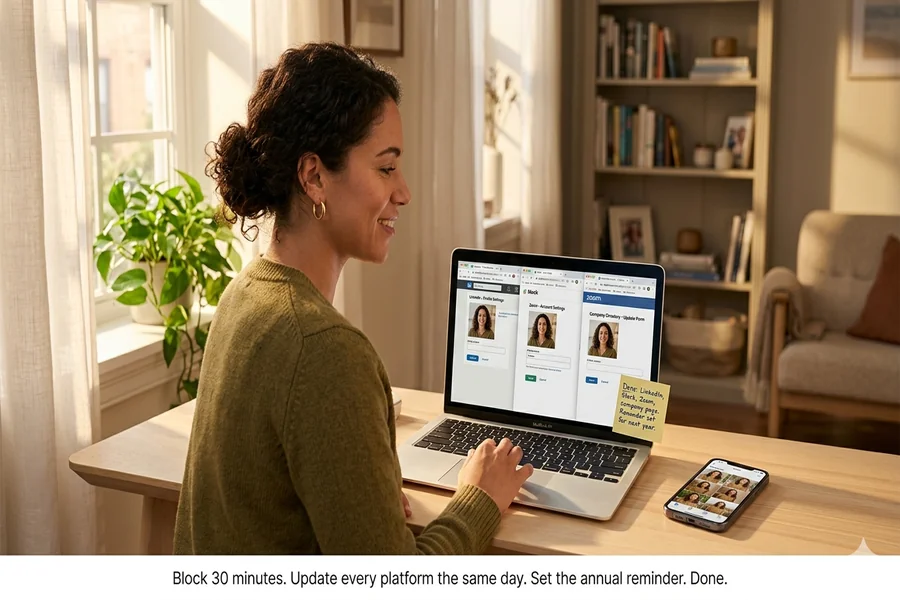
Step four: distribute it everywhere on the same day. Don’t spread this out over weeks. Block 30 minutes, open every platform from your list, and update them all at once. This prevents the “I updated LinkedIn but forgot about Slack” drift.
Step five: set a calendar reminder. Twelve months from now. That’s your refresh date. Not because your face changes dramatically in a year, but because your circumstances do. New role, new company, new hairstyle, new glasses. Annual updates keep the drift from compounding.
The Signal You’re Actually Sending
Professional presentation in a remote world isn’t about vanity. It’s about intentionality.
The colleagues, clients, and hiring managers you interact with are constantly (and mostly unconsciously) reading signals about how seriously you take your work, how organized you are, how much attention you pay to details. Your profile photo is one of the loudest of those signals, precisely because it’s always on.
You don’t need to look perfect. You don’t need a magazine cover shot. You need to look like someone who pays attention. Someone whose digital presence reflects the same care they bring to their actual work.
In a remote world, that’s not a small thing. It might be the only thing people see before deciding whether to trust you.

Passionate about exploring diverse ideas and sharing inspiration, I curate content that sparks curiosity and encourages personal growth. Join me at ElementalNest.com for insights across a wide range of topics.