
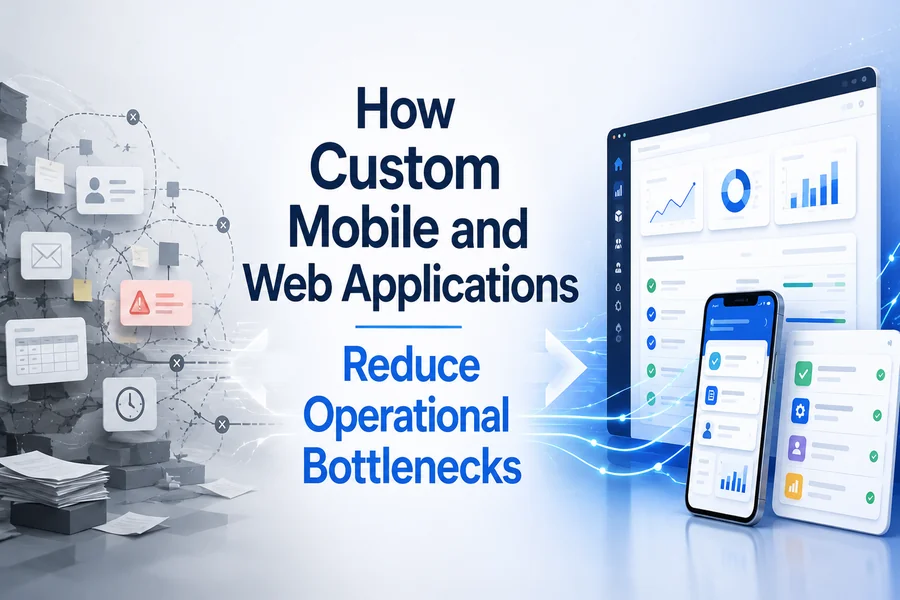
Every growing business eventually hits a wall. Processes that worked smoothly with ten employees start to strain at a hundred. Spreadsheets that once tracked everything become tangled webs of manual errors. Off-the-shelf software that promised efficiency now forces teams to bend their workflows around its limitations. These are not isolated frustrations. They are symptoms of operational bottlenecks, and more often than not, the root cause sits in the technology layer.
For business owners, CTOs, and decision-makers, the question is rarely whether to invest in technology. It is whether the technology you choose will scale with your ambitions or quietly hold you back. Scalable, enterprise-grade applications matter precisely because they determine how gracefully your organization can grow. Poorly architected software creates friction everywhere: slow systems, fragmented data, brittle integrations, and rising maintenance costs that compound over time.
This is where purpose-built solutions earn their value. Well-designed custom web application development services give companies the freedom to model software around their actual operations rather than squeezing operations into rigid templates. Instead of paying for features you never use and lacking the ones you need, you build exactly what the business requires.
The mobile dimension is equally important as customers and field teams increasingly expect responsive, on-the-go access. Investing in custom mobile application development services ensures that your workforce and your customers interact with tools designed for their context, not generic apps retrofitted to half-fit the job. Together, tailored web and mobile platforms remove the recurring friction that drains productivity and slows decision-making.
The cost of ignoring software architecture early is rarely visible at first. It surfaces later as technical debt, downtime, and an inability to respond to market shifts. Understanding what separates enterprise-grade applications from ordinary ones is the first step toward building something durable.
What Defines Enterprise-Grade Applications
Not all software is built to the same standard. The difference between a quick solution and an enterprise-grade application becomes obvious the moment demand increases or requirements change. Five characteristics consistently define the latter.
Scalability is the ability to handle growth without rewrites. A scalable system absorbs more users, more transactions, and more data without collapsing under its own weight or requiring you to rebuild from scratch every eighteen months.
Security is non-negotiable. Enterprise-grade applications protect sensitive data through encryption, access controls, and proactive vulnerability management. As regulatory scrutiny tightens across industries, security is both a technical requirement and a business safeguard.
Performance keeps systems fast and responsive even under load. Slow applications quietly erode productivity and customer patience. A well-engineered platform maintains speed whether ten people or ten thousand are using it.
Reliability means the system stays available when it matters. Downtime carries real costs in lost revenue and damaged trust. Enterprise applications are built with redundancy and failover in mind so a single fault does not halt operations.
Integration capabilities allow your software to communicate with the rest of your ecosystem. Tools that operate in isolation create data silos. Applications designed with open, well-documented interfaces connect cleanly to your CRM, ERP, analytics, and third-party services.
When these qualities are present, software stops being a constraint and becomes a foundation.
Key Pillars for Long-Term Growth
Building for the long term requires deliberate architectural choices. A few pillars consistently distinguish applications that age well from those that crumble.
Modular architecture is one of the most consequential decisions. The classic debate pits microservices against the monolith. A monolithic application bundles everything into one codebase, which can be simpler to start but harder to scale and update as it grows. A microservices approach breaks the system into independent components that can be developed, deployed, and scaled separately. For organizations expecting growth and frequent change, modular design offers flexibility that a monolith struggles to match.
Cloud-native development takes full advantage of modern infrastructure. Rather than treating the cloud as a place to host old software, cloud-native applications are built to expand and contract with demand, recover automatically from failures, and deploy updates without disruption. This elasticity translates directly into cost efficiency and resilience.
Data-driven decision making depends on software that captures and surfaces meaningful information. When your applications generate clean, accessible data, leadership can move from gut instinct to evidence. Bottlenecks become visible, measurable, and addressable instead of remaining hidden in disconnected systems.
Automation and AI readiness future-proof your investment. Applications structured with clean data pipelines and well-defined interfaces are far easier to enhance with automation and machine learning later. Building with this readiness in mind means you can adopt emerging capabilities without tearing down what you already have.
Common Mistakes Businesses Make
Many costly software problems trace back to a handful of avoidable decisions made early in the journey.
The short-term development mindset is the most frequent culprit. Under pressure to launch quickly or cut costs, teams choose the fastest path rather than the most sustainable one. The initial savings feel real, but they are usually borrowed against the future. Shortcuts accumulate as technical debt that slows every subsequent change.
Ignoring scalability early is another recurring error. When a system is designed only for current volumes, it works fine until success arrives. Then the very growth a business worked hard to achieve becomes the thing that breaks its software. Retrofitting scalability after the fact is expensive and disruptive.
Choosing the wrong technology stack can quietly limit a company for years. A stack selected for convenience or familiarity, without regard for the problem at hand, may lack the performance, talent availability, or ecosystem support the business needs. The wrong foundation makes every future decision harder.
None of these mistakes are obvious in the moment. They reveal themselves slowly, which is exactly why thoughtful planning at the outset pays such large dividends.
Best Practices for Building Future-Ready Applications
Avoiding those pitfalls is less about technical wizardry and more about discipline and intent.
Strategic planning before development sets the tone for everything that follows. Clarify the business goals the software must serve, the workflows it needs to support, and the growth you anticipate. A clear understanding of the problem prevents expensive course corrections later. Architecture decisions made on day one are difficult to reverse, so they deserve serious attention.
Choosing the right development partner often matters more than any single technology choice. A capable partner brings not only engineering skill but also the judgment to ask hard questions and steer you away from short-term thinking. This is where expert consultation proves its worth. An experienced team helps you balance speed, cost, and durability in ways that internal pressure alone rarely allows.
Continuous optimization and iteration keep applications healthy over time. Software is never truly finished. Markets shift, user needs evolve, and new capabilities emerge. Treating your application as a living asset, with regular performance reviews and incremental improvements, protects the value of your investment and keeps operational friction low.
A Real-World Perspective
Consider a mid-sized logistics company that relied on a patchwork of generic tools and manual coordination. As order volume climbed, dispatchers spent hours reconciling data across systems, and delays multiplied. Customer complaints grew, and the team found itself firefighting instead of improving service.
The company invested in a custom platform built on modular, cloud-native architecture. Order intake, routing, and tracking were unified into a single system with a mobile interface for drivers and a web dashboard for managers. Because the design accounted for growth from the start, the platform handled a doubling of order volume without performance issues.
The results were practical and measurable. Manual reconciliation nearly disappeared, dispatch time dropped significantly, and managers gained real-time visibility into operations through clean, centralized data. The bottleneck that had once limited growth became a competitive advantage. The lesson is not that custom software is magic. It is that software architected around the business removes the friction that generic tools quietly impose.
Conclusion
Operational bottlenecks are rarely solved by working harder. They are solved by removing the structural friction that makes work slow in the first place, and much of that friction lives in software. Enterprise-grade applications, built with scalability, security, performance, reliability, and integration in mind, give organizations room to grow without constantly fighting their own tools.
The long-term benefits compound. Cleaner data leads to better decisions. Modular, cloud-native design absorbs growth instead of resisting it. Readiness for automation and AI keeps your business positioned for what comes next. These advantages do not appear by accident. They are the product of deliberate planning and sound architectural choices made early.
For leaders weighing where to invest, the message is straightforward. Treat software as foundational infrastructure rather than a one-time expense. Plan carefully, choose the right partner, and commit to building solutions that scale. The organizations that thrive over the next decade will be the ones that stopped letting their technology hold them back and started letting it carry them forward.

Passionate about exploring diverse ideas and sharing inspiration, I curate content that sparks curiosity and encourages personal growth. Join me at ElementalNest.com for insights across a wide range of topics.