
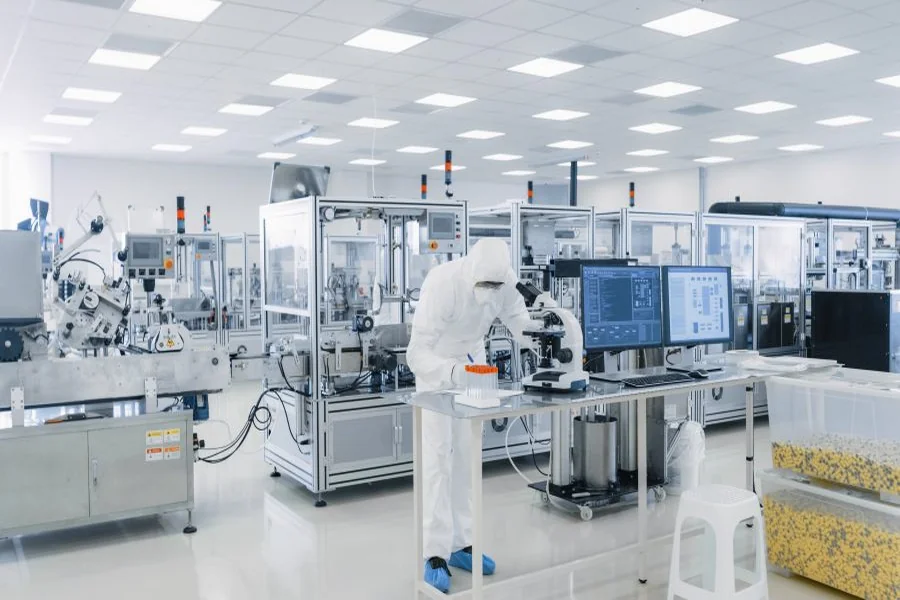
Digital transformation has reached even the most tightly regulated corners of manufacturing. Pharmaceutical production, long defined by paper-based records and manual checks, is now shifting toward fully digitized cleanroom operations. This shift brings real benefits in speed, accuracy, and traceability, but it also introduces a new dependency: the hardware running inside the cleanroom has to be just as reliable and compliant as the production process itself.
Companies that get this transition right see faster decision-making, fewer manual errors, and stronger audit outcomes. Companies that get it wrong often discover the hard way that not every computer or tablet can survive the conditions a pharmaceutical cleanroom demands.
The Hidden Complexity Behind Digitizing a Cleanroom
On the surface, digitizing a cleanroom sounds straightforward: replace paper records with tablets, give operators real-time access to data, and connect everything to existing production systems. In practice, the hardware layer turns out to be far more complicated than most teams expect.
Cleanroom environments operate under strict particle control requirements defined by ISO, FDA, and EU GMP standards. Every device introduced into that space, whether a fixed terminal or a handheld tablet, must avoid contributing particles or harboring contamination. That immediately rules out most standard consumer or even industrial-grade computers, which typically include vents, seams, and moving fan systems that create exactly the kind of crevices regulators are trying to eliminate.
Beyond particle control, the equipment must survive aggressive and frequent disinfection. Isopropyl alcohol, vaporized hydrogen peroxide, and other sterilizing agents are part of daily cleanroom routines, and most plastics and coatings degrade quickly under that kind of chemical exposure. A device that looks fine on a spec sheet can fail within months once it meets the realities of pharmaceutical cleaning protocols.
A clear and practical GMP cleanroom computer guide helps cut through this complexity by laying out exactly what separates a true cleanroom-grade system from a standard industrial PC, covering everything from passive cooling design to compatibility with common disinfectants and integration with existing ERP and MES platforms.
Reliability adds another layer of difficulty. Many pharmaceutical facilities run production continuously, and unplanned downtime on a single line can mean the loss of an entire batch. Hardware with moving parts or multiple potential points of failure introduces risk that most quality teams are simply not willing to accept once they understand the financial exposure involved.
How Digital Cleanroom Infrastructure Changes Daily Operations
Once the right hardware is in place, the operational impact becomes immediately visible. Real-time data capture replaces the lag inherent in paper-based systems, allowing quality teams to catch deviations as they happen rather than discovering them during a later review.
This shift also changes how operators interact with documentation. Instead of stepping away from their task to fill out a form at a fixed station, they can update batch records, complete digital QA checks, and follow standard operating procedures directly from a mobile device, even while wearing multiple layers of cleanroom gloves. That small change removes friction from dozens of small interactions throughout a shift, and the cumulative time savings can be substantial across a large facility.
Connectivity to broader systems is where the real payoff often appears. When cleanroom hardware integrates cleanly with ERP, MES, and LIMS platforms, data flows automatically instead of requiring manual entry at multiple points. This reduces transcription errors, speeds up reporting, and makes audit preparation considerably less painful since records are already structured and timestamped rather than scattered across paper logs.
None of this works, however, if the underlying hardware cannot be trusted to run continuously and stay clean. The technology decisions made early in a digitization project tend to determine how smoothly everything downstream actually functions. Facilities that select equipment built specifically for GMP environments avoid a long list of problems that show up later: premature hardware failure, contamination risk, and costly mid-project replacements.
Choosing Technology That Matches the Stakes of Regulated Industries
The broader lesson here extends well beyond pharmaceutical manufacturing. Any organization operating in a heavily regulated or compliance-sensitive environment faces a similar challenge: standard, off-the-shelf technology often fails to meet the specific demands of that environment, even when it looks adequate on paper.
This pattern shows up clearly in other regulated and compliance-driven sectors as well. Just as pharmaceutical facilities need hardware engineered for GMP conditions, multinational organizations handling sensitive documentation across multiple jurisdictions need software built specifically for that level of complexity. The same logic that applies to cleanroom hardware applies when evaluating enterprise tools designed for compliance-driven, multi-department operations, where generic solutions tend to break down under real operational pressure in ways that only become obvious after deployment.
For any team evaluating new technology in a regulated environment, the lesson is the same. Specifications on paper rarely tell the full story. What matters is whether the equipment or software was actually designed with that specific regulatory and operational context in mind, rather than adapted from a more general-purpose product after the fact.
As pharmaceutical production continues to digitize and regulatory scrutiny intensifies globally, the gap between purpose-built and generic technology will likely keep widening. Organizations that invest early in the right infrastructure position themselves to scale smoothly, while those that cut corners often face costly retrofits down the line.

Passionate about exploring diverse ideas and sharing inspiration, I curate content that sparks curiosity and encourages personal growth. Join me at ElementalNest.com for insights across a wide range of topics.