
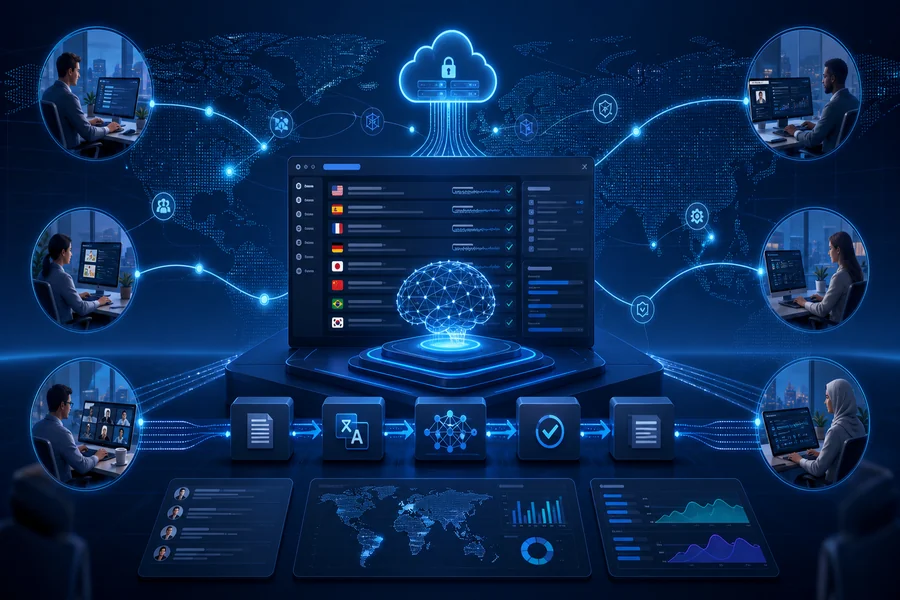
Enterprise AI translation software provides organizations with neural machine translation platforms built for high-volume, multi-department, and compliance-driven content operations. Unlike consumer-grade tools such as Google Translate or a standalone translator app, these platforms combine centralized translation memory, controlled glossaries, hybrid human-review processes, and robust security architecture to meet the demands of global businesses operating at scale. Crowdin’s ai translation software is one example of a service in this category, packaging these capabilities into a single managed platform built for enterprise teams.
This guide covers enterprise deployment models, security and compliance considerations, essential platform features, implementation strategies, and common challenges faced by IT decision makers, localization managers, and global operations teams in mid-to-large enterprises. If you need to translate text across dozens of markets while maintaining consistent terminology, regulatory compliance, and brand voice, this is the resource for you.
The direct answer: Enterprise-grade translation software combines neural machine translation engines with centralized management dashboards, role-based access controls, workflow automation, and compliance-ready infrastructure-enabling organizations to automatically translate text across departments while maintaining quality and security at enterprise scale.
By the end of this guide, you will understand:
- How to evaluate AI-powered translation platforms against enterprise requirements
- Which features separate enterprise solutions from basic translation tools
- How to plan deployment and integration with existing business systems
- Strategies for reducing translation costs by 50–90% while improving accuracy
- How to maintain brand voice and consistent terminology across multiple languages
Understanding Enterprise AI Translation Requirements
Enterprise translation needs differ fundamentally from consumer or small business requirements. Where an individual might need quick text translation for an email, organizations face the challenge of processing thousands of documents simultaneously, enforcing domain-specific terminology across departments, meeting regulatory obligations, and integrating translation workflows into complex technology stacks. Standard translation tools fall short because they lack the security controls, scalability, and workflow orchestration that enterprise-grade capabilities demand.
Volume and Scale Considerations
Large organizations routinely manage translation tasks spanning technical documentation, marketing materials, legal documents, product interfaces, and compliance reports-often across 50+ language pairs simultaneously. Google Translate processes 100 billion words daily across 249 languages, demonstrating the sheer scale modern neural networks can handle. Amazon Translate supports 75 languages and translates 50,000 words per hour, designed specifically for high-volume text. These numbers illustrate the throughput enterprises require, but raw volume is only one dimension.
Content diversity adds complexity. Enterprises must handle various document formats-from word docs and PDFs to UI strings with character-length constraints-each demanding different levels of technical accuracy and tone. A translation management system (TMS) must accommodate this diversity while supporting broad language coverage and consistent quality. High-volume enterprise localization requires strong AI-powered automation to keep pace with content production cycles.
This scale, in turn, demands advanced security measures to protect sensitive data flowing through translation pipelines.
Data Security and Compliance
Regulated industries-finance, healthcare, government, legal-require translation platforms that meet stringent compliance standards. GDPR, HIPAA, and SOC 2 Type II certification requirements are non-negotiable for many enterprises. Deployment options influence enterprise AI translation tool choices significantly: organizations handling classified or patient data may need to offer on-premise deployment capabilities rather than relying solely on cloud infrastructure.
LILT holds certifications including SOC 2 Type II and HIPAA, making it suitable for healthcare and financial services workflows. DeepL is GDPR compliant and offers a Bring Your Own Key option for encryption control. Amazon Translate has FedRAMP High authorization for US government use. Google Cloud Translation holds HIPAA and GDPR certifications. SYSTRAN can be deployed on-premise for sensitive data handling, giving organizations complete control over where their data resides.
Encryption at rest and in transit, audit logging, data residency controls, and SAML SSO are baseline expectations. This security foundation enables the advanced enterprise features covered in the next section.
Essential Features for Enterprise AI Translation Software
Building on the compliance and security infrastructure, enterprise platforms differentiate themselves through three interconnected feature categories: centralized management, deep integration capabilities, and hybrid workflows that combine AI speed with human judgment.
Centralized Translation Management
Role-based access controls allow organizations to assign granular permissions-administrators, localization managers, translators, reviewers, and legal teams each access only what they need. Project dashboards provide real-time visibility across all translation workflows, tracking content status from initial translation through review, QA, and deployment.
Translation memory and glossary management form the backbone of brand consistency. AI-powered translation memory improves translation efficiency by reusing previously translated documents and segments, reducing both cost and turnaround time. Terminology management tools enforce custom terminology so that the same term is rendered identically whether it appears in a product manual or a marketing campaign. These structured localization workflows help maintain consistency across every touchpoint.
Advanced Integration Capabilities
Native API connections to CMS, CRM, and content management platforms-including systems like Adobe Experience Manager, WordPress, and Shopify-allow content to flow into translation pipelines automatically. Microsoft Translator integrates natively with Microsoft 365 and Azure, while Amazon Translate integrates seamlessly with AWS services via API. Google Cloud Translation supports integration with Google Workspace. LILT offers 60+ pre-built connectors for various platforms, and DeepL integrates with Windows, iOS, and Chrome via plugins.
Automated workflow triggers enable continuous localization: when source files change in a Git repository or CMS, the platform detects updates, runs AI pre-translation, assigns human reviewers, performs QA checks, and exports completed translations. Platforms like Crowdin support 700+ integrations and provide CLI tools, GitHub/GitLab sync, and cloud translation API access that fits into existing CI/CD pipelines.
The ability to leverage multiple machine translation engine providers-selecting among OpenAI, Anthropic, Azure, Google, or DeepL depending on content type and target language-gives enterprises flexibility to optimize for cost, latency, and translation quality across different use cases.
Hybrid AI and Human Workflows
The most effective enterprise deployments combine neural machine translation service speed with human review precision. AI provides the initial translation draft; human translators refine terminology, tone, and accuracy. Human verification is crucial for regulatory compliance in translations-particularly for legal documents, medical content, and financial disclosures.
Quality assurance tools and automated error detection catch issues with placeholders, formatting, spelling, and terminological consistency. Confidence scoring routes high-risk segments through additional review layers, while low-risk routine business content can proceed with minimal oversight. Context-aware AI learns from human feedback in real time, continuously improving output quality.
Customizable approval workflows allow different content sensitivity levels to follow different paths: marketing copy might need a single reviewer, while compliance documents trigger multi-stage legal sign-off. Understanding these features leads directly to deployment planning.
Implementation and Integration Strategies
With a clear picture of essential features, enterprises can move to practical deployment-a process that benefits from structured planning and informed platform comparison.
Deployment Planning Process
- Assess current translation volume and identify key content sources. Quantify words and documents per month across departments. Identify whether marketing materials, technical documentation, or legal documents represent the largest volume.
- Evaluate security and compliance requirements for your industry. Map regulatory obligations (GDPR, HIPAA, FDA) to platform capabilities. Determine whether cloud-only, hybrid, or on-premise deployment is required.
- Map integration points with existing business systems. Catalog every CMS, code repository, design tool, and communication platform that holds translatable content. Plan how translation triggers and batch translation workflows will connect.
- Design approval workflows for different content types and departments. Classify content by sensitivity level. Define who reviews, what quality thresholds apply, and which glossaries or style guides govern each content stream.
- Plan pilot program with low-risk content before full rollout. Select a few language pairs and non-critical content. Measure cost, turnaround, translation accuracy, and error rates. Adjust workflows before scaling.
Platform Comparison Framework
| Criterion | Cloud-Only Solutions | Hybrid Deployment | On-Premise Options |
| Security Control | Standard encryption | Configurable data residency | Complete data control |
| Implementation Speed | Days to weeks | 2-6 weeks | 6-12 weeks |
| Compliance Support | GDPR, basic certifications | Industry-specific standards | Full regulatory compliance |
Pricing context matters. DeepL charges €24.99 for one million characters per month. Amazon Translate costs $15 per million characters for paid usage. Google Translate offers the first 500,000 characters per month for free. Microsoft Translator provides a free tier for up to 2 million characters monthly. Cost-effectiveness is a key factor in selecting AI translation tools, but enterprises should weigh pricing against deployment model, supported languages, and compliance capabilities.
Performance benchmarks vary. DeepL delivers translations with 90% accuracy for similar language pairs, with an average processing time of 0.51 seconds per translation. Microsoft Translator supports 179 languages with fast processing times. DeepL supports 36 languages and excels in nuanced, natural sounding translations. Domain-specific models improve translation accuracy for specialized content-Microsoft Translator offers customization for industry-specific terminology, while LILT combines AI translation with optional human verification in workflows.
Flexibility is essential for managing complex multi-language projects, and no single platform dominates every criterion. Enterprises should evaluate based on their specific regulatory environment, content types, and integration needs. Even well-planned implementations, however, face common obstacles.
Common Enterprise Translation Challenges and Solutions
Even with advanced AI-powered translation platforms, four persistent challenges require deliberate strategies.
Inconsistent Terminology Across Departments
When departments operate in silos, glossaries diverge and brand voice fractures across markets. The solution: implement centralized translation memory and glossary management with role-based editing permissions. Establish terminology review processes with domain experts before deploying AI translation across new content streams. Terminology tools with restricted edit access ensure that specific industry terminology remains locked and consistent. AI translation can maintain quality at a fraction of human translation costs, but only when terminology governance is in place.
Integration Complexity with Legacy Systems
Many enterprises run legacy CMS platforms, proprietary documentation systems, or older workflows that lack modern API support. Start with API-first platforms that offer flexible integration options, comprehensive documentation, and CLI tools. Phase the integration rollout: begin with newer systems where connectors already exist, then tackle legacy infrastructure using middleware or ETL pipelines. Enterprise localization involves adapting content for specific markets at scale, and integration depth determines how seamlessly that adaptation flows.
Balancing Speed with Quality Control
AI translation tools can process content significantly faster than human translators-AI translation can reduce translation time by 90% in many workflows. But speed without quality control creates risk. Configure automated quality checks with human review triggers based on content sensitivity and target audience. Use confidence scoring to route high-risk translations through additional review layers while allowing low-sensitivity translated content to proceed quickly. Context extraction tools-drawing from UI screenshots, code comments, and broader context-can reduce post-editing by up to 75%.
Managing Translation Costs at Scale
AI translation tools can handle large volumes of content efficiently, but costs can spiral without governance. Leverage translation memory to reduce costs on repetitive content: reusing previously translated segments eliminates redundant work. Implement usage analytics to identify waste and optimize provider selection. AI translation software reduces costs compared to traditional human translation-case studies document savings of 68–92% when enterprises combine AI pre-translation with targeted human review. Translation agents and agentic AI workflows are accelerating this trend, with some organizations achieving 90% automation rates for compliance document translation.
Addressing these challenges positions enterprises for successful global scaling with confidence.
Conclusion and Next Steps
Enterprise AI translation software transforms global operations when organizations implement it with deliberate attention to security architecture, system integration, and structured localization workflows. The technology has matured beyond basic translation into a comprehensive translation process that encompasses terminology management, compliance controls, continuous localization, and hybrid AI-human workflows capable of delivering accurate translations across dozens of markets simultaneously. AI translation tools eliminate language barriers for global business expansion while maintaining the quality and compliance standards enterprises require.
Immediate next steps:
- Audit your current translation volume, content types, and language pairs to establish baseline requirements
- Document compliance and data residency obligations specific to your industry
- Identify integration points across your CMS, development, and content systems
- Evaluate platforms with enterprise features-prioritizing those that match your deployment model, compliance needs, and integration depth
- Launch a pilot program with non-sensitive content and 2–3 language pairs to validate quality, cost, and workflow fit before full rollout
For related topics, explore localization management systems for deeper workflow orchestration, translation quality assurance frameworks for establishing internal benchmarks, and global content strategy methodologies for aligning translation capabilities with market expansion goals.

Passionate about exploring diverse ideas and sharing inspiration, I curate content that sparks curiosity and encourages personal growth. Join me at ElementalNest.com for insights across a wide range of topics.