
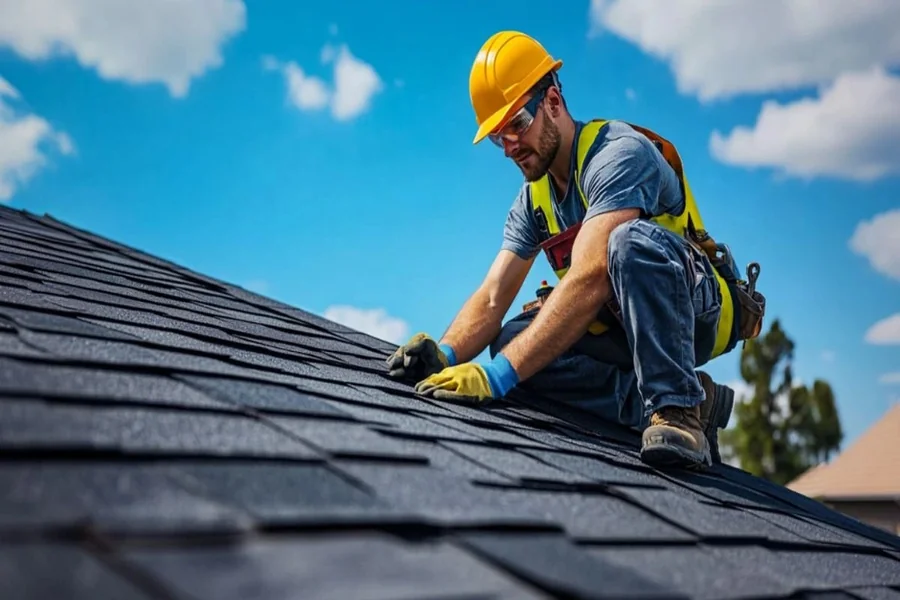
Your next roof will probably outlive your mortgage. That’s not hyperbole, that’s the math of standing seam steel versus the asphalt shingles most of Steiner Ranch was built with. And if you’re shopping right now, you’ve likely already noticed the price gap, the 30 year warranties, and the neighbor three streets over who hasn’t touched his roof since 2015. Here’s what you actually need to know before you sign anything, from panel profiles to hail ratings to the exact questions that separate great metal roofers from guys with a brake and a truck.
Why Steiner Ranch Homes Eat Through Asphalt Faster Than You Think
The Texas Hill Country doesn’t just get hot. It gets hot, then it hails, then it floods, then it bakes again, all inside a single calendar year. That cycle is brutal on composition shingles. The sun’s UV radiation degrades the asphalt binder, the thermal cycling between 100 degree afternoons and 50 degree nights makes the shingles expand and contract until they crack, and one solid hail event can create granule loss that accelerates everything else.
You see the results all over Steiner Ranch: curled tab edges, bald spots on south facing slopes, and gutters that fill with grit every time it rains. That grit is your roof wearing away. The U.S. Census Bureau’s 2023 American Housing Survey found the median age of owner occupied homes in the South is around 37 years, but the roofing materials on those homes were never designed to last that long. Asphalt shingles, even the good ones, carry warranties in the 25 to 30 year range, and the real world performance in a climate like this frequently falls short of the sticker.
So when your insurance adjuster tells you that a new dimensional shingle roof is “the standard fix,” you should hear that as “the cheapest fix.” It is the baseline, not the benchmark.
The Price Math Nobody Wants to Do Out Loud
Let’s talk dollars because that’s the first thing everyone asks about. A metal roof in Texas typically runs between two and three times the upfront cost of a comparable asphalt job. That sounds painful. But the total cost of ownership flips the equation.
Asphalt needs replacing roughly every 15 to 20 years in this climate, and sometimes more often if hail finds you. A standing seam metal roof, installed correctly, carries a 30 year finish warranty and a structural service life that often spans 50 years or more. Do that math over three decades and you are paying for one metal roof versus two, possibly three, asphalt roofs. The labor and disposal costs for those tear-offs, the disruption of having crews on your property again and again, and the risk of one bad shingle install failing early, it all swings the comparison hard.
There is also a quieter financial angle that matters in a place like this. The U.S. Department of Energy’s Energy Saver guide notes that cool roofs, which include many metal products with reflective coatings, can lower peak roof surface temperatures by up to 50°F. That translates into real attic temperature reductions and lower cooling loads in a market where summer electric bills can spike. You are not just buying a roof, you’re buying a smaller monthly utility number from May through September.
What the Panels Actually Look Like: A Field Guide
You’ve got two main profiles to consider, and I’ll tell you straight up which one I prefer.
Standing seam. This is the one with the raised vertical ribs and the hidden fasteners. The clips that attach the panels to the deck allow for thermal movement, which means the metal can expand and contract without tearing its own fasteners out. That’s the system designed for a 50 year service life. You’ll see a lot of these in Steiner Ranch on the higher end builds because the clean vertical lines fit the modern Hill Country aesthetic.
Exposed fastener panels. These have visible screws with rubber washers on top. They are cheaper and faster to install, but every one of those screw penetrations is a future leak point. The washers dry out and crack, usually in 10 to 15 years, and then you have a maintenance treadmill. I would not put exposed fasteners on a roof I planned to own for more than a decade. The savings just don’t justify the schedule.
Steel thickness matters too. Cheaper panels run 29 gauge, which is thin and can oil can, that wavy distortion you sometimes see. Better residential roofs use 24 gauge or heavier. Your contractor should know the gauge without checking. If they don’t, that’s a red flag.
Hail, Wind, and the UL Ratings That Keep Insurance Companies Happy
Here is a table that will matter when you call your insurer, because hail resistance is not just a comfort feature in Central Texas.
| Roof Material | Typical Hail Rating (UL 2218) | Typical Wind Rating (UL 580 / Miami-Dade) | Expected Service Life in TX Climate
|
| 3-tab asphalt | Class 1 (lowest) | Not rated | 12-15 years |
| Architectural asphalt | Class 2 to 3 | Varies | 18-22 years |
| Standing seam steel (painted) | Class 4 (highest) | Often rated to 150+ mph | 40-50+ years |
| Stone coated steel | Class 4 (highest) | Often rated to 150+ mph | 40-50+ years |
That Class 4 impact rating is the one your insurance company actually recognizes. Many carriers in hail prone Texas counties now offer premium discounts for Class 4 rated roofing because the actuarial data clearly shows fewer claims. When you’re comparing quotes, ask the roofer to put the specific UL 2218 class of the panel in writing. “Impact resistant” is marketing. “Class 4 rated” is a tested fact.
The Install Crew Matters More Than the Panel Brand
Here’s the part that separates a roof that lasts 50 years from a roof that leaks at year nine: the people standing on it.
A metal roof is a manufactured component system. The panels are rolled to exact lengths, the flashing is custom bent, and the success of the whole assembly depends on the crew understanding the specific installation details. A subcontracted crew that mostly hangs shingles will not treat a standing seam installation with the care it requires. They’ll overdrive screws, mishandle the panels, and leave penetrations improperly flashed.
Look for a company that employs dedicated, permanent install crews. Ask about their training specifically on the brand of panel you’re buying. The manufacturer certifies installers for a reason, and those certifications are not handed out freely. You can check with the Metal Roofing Alliance’s educational resource, which publishes guidance on selecting certified contractors and explains the difference between a handyman install and a factory certified one. That resource naming convention matters because the association tracks installer credentials and warranty validation requirements.
One more thing to check: the crew’s familiarity with Steiner Ranch’s specific conditions. The wind patterns off Lake Austin, the limestone substrate, the steep grade changes on some of those lots, they all influence flashing details and fastening schedules. A roofer who works in the neighborhood regularly has seen the failure modes of the houses built here in the 90s and 2000s. That local knowledge is worth real money, it is the difference between a generic install and one tuned to your actual roof deck.
When You Call for Quotes: A Five Question Screening
You should talk to at least three companies, and I’d make them all answer these five questions on the first call. If any of them stalls, that’s your answer.
- What gauge steel and what finish warranty? You want 24 or 26 gauge and a finish warranty of at least 30 years from the paint manufacturer, not the installer.
- Who is on the crew? Direct employees or subcontractors? What is their installation training on the panel you’re spec’ing?
- What does the hail rating say on the panel spec sheet? They should produce the UL 2218 class in writing.
- Who does the flashing and trim? On site custom fabrication by the crew, or preordered generic pieces? Custom always fits a real roof better.
- What is the real timeline including weather delays? Metal installs are faster than shingles, but a realistic schedule accounts for Texas thunderstorms and high wind days that shut down work.
And when you compare the bids, do not default to the cheapest number. The difference in labor quality between a $35,000 roof and a $45,000 roof is not markup, it’s the difference between a crew that owns its mistakes and one that disappears after the final check clears. You want the roof that is installed with the panel manufacturer’s actual details followed to the letter.
Financing and the Real Timeline of a Roof Swap
Most people do not have $40,000 sitting around, and that’s fine. Good metal roofing companies in this area offer financing plans with terms from five to fifteen years, and many work with third party lenders who specialize in home improvement. You should ask whether the company holds the financing in house or brokers it, because that changes who you negotiate with if there’s a dispute.
Also ask about insurance claims assistance. If your roof was damaged by hail, your homeowners policy may cover a significant portion of the replacement, and experienced companies know exactly how to document the claim. Good ones will even handle the adjuster meeting themselves. A reputable local provider offering metal roofing services in Steiner Ranch will typically walk you through the insurance process and the financing options together, so you understand your actual out of pocket before any panels get ordered.
As for the timeline, a standard residential metal roof takes one to two weeks of active installation depending on complexity. That is substantially faster than the two to four weeks you might see with a shingle tear off and re-deck. The reason is simple: metal panels cover large areas quickly, and there is no drying time for adhesives or waiting on tar paper layers. You will lose access to part of your driveway during delivery, and you’ll hear some banging, but you will not be camping out of your own house for a month.
What a Finish Warranty Does and Does Not Cover
The 30 to 40 year paint warranty on a good metal panel sounds bulletproof. It is not unlimited.
The warranty covers premature fading, chalking, and peeling of the paint finish under normal conditions. It does not cover hail damage dents, which are an impact claim to your insurance, not a finish claim to the manufacturer. It also does not cover panel damage from branches, ladders, or someone walking on the roof with the wrong footwear. And most importantly, the finish warranty is voided if the roof was not installed in accordance with the manufacturer’s specific details. That is why the crew quality point above is so critical. A tiny flashing error on day one can invalidate the entire warranty by year four.
Read the warranty document before you sign the contract. Ask the installer to flag the maintenance requirements. Some finishes need an annual gentle wash in certain climates, though most modern PVDF coatings handle Texas grime fine. Know that “white” colored panels reflect more heat than dark bronze ones, and you will pay a modest premium for the lighter color that may be worth it in cooling savings.
So what is the actual question you need to answer before you pick up the phone? It is not “can I afford metal?” It’s “can I afford to replace my roof a second time in the next 20 years?” For a house in Steiner Ranch, with hail season every spring and summer UV that bakes the hills all afternoon, the math almost always lands on steel. The only real variable is whether you pick a contractor who treats your roof like their own. Talk to three, use the screening questions above, and trust the crew that answers them all without hesitation.

Passionate about exploring diverse ideas and sharing inspiration, I curate content that sparks curiosity and encourages personal growth. Join me at ElementalNest.com for insights across a wide range of topics.