
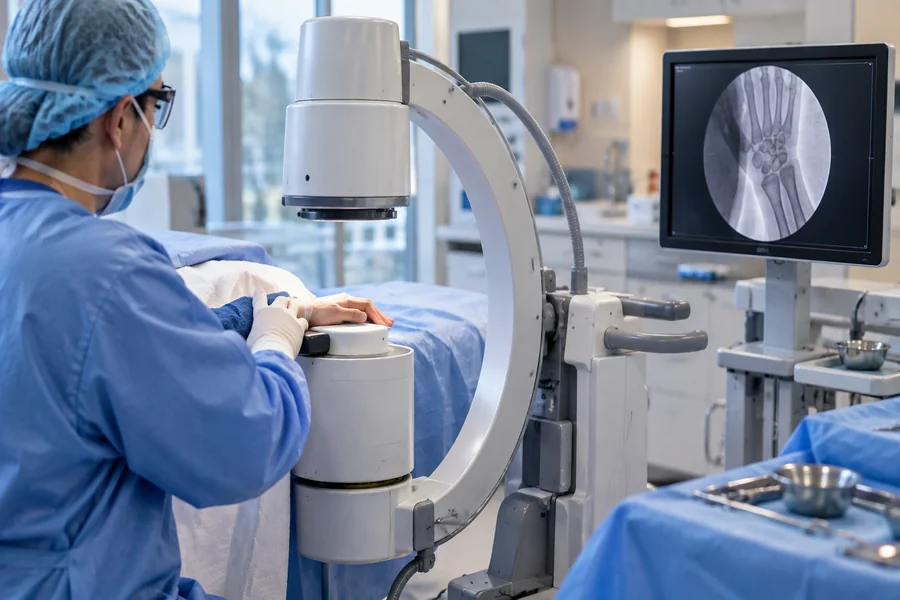
In extremity imaging, progress is rarely defined by dramatic breakthroughs alone. More often, meaningful innovation comes from improvements that make clinical workflows smoother, faster, and easier to manage in real-world settings. This is especially true across orthopedic practices, ambulatory surgery centers, and urgent care environments, where efficiency and adaptability are critical.
As a result, imaging systems are increasingly evaluated not just by their technical output, but by how well they integrate into day-to-day clinical operations. Compact fluoroscopic platforms are gaining attention because they are better aligned with the realities of modern care delivery, where mobility, usability, and procedural flow all play a central role.
Why Mobility Has Become a Core Requirement in Extremity Imaging
Mobility is no longer a secondary consideration in imaging design. In many care environments, it directly impacts how efficiently providers can move between rooms, manage schedules, and support procedures across multiple settings.
Compact systems designed for portability allow imaging to follow the workflow, rather than forcing workflow to adapt to fixed equipment. This is particularly valuable in outpatient and satellite care environments, where space constraints and operational flexibility are constant factors.
As expectations shift, the broader c arm category is being re-evaluated with mobility in mind, not just as a feature, but as a strategic advantage that supports more flexible care delivery models.
The Rise of Intuitive Interfaces in Imaging Equipment
Another important shift in imaging technology is the growing emphasis on usability. Clinical teams are accustomed to intuitive digital tools in other areas of their work, and they increasingly expect the same level of simplicity from imaging platforms.
Touchscreen interfaces, streamlined controls, and simplified navigation are no longer nice-to-have features. They can influence how quickly staff adopt new systems, how easily teams are trained, and how smoothly imaging fits into the procedural workflow.
This reflects a broader move toward user-centered design in medical technology, where the goal is not just performance, but ease of use in high-demand clinical environments.
Why Dose Efficiency Is Becoming Central to Equipment Decisions
Radiation exposure remains an ongoing consideration in fluoroscopic imaging, particularly in settings where systems are used frequently across a wide range of extremity procedures. As a result, dose efficiency has become a more prominent part of the evaluation process.
Modern imaging platforms are expected to balance clarity with responsible dose management, supporting both clinician confidence and patient safety. Advances in pulsed fluoroscopy, dose filtering, and optimized imaging protocols reflect this priority.
For decision-makers, this trend reinforces a larger point. The most valuable innovations are often those that improve everyday usability and clinical outcomes without adding unnecessary complexity.
How Specialized Imaging Platforms Support Modern Care Environments
Healthcare organizations are increasingly moving away from generalized equipment decisions and toward more targeted investments. In extremity imaging, this means selecting systems that are purpose-built for specific procedural needs rather than trying to cover every possible use case with a single platform.
Focused imaging systems can better align with the realities of orthopedic, podiatric, and outpatient care. They are often easier to integrate into smaller spaces, better suited to repeated procedural use, and more supportive of efficient clinical workflows.
For example, systems like the Orthoscan Versa Mini C-Arm are designed with these environments in mind, emphasizing portability, usability, and workflow compatibility in extremity-focused settings.
Why Practical Fit Outweighs Feature Volume
In capital equipment decisions, there is a growing recognition that more features do not always equate to greater value. What matters more is how well a system fits the clinical environment in which it will be used.
Does it support the most common procedures?
Does it work well within the available space?
Does it simplify, rather than complicate, the workflow?
These questions are increasingly guiding purchasing decisions. In many cases, a system that is well-matched to the care setting will deliver more long-term value than one with broader but less relevant capabilities.
What This Means for the Future of Mini C-Arm Adoption
The future of mini c-arm adoption will likely be shaped by the same factors influencing healthcare delivery more broadly. Specialization, efficiency, and adaptability will continue to drive decision-making. As care moves further into outpatient and procedure-focused settings, the demand for imaging systems that support these models will only grow.
Platforms that combine mobility, intuitive operation, and strong alignment with extremity workflows are well positioned to meet these needs. Their value lies not just in their technical capabilities, but in how effectively they support the clinical environment as a whole.
For orthopedic and outpatient leaders, this represents a shift in perspective. Imaging is no longer just a supporting tool. It is an integral part of workflow design and operational efficiency. Systems that reflect that reality are likely to remain central to imaging strategy in the years ahead.

Passionate about exploring diverse ideas and sharing inspiration, I curate content that sparks curiosity and encourages personal growth. Join me at ElementalNest.com for insights across a wide range of topics.