
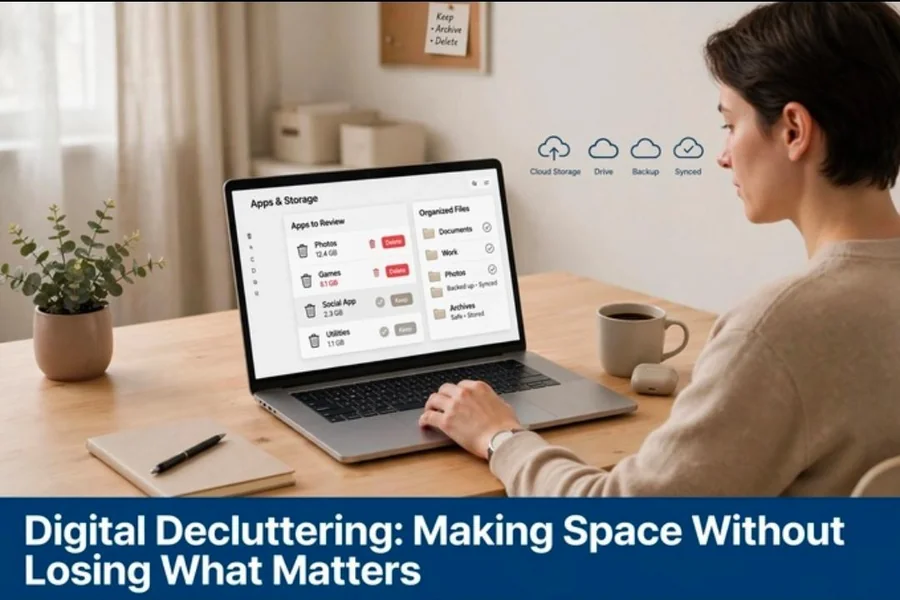
Clearing a room has a satisfying finality to it. Bags go to the charity shop, the surfaces are clear, and the effect on how the space feels is immediate. Clearing a phone or a laptop offers none of that. The screen looks identical afterwards, nothing feels lighter, and the low background hum of forty thousand unsorted photographs continues undisturbed.
Which is why digital clutter tends to be the last thing anyone tackles, despite being the clutter people interact with most. It is also the only kind where deleting the wrong item is genuinely irreversible, and that fear alone keeps most collections growing indefinitely.
Why it accumulates differently
Physical clutter is self limiting. A cupboard fills up and forces a decision. Digital storage expands, quietly, for a small monthly fee, so the decision never arrives. Every screenshot, duplicate burst photo, downloaded attachment and half finished note simply stays.
There is a second difference that matters more. Physical objects are visible, so their presence nags. Digital files are invisible until you go looking, which means the cost shows up only at the worst moments, when you cannot find the document you need or you are told there is no space to take another photograph.
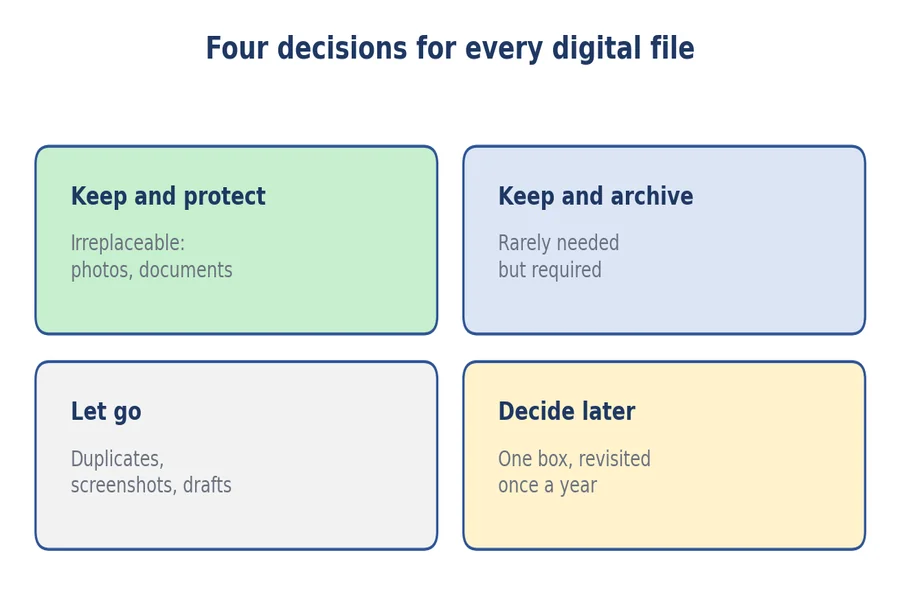
Every file falls into one of four categories, and only one of them requires thought.
Four decisions, not one
Trying to sort a decade of files with a single keep or delete question is what makes this exhausting. Most items are not close calls, and treating them as though they were is what leads people to abandon the effort after twenty minutes.
- Keep and protect: photographs, personal documents, anything irreplaceable. These need a copy somewhere other than the device holding them.
- Keep and archive: tax records, warranties, contracts. Needed rarely, required occasionally, and safely out of daily view.
- Let go: duplicates, blurry frames, screenshots of things you have since dealt with, downloads you opened once. This is usually the largest group by a wide margin.
- Decide later: one folder, honestly labelled, revisited once a year. Anything still untouched after two passes can go.
The fourth category is what makes the process finishable. Perfectionism is the real obstacle here, and giving uncertain items a legitimate holding place removes it.
Start with the largest offenders
Sorting chronologically means starting in the distant past and losing momentum before reaching anything recent. Sorting by size means the first hour produces a visible result, which is what sustains the effort.
On most devices the biggest consumers are videos recorded by accident, duplicate photo bursts, and downloaded media from messaging apps. Clearing those three categories usually frees more space than a week of careful decisions elsewhere, and none of it requires any judgement at all.
Where the keepers should live
A cleared device is not the same as a protected archive. The files you decided to keep are now concentrated in one place, which makes that place more important than it was before, not less. A single device holding the only copy of everything you chose to save is a worse position than the mess you started with.
This is where a copy held elsewhere earns its place. Storing the protected category in cloud storage with end to end encryption means the files survive a lost or broken device, and remain readable only by you rather than by whoever operates the service. For personal documents and family photographs, that distinction is the whole point.
The underlying principle is well established. Personal digital preservation guidance published by the Library of Congress recommends keeping more than one copy of anything irreplaceable, storing copies in separate locations, and checking occasionally that the files still open. The last step is the one everyone skips, and the one that catches silent corruption before it matters.
Keeping it clear
The maintenance habit that actually holds is small and attached to something that already happens. Ten minutes at the end of each month, or whenever a phone gets replaced, is enough to stop the backlog rebuilding.
Turning off automatic saving of media from group chats makes a larger difference than any amount of sorting. Most of the volume in a cluttered photo library was never chosen, it simply arrived.
The trap of the perfect system
A recurring pattern is worth naming. Someone decides to sort their files, researches folder structures, reads about naming conventions, builds an elaborate hierarchy, and abandons it three weeks later because filing anything requires a decision about which of eleven categories applies.
A structure simple enough to use carelessly beats a structure that is theoretically better. Two levels of folders and a habit of starting filenames with the year covers almost every household need, and it survives the weeks when nobody has the energy to be tidy.
The calmer part
There is a quieter benefit that has nothing to do with storage capacity. Knowing where your important documents are, and knowing they exist in more than one place, removes a background anxiety most people do not consciously register until it lifts.
It is the same relief as a cleared surface in a room, arriving in a less visible form. An afternoon of sorting, one protected copy, and a ten minute monthly habit is the whole method.

Passionate about exploring diverse ideas and sharing inspiration, I curate content that sparks curiosity and encourages personal growth. Join me at ElementalNest.com for insights across a wide range of topics.