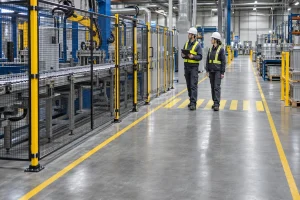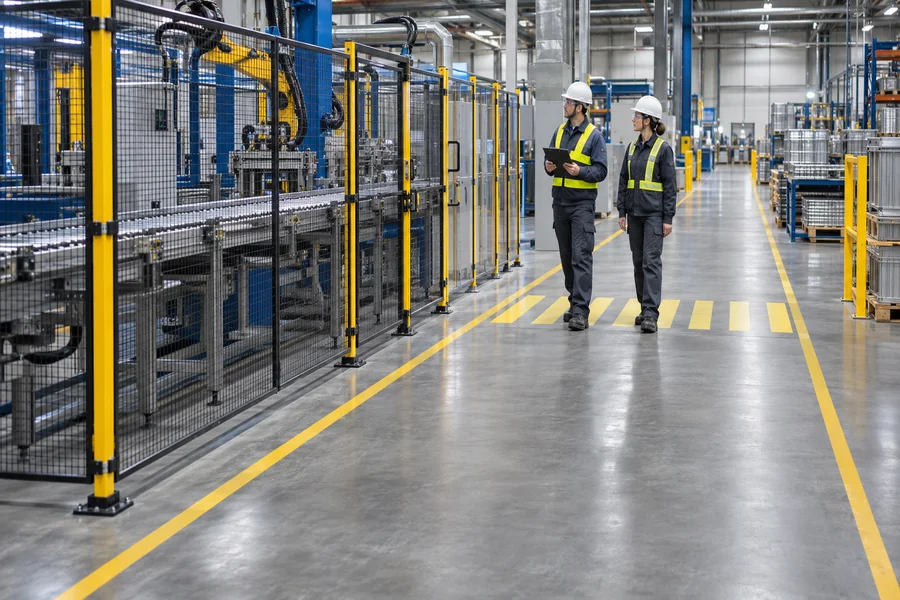
Of course, it helps to keep the workplace as neat and orderly as possible, but this alone will not ensure it is safe to work in. A frayed or defective flex will be obvious to most people, but high noise levels or inadequate methods of maintaining plants are much less obvious and may continue for considerable time.
Identifying all of these potential sources of injury and ill health, prioritising them and taking preventive measures is clearly desirable.
As with many areas of Occupational Safety and Health (OSH), effective measures can start with a simple observation of activities, without resorting to elaborate systems. Observation should be paired with worker feedback, reviews of incident and maintenance records, and a clear plan for addressing the most serious hazards. Assign a person to each action and check whether the chosen control works.
What You’ll Learn
- The importance of identifying hazards
- Other hazards to look out for
- Assess level of risk
- Preventing and minimising exposure
- Maintaining an up-to-date assessment
- Summary
The importance of identifying hazards
As noted above, any source of potential injury or ill health should be regarded as a hazard, while risk is a judgement of probability and extent of injury. Clearly there could be many hazards present before an accident or illness event occurs.
In 2024, 2.5 million nonfatal cases of workplace injuries and illnesses were reported by U.S. private industry employers to the Bureau of Labor Statistics.
Clearly many more hazards exist than this figure would suggest. There is clearly no case for adopting a ‘wait and see’ attitude towards preventing accidents and ill health at work.
Examine all operations, machinery, plant and the environment and consider any difficulties encountered. Workers will frequently be aware of ‘near miss’ incidents, unsatisfactory methods, such as inadequate time allowed to transfer a load between processes.
Past accidents, plant overhauls and maintenance operations, and SDSs, may also give valuable information.
Other hazards to look out for
Physical surveys of the workplace are valuable, but consideration should also be given to preparatory and finishing operations, cleaning and any abnormal situation, such as maintenance or breakdowns.
A business wishing to undertake some fabrication operations may conclude, following this exercise, that its plant is inadequate, and so wish to investigate sub-contracting some operations, such as sheet metal laser cutting. There would still be hazards associated with receiving and moving these components around the business.
Clearly, introducing new operations and methods may introduce new hazards.
There are many aspects to consider: moving plants and machinery, electricity, falling from height, high temperatures and noise, all physical hazards. A wide range of substances may be in use or generated as dusts or fumes, and may not be adequately extracted. Manual handling, postural and other ergonomic problems may be present. Finally, inadequate organisation of work, such as long hours leading to tiredness and errors, lack of information, pressure of time, isolation, and so on.
Visitors to the premises of all types, including contractors and new employees, should be considered.
For example, a range of issues may need consideration around plant cutting metals: cuts from sharp components, plant fumes, and perhaps laser emissions. There are, of course, many other operations carried out away from workshops, such as office and distribution work, which may benefit from similar scrutiny.
Assess level of risk
With a list of potential hazards identified, the question then arises as to which should be addressed first.
This will depend upon how injury may occur, the degree of injury or ill health that could result, the probability of occurrence, and the number of people exposed. Many formats exist for making an overall assessment of these factors, but obviously these should be a true reflection of circumstances.
One suitable approach may be:
- List all operations, including cleaning and maintenance;
- List possible hazards for each and any people exposed;
- Note any current preventive measures;
- Determine degree of risk remaining from 2. above, including the number of people exposed and frequency of exposure; and
- Decide what further measures are warranted, who will implement them and when they should be reviewed.
Clearly some items, such as a loose carpet square, will be straightforward to rectify. On the other hand, plant missing guards would warrant prompt action to prevent employees contacting moving and other dangerous parts.
Appropriate precautions should obviously be taken pending further action where the degree of exposure, for example to substances in air, cannot readily be assessed, and expert assistance and measurements may be advisable.
Preventing and minimising exposure
It is obviously pointless to identify hazards if nothing is subsequently done.
A well-recognised sequence of options will generally be adopted to minimise exposures. It is preferable, wherever possible, to prevent employees being exposed in the first place, rather than rely on their complying with certain rules.
Thus one would seek to eliminate a hazard if possible, failing which replace the operation or substance with a less hazardous one, then prevent access, for example by guarding and extraction, and alter methods and access. PPE would then be selected as appropriate.
Clearly employees would need to be advised to exercise caution around a dangerous part of the machine, but preferably this would be complemented by effective guarding. Employees may still require PPE.
A combination of measures may well be required, for example altering equipment, restricting time of exposure and providing ear protectors, to reduce noise exposures.
It is also worthwhile to consider if any remedial action may give rise to further hazards. Extracting to another area of the workshop frequented by others would obviously be undesirable. Employees should be asked to trial any proposed improvements.
Maintaining an up-to-date assessment
Changes in processes and materials used, relocation of equipment and plant, breakdowns, alterations to shift patterns, and so on may all give rise to further or increased exposures to employees.
It follows that work areas should be periodically inspected and any near-misses investigated, with reassessments undertaken prior to significant alterations to operations. Plant maintenance and shutdown periods deserve particular scrutiny.
Information recorded should include the hazard, employees affected, current precautions, proposed action to be taken, the person responsible, by when, and date to review progress.
Equally important is verifying the effectiveness of any measures implemented, for example that guards cannot easily be bypassed and are secure, extraction systems operate efficiently and methods can be readily followed without giving rise to other problems. Employees will need appropriate information and training on reporting hazards and deficiencies, ceasing work if considered unsafe and action if precautions fail.
Summary
Ideally the outcome of such an assessment would be reduced hazards associated with each operation. So select key operations, observe how they are performed and question employees on difficulties experienced, then identify hazards, prioritise actions to reduce highest risks, allocate responsibility and review. Repeat whenever there are changes to any aspect of operations. This should be far more beneficial than a protracted exercise resulting in little more than a comprehensive document gathering dust!

Passionate about exploring diverse ideas and sharing inspiration, I curate content that sparks curiosity and encourages personal growth. Join me at ElementalNest.com for insights across a wide range of topics.