
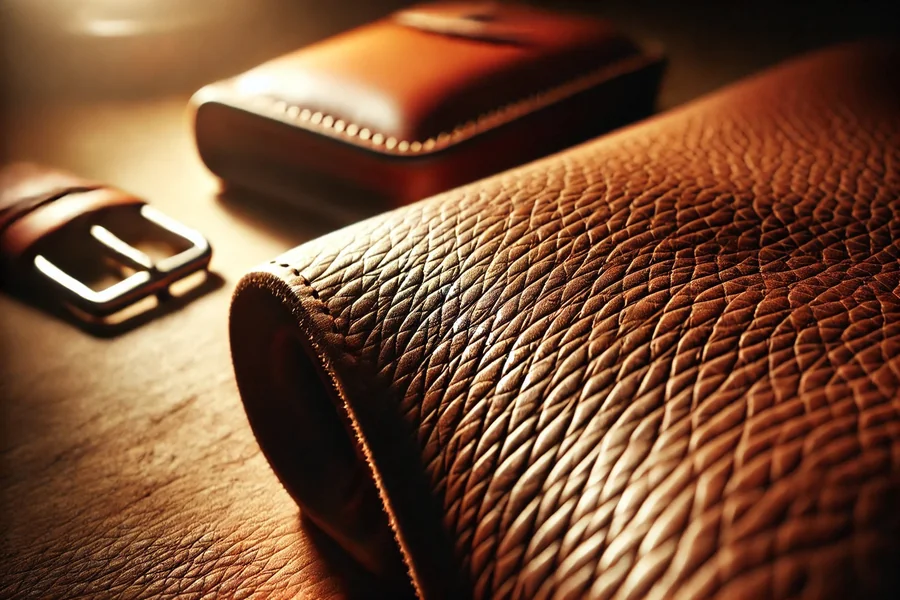
There is a reason the most enduring pieces in any serious wardrobe are made of leather. Not just any leather — full-grain leather, the kind that comes from the top layer of the hide, untouched by sanding or buffing, carrying every natural grain and character mark intact. This is the material that improves with age rather than deteriorating with use. It is the material that luxury houses have returned to for centuries, and the one that modern designers with a serious eye for craft continue to choose above all others.
The difference between full-grain leather and the corrected or bonded alternatives that flood the contemporary market is not subtle. It is the difference between a garment that becomes yours over time — that molds to your body, deepens in color, develops a patina specific to how you move and live — and one that begins to peel and crack within eighteen months. One is an investment. The other is a transaction.
What Makes Full-Grain Different
Leather is graded by which layer of the hide it comes from and how much processing it undergoes. Full-grain leather uses the outermost layer of the hide, with the natural surface left intact. This means the tight, dense fiber structure remains uncompromised. The result is a material with exceptional tensile strength, natural breathability, and a surface that reacts to the environment over time — developing what tanners call a patina, a living record of the object’s life.
Top-grain leather, one step below, has the surface lightly sanded to remove blemishes and is often given a finish coat. It looks more uniform at first glance, but that processing removes the very characteristics that make leather exceptional: natural texture variation, breathability, and the capacity to age well. Corrected-grain and bonded leather occupy the bottom rungs — the latter being essentially leather dust pressed back together with adhesives, offering none of the durability or character of the real thing.
For fashion applications — corsets, chokers, harnesses, belts, and structured accessories — the grade of leather has direct consequences on how a piece performs, feels, and presents. Full-grain leather holds structure without stiffness. It drapes with authority. It responds to body heat and movement in a way that makes even the most architectural silhouette feel wearable.
Italy and the Art of Sourcing
The origin of leather matters as much as the grade. Italian tanneries, particularly those in Tuscany, operate within a tradition of vegetable tanning that dates back to the medieval guilds. The process is slow — taking weeks rather than days — and uses organic plant-based tannins that bind to the leather fiber at a molecular level. The result is leather that is denser, more supple, and more responsive to aging than chrome-tanned alternatives.
Italian full-grain leather sourced from these tanneries carries a quality assurance built into the material itself. It requires no synthetic coatings to look refined. The natural surface variation — the slight differences in grain from one section of the hide to another — is considered a mark of authenticity rather than a flaw. Every piece cut from this leather is, in the truest sense, unique.
Brands that source from Italian tanneries and work with full-grain hides are making a commitment to quality that begins before the first cut. The leather is selected for thickness, hand feel, and grain consistency. Hides are assessed individually. There is no mass production shortcut at this stage — the material demands attention, and that attention is reflected in every finished piece.
Structure, Silhouette, and the Architecture of Leather
What leather does to a silhouette is unlike any other material in fashion. A well-cut leather corset does not merely sit on the body — it shapes it, defines the waist, anchors the torso, creates a presence. This is the structural power of the material working in tandem with pattern cutting. Leather holds its form in a way that fabric cannot. It does not require boning or stiffening agents to maintain shape. The material itself provides the architecture.
For accessories — chokers that define the neckline, belts that articulate the waist, harnesses that add dimension and layering interest — full-grain leather delivers a weight and substance that reads as luxury even before you touch it. The way it catches light, the soft sheen of a well-finished surface, the clean edge of a precision cut — these are the details that separate a considered leather piece from a mass-market approximation.
Sculptural leather pieces work particularly well when the design exploits the material’s natural properties rather than working against them. Clean geometric lines read clearly because leather holds an edge. Curved silhouettes work because full-grain leather can be shaped over forms without cracking. Hardware — buckles, rings, clasps — sits securely in full-grain leather in a way that is physically impossible with lower-grade materials.
The Long-Term Value Proposition
Fashion has spent the last decade reckoning seriously with the concept of cost-per-wear — the idea that the true cost of a garment is its price divided by how many times it is actually used. By this measure, full-grain leather pieces consistently outperform almost everything else in the wardrobe. A leather corset from a brand that sources well and constructs carefully will last fifteen years with minimal maintenance. A fast-fashion alternative, regardless of how it looks on the hanger, will not survive three seasons.
This is not a niche concern. The market for investment-grade fashion has grown consistently even as the broader fashion industry contracts. Buyers are choosing fewer, better pieces — pieces with clear provenance, visible craftsmanship, and materials that can withstand the test of actual use. Full-grain leather sits at the center of this shift.
The care requirements for full-grain leather are minimal but specific. A quality leather conditioner applied every few months keeps the material supple. Natural beeswax-based products protect the surface without altering the patina. Storage away from direct sunlight prevents uneven color development. These are not burdensome maintenance requirements — they are the rituals of ownership that come with choosing materials that were made to last.
Choosing Well
When building a wardrobe with genuine longevity, the question is not whether leather deserves a place in it. The question is what kind of leather, from what source, cut and constructed by whose hands. Full-grain leather sourced from Italian tanneries and shaped by skilled craftspeople is not simply a luxury choice — it is the logical choice for anyone who wants their clothes to reflect both personal style and real judgment about quality.
The investment in a single full-grain leather piece — a sculptural corset, a precisely cut choker, a harness that layers beautifully over seasonal pieces — pays back over years of wear. It ages into something better than it began. That is the essential promise of the material, and it is one that very few things in the fashion industry can honestly make.

Passionate about exploring diverse ideas and sharing inspiration, I curate content that sparks curiosity and encourages personal growth. Join me at ElementalNest.com for insights across a wide range of topics.