
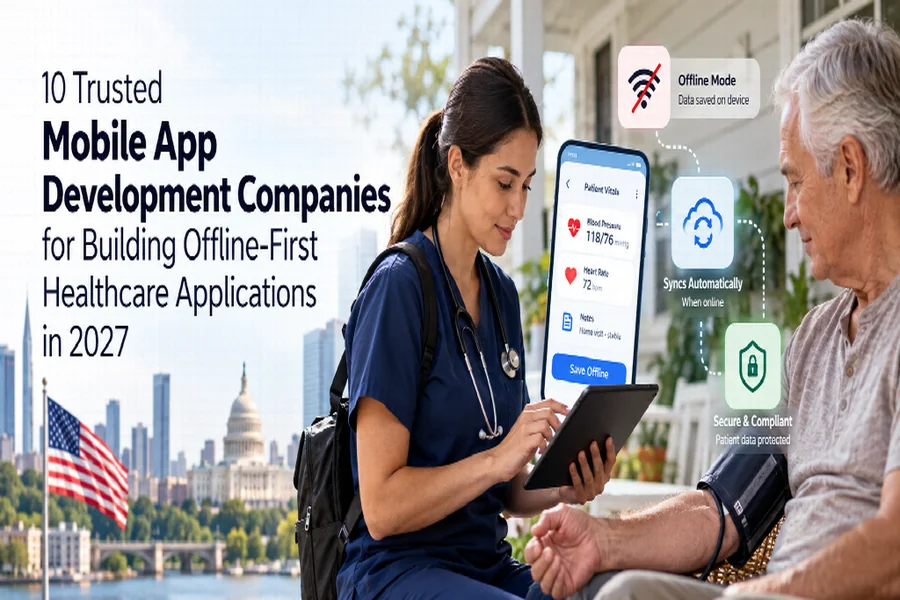
A community health worker recording a patient’s blood pressure during a home visit should not have to wait for an internet connection to save the reading. The same goes for situations when it comes to nurses updating clinical notes in remote clinics or patients using mobile apps to track their health.
This is why building such applications requires careful decisions about data storage, synchronization, security, and integration with electronic health record (EHR) systems. Healthcare app development services must address how patient information remains protected on the device and how users can identify which changes have been saved or are still waiting to sync. Choosing a development partner, therefore, means looking beyond interface design to assess its healthcare experience and ability to handle these engineering challenges.
What to Look for in an Offline-First Healthcare App Development Partner?
An offline-first healthcare app must protect patient records, preserve changes made on different devices, and give users a clear picture of what has reached the central system. When evaluating mobile app development services, healthcare organizations should consider how well a development partner can address these requirements.
- Start with the data architecture: The app should store the information needed for core tasks on the device and queue changes until a connection becomes available. Once the device reconnects, the app should synchronize pending updates without requiring staff to enter the same information again.
- Check how the system handles errors: The app needs a defined way to identify and resolve that conflict. It should also prevent duplicate submissions and resume interrupted uploads where possible.
- Ask how patient data stays protected: Locally stored health information needs safeguards, and audit trails should record relevant changes and actions where required, even when the device cannot immediately send those records to a central system.
- Examine healthcare integration experience: Depending on the product, the app may need to exchange records with electronic health record systems or other clinical platforms. Experience with standards such as HL7 FHIR can be useful, but the team must also understand the specific system, data formats, and workflows involved in the integration.
- Look at testing and usability together: Ask how the team tests lost connections, slow networks, failed uploads, and conflicting changes. Users should be able to tell whether a record is saved on their device, waiting to synchronize, or confirmed by the central system. The app should make these states clear without interrupting routine clinical work.
Top 10 Mobile App Development Companies in the US for Offline-First Healthcare Projects
Healthcare applications must keep essential tasks available when connectivity drops, protect patient records stored on devices, and synchronize updates when a connection returns. The following companies offer mobile engineering capabilities that will be suitable for healthcare projects:
1. GeekyAnts
GeekyAnts is an AI-Powered Digital Product Engineering & Consulting Company. Their capabilities span mobile app development services, product engineering, backend systems, cloud infrastructure, testing, and security. This combination can support healthcare applications that need to connect patient-facing features with APIs and clinical systems. For an offline-first project, buyers should ask how the team approaches local data storage, synchronization, conflict resolution, and protection of patient information.
Clutch Rating: 4.9/5 (120 reviews)
Address: GeekyAnts Inc., 315 Montgomery Street, 9th and 10th floors, San Francisco, CA 94104, USA
Phone: +1 845-534-6825, Email: info@geekyants.com, Website: geekyants.com
2. AppVerticals
AppVerticals combines mobile app development with custom software engineering and AI development. Its services cover iOS, Android, cross-platform applications, product design, and backend development, with health and wellness represented in its mobile work. These capabilities may suit patient platforms that need a mobile interface connected to clinical or administrative services. Buyers should confirm whether the team has delivered applications that preserve user input during connectivity loss and synchronize records safely after reconnection.
Clutch Rating: 4.8/5 (29 reviews)
Address: 1341 W Mockingbird Ln, Suite 600W, Dallas, TX 75247, USA
Phone: +1 833 888 2433
3. Quartus Technology, Inc.
Quartus Technology develops mobile applications and includes AI development among its services. Its mobile development focus covers health and wellness, making its experience relevant to patient-facing products that combine mobile workflows, backend services, and AI features. For offline-first healthcare projects, the key question is how the company handles records created without a connection, failed uploads, and updates made on multiple devices. Buyers should request examples that show how these cases were addressed in a deployed application.
Clutch Rating: 4.8/5 (11 reviews)
Address: 1221 Post Road East, Suite 203, Westport, CT 06880, USA
Phone: +1 866 444 5596
4. Inicrea Technologies LLC
Inicrea Technologies develops mobile and web applications, with health and wellness included among its mobile development areas. Its work across iOS, Android, and web products may suit healthcare teams building a patient-facing app alongside the services that support it. The fit depends on the project’s requirements, particularly if patients or clinicians need to record information in places with unreliable internet access. Buyers should ask for evidence of offline data handling, secure local storage, and synchronization after a device reconnects.
Clutch Rating: 4.7/5 (3 reviews)
Address: 30 N Gould St, Suite R, Sheridan, WY 82801, USA
Phone: +977 9801023843
5. KRUTSCH
KRUTSCH brings together mobile development, AI, and UX/UI design with healthcare work that includes clinical research and cardiovascular care. This experience may be relevant when an application needs to present clinical information in a way that patients or healthcare professionals can use during routine tasks. For an offline-first project, buyers should examine how the team designs record-entry screens, communicates synchronization status, and prevents users from submitting the same information twice after an interruption.
Clutch Rating: 4.7/5 (20 reviews)
Address: 107 N Washington Ave, Suite 200, Minneapolis, MN 55401, USA
Phone: +1 612 605 7549
6. Red Hawk Technologies
Red Hawk Technologies works across custom software, mobile applications, AI development, systems integration, and application support. This mix may suit healthcare organizations building an app that must exchange information with existing systems and remain supported after launch. For offline-first work, buyers should assess how the team handles failed synchronization, protects data stored on devices, and tests the application under poor network conditions.
Clutch Rating: 4.8/5 (15 reviews)
Address: 1 Moock Road, Building A, Suite 202, Wilder, KY 41071, USA
Phone: +1 859 360 5583
7. Sonatafy Technology
Sonatafy Technology provides custom software development, mobile application engineering, and enterprise application modernization. Their services may fit healthcare organizations that need to extend an existing product or update older software. Buyers should establish whether the team can work within the current architecture while addressing offline data access, synchronization, and device compatibility.
Clutch Rating: 4.8/5 (25 reviews)
Address: 14362 N Frank Lloyd Wright Blvd, Suite 1000, Scottsdale, AZ 85260, USA
Phone: +1 602 740 9866
8. Euvic
Euvic offers custom software development, mobile engineering, managed IT services, modernization, and AI solutions. Its range of services may suit healthcare organizations whose mobile applications must work alongside a wider set of clinical and business systems. For an offline-first project, buyers should clarify how the team would manage integrations, protect local records, and maintain the application as requirements change. Its ability to support the full system matters when a mobile app depends on several services to complete a clinical task.
Clutch Rating: 4.8 (22 reviews)
Address: 101 Hudson Street, 21st Floor, Jersey City, NJ 07302, USA
Phone: +1 201 409 2342
9. Iron Forge Development
Iron Forge Development builds mobile applications, web platforms, and custom software, with med-tech among the sectors represented in its work. Their services span product planning, development, maintenance, and scaling, which may help healthcare teams that need support beyond an initial release. Buyers should ask for relevant examples of medical software and check how the team approaches local data storage, interrupted uploads, and secure synchronization.
Clutch Rating: 4.8/5 (23 reviews)
Address: 2000 PGA Blvd, Building D, Suite 4440, Palm Beach Gardens, FL 33408, USA
Phone: +1 833 290 8900
10. Activeone
Activeone combines mobile app development, custom software, API integration, AI development, and engineering services. Their capabilities may suit healthcare products that need patient-facing features alongside connections to clinical systems or AI-powered functions. For offline-first projects, buyers should determine whether the proposed architecture can retain updates during a network outage, prevent duplicate records, and synchronize data securely when access returns. They should also clarify how the team will test these conditions and support the application after release.
Clutch Rating: 4.8/5 (13 reviews)
Address: Orlando, FL, USA
Phone: +1 321 236 0010
How to Evaluate a Partner Before Committing to an Offline-First Healthcare App
Before committing to a development partner, ask the team to walk through situations that could occur during daily clinical work.
Request a demonstration of how the app behaves when two users update the same patient record, an upload stops midway, or a user submits the same form twice. The team should explain how it detects conflicting changes, resumes interrupted synchronization, and prevents duplicate entries from creating inaccurate records. Ask to see these scenarios in action rather than relying on a description of how the system should work.
When evaluating healthcare app development services, discuss integration with existing electronic health record systems, support for the devices used by clinical staff, and plans for maintenance as the application grows. Clarify who will make architecture decisions, run connectivity and security tests, review vulnerabilities, and handle issues after launch. These responsibilities should be agreed upon before the project scope is finalized.
A company’s public portfolio can establish initial credibility, but practical validation determines whether its approach fits the clinical environment. The right partner should be able to show how its decisions protect patient data and keep essential workflows running when connectivity fails.
Conclusion
Building an offline-first healthcare application involves more than saving information on a device when the internet goes down. The app must preserve every valid update, synchronize records without creating duplicates, and protect patient information throughout the process. It must fit the way clinicians work and exchange data with the healthcare systems they already use.
The architecture should support the application’s clinical needs today and allow it to handle more users, devices, and integrations as those needs change. So the strongest choice would be to select a partner whose engineering decisions reflect the conditions in which the app will operate and the responsibility that comes with supporting patient care over time.

Passionate about exploring diverse ideas and sharing inspiration, I curate content that sparks curiosity and encourages personal growth. Join me at ElementalNest.com for insights across a wide range of topics.