
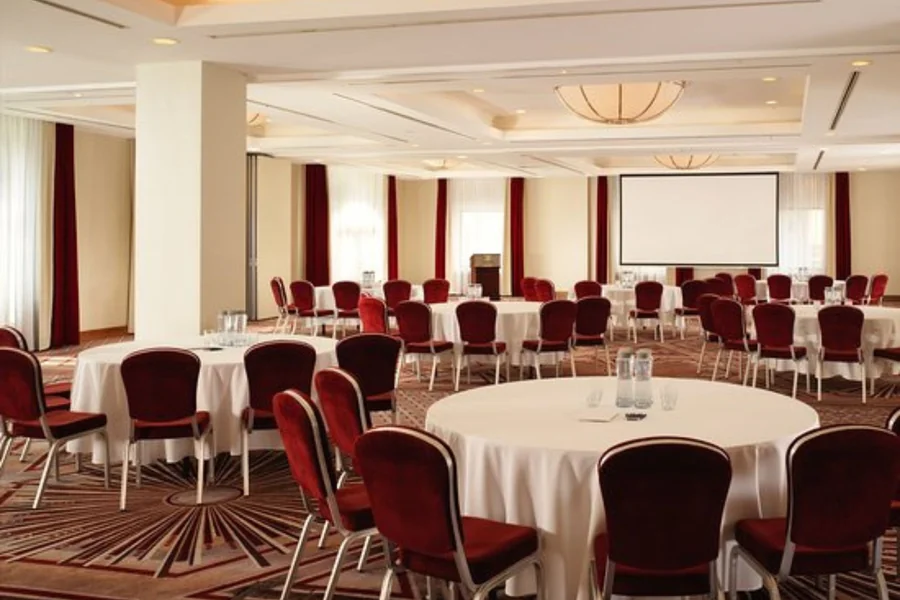
An empty room lies to you. Chairs look right, aisles look generous, the spacing seems obvious, and everything about the layout reads as settled. Then two hundred people walk in wearing coats and carrying drinks, and the room becomes an entirely different object with entirely different problems.
Hosts who have run the same space for a few seasons know this and buy accordingly. Experienced operators specify their banquet chairs around the second hour of a full room rather than the first ten minutes of an empty one. Everything worth knowing about a chair reveals itself under load. Five things in particular, every time, in roughly the same order.
The Noise Arrives First
Sound is the earliest signal and the one nobody anticipates.
An empty room is quiet, so the acoustic behavior of the seating is invisible during setup. Fill it and the chairs become the loudest object in the space. Two hundred people adjusting their position produces a continuous scrape against a hard floor, and it sits directly in the frequency range that competes with speech. Guests respond by talking louder, which raises the whole room, which makes them adjust more.
Glide material is the whole story here. Felt or soft polymer glides remove most of it. Hard nylon on a polished floor amplifies it, and no amount of soft furnishing elsewhere in the room compensates. Test this by dragging one chair across the actual floor before you order two hundred, and listen from thirty feet away rather than from directly above it.
How Much Room a Chair Back Actually Takes
The second discovery is spatial, and it usually arrives when the first course does.
Layouts get planned from seat width. Rooms get lived in from back-to-back depth, which is a different and larger number. Two guests at adjacent tables lean back at the same moment and their chairs meet, and now a server can’t get through with a tray. That aisle measured fine on the plan, because the plan assumed everyone would sit upright.
Clearance standards exist for exactly this reason. The federal guidance on accessible routes sets minimum widths that hold when a room is occupied, not when it is empty. Rooms planned to those figures survive a full house better than rooms planned to the tighter number a drawing allows. Measure the depth of the chair with somebody actually sitting in it and leaning back. That’s your real number.
The Twenty Minute Comfort Cliff
Every banquet chair is comfortable for ten minutes. That tells you nothing.
What separates chairs is what happens between minute twenty and minute ninety, which is the span of an actual seated event. A seat pan that is too flat pushes weight forward onto the thighs. A back angle that is too upright leaves nothing to rest against. Padding that is too thin bottoms out and the frame edge starts to make itself known through the fabric.
The tell in a full room is visible from the back wall. People start shifting in a wave somewhere in the second half hour, then a few stand up during a speech and drift toward the bar, and the room’s attention fragments. Hosts often read that as a programming problem. Frequently it’s a seating problem wearing a programming costume.
What the Fabric Does Under Real Lighting
Fabric behaves differently in three conditions that never coincide during the buying process.
The showroom sample sits under neutral daylight. Your storage room sees it under nothing. Your event sees it under a warm wash at eight in the evening with the house lights down, and that’s the only condition that matters. Colors shift, sheen appears where the sample looked matte, and any variation between dye lots becomes visible in a way it simply isn’t on a single chair.
There’s a compliance dimension here that gets discovered late and should be discovered early. Under 16 CFR part 1640, upholstered furniture must meet the test method in California Technical Bulletin 117-2013, a requirement that has applied to items manufactured, imported, or reupholstered on or after June 25, 2021. The CPSC keeps the upholstered furniture requirements published in full, and a supplier who can’t produce that record has handed you a question you don’t want asked for the first time by an inspector.
The Stack That Fights Back at Midnight
The fifth thing gets noticed after the guests leave, which is why it takes hosts the longest to learn.
Teardown is the honest test of a chair. A frame that nests cleanly comes apart in stacks quickly and quietly. A frame that binds, or that has to be aligned just so before the next chair will seat, turns a forty minute strike into ninety. That happens at one in the morning, with a crew that started at seven. Chairs that scratch each other during stacking accumulate visible wear along exactly the surfaces guests look at.
Ask about the stacking interface specifically, since this is where cheap frames reveal themselves. Bumpers or glide-to-frame contact points that prevent metal touching metal are a small detail that decides how the inventory looks in year four.
What to Test Before the Next Order
The five discoveries above can all be made in advance, in an afternoon, with one sample chair:
- Drag it across your actual floor and listen from across the room
- Measure back-to-back depth with somebody seated and leaning back
- Sit in it for ninety minutes at the table height you actually use
- View the fabric under your evening lighting, not under daylight
- Stack and unstack it twenty times and look at the contact points
Rooms Tell You in the Second Hour
Ask anyone who runs events regularly what makes a room work and they will describe a feeling rather than a specification. People stay. Conversations keep going. The energy in the room at nine o’clock resembles the energy at seven, and nobody drifts toward the exit during the part of the evening the whole night was built around.
None of that is an accident, and very little of it is visible during setup. A room reveals its seating in the second hour, in front of guests, when nothing can be changed. Hosts who have been through that a few times stop buying chairs from photographs. Bodies like the one that accredits US technical standards exist partly so buyers have something firmer than a photograph to work from. The chair that survives the second hour isn’t usually the one that looked best in the empty room, and finding that out before the order rather than after it is the whole discipline.

Passionate about exploring diverse ideas and sharing inspiration, I curate content that sparks curiosity and encourages personal growth. Join me at ElementalNest.com for insights across a wide range of topics.