
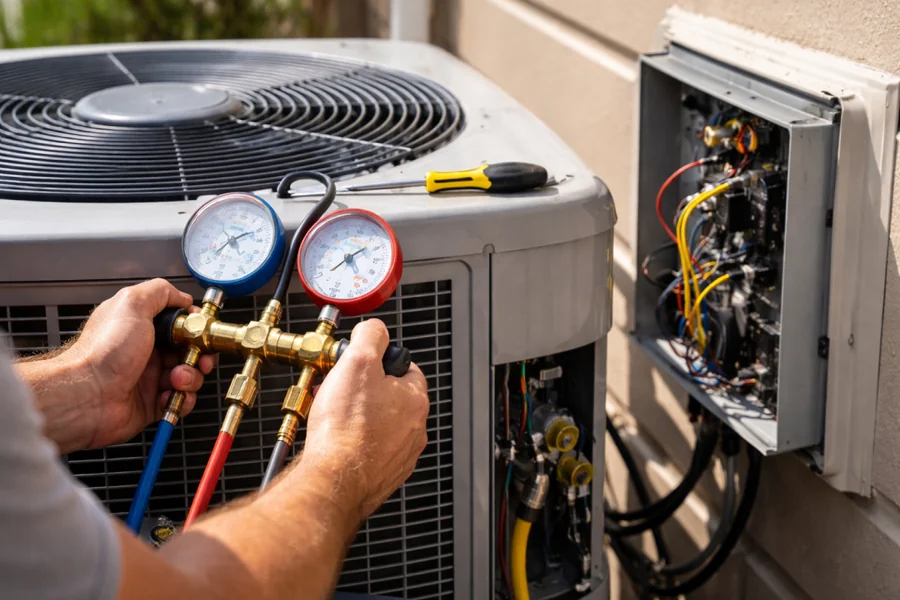
Your air conditioner cruised through April and May without a hiccup. Then July hit, and suddenly warm air is blowing from the vents while the thermometer outside reads 96 degrees. This is the most common service call pattern in Florida, and it is almost never bad luck. The system did not suddenly break. It got pushed past a limit that mild spring weather never tested.
Here is what actually happens inside your unit when the heat arrives, why the failure feels so sudden, and the specific things you can check before you pay for a service visit. You will save yourself a sweaty afternoon and maybe a repair bill.
What Changes When the Temperature Crosses 90
Your AC is not a fixed machine. It is a system with a capacity curve, and that curve depends on the temperature outside. When spring temps sit in the high 70s, your unit cools your home using maybe 60 percent of its capacity. The compressor cycles on briefly, removes the humidity, and shuts off. Everything runs cool, literally and figuratively.
When outdoor temps climb into the mid 90s, the same unit must run nearly continuously to hold 74 degrees inside. The Department of Energy explains that cooling systems lose efficiency as outdoor temperatures rise, which means the compressor works harder for less result. That constant running exposes weaknesses that short cycles never did. A capacitor that was already marginal overheats and fails. A refrigerant charge that was 10 percent low now cannot keep up.
The system does not break in July. It was already weak, and July is where weakness shows up.
Think of it like your car on a long interstate trip versus short errands. The errands never reveal a tired radiator fan. The 400 mile drive does.
The Spring Illusion: Why Short Cycles Hide Problems
Here is the sneaky part. During mild weather, your AC might run for 10 minutes and then rest for 20. That schedule masks almost every developing problem because nothing gets pushed to its limit.
Low refrigerant is the classic example. A slightly low charge still cools fine when the load is light. The evaporator coil gets a little warmer than it should, but not enough to freeze. You notice nothing. Then the summer load arrives. The coil temperature drops below freezing, the airflow stops, and you find ice on the lineset by noon. The system looks like it failed overnight. It actually failed slowly over three months while you were enjoying 78 degree spring days.
The EPA notes that refrigerant leaks are a leading cause of efficiency loss in older systems, and the loss compounds silently. The unit works fine until it does not.
The Real Failure Points When Heat Arrives
When a technician opens up a unit that “worked yesterday,” they find the same handful of culprits almost every time. Knowing these gives you a sharper eye when your own system starts struggling.
- Run capacitors. These small cylindrical parts give the compressor and fan motor their starting kick. Heat degrades them fast. A failing capacitor makes the compressor struggle to start, draw excess current, and eventually trip a thermal overload. This is the most common single failure in Florida summers.
- Dirty condenser coil. The outdoor coil rejects heat to the air outside. When it is coated in pollen, grass clippings, and dust, the heat has nowhere to go. The compressor runs hotter and longer, and high pressure builds. Many units shut down on a high pressure safety switch after years of operation.
- Aged contactors. These are the switches that send power to the compressor. Over years of cycling, the contacts pit and corrode. Under heavy summer loads, they arc, weld shut, or simply stop passing current. The result is a system that hums but the compressor never starts.
- Frozen evaporator coils. Usually caused by low refrigerant or restricted airflow, a frozen coil blocks all cooling. You hear the system running but feel nothing from the vents.
Every one of these failures is accelerated by the exact conditions of a Florida July: high ambient temperature, high humidity, and long run times.
What You Can Check Before You Call Someone
You do not need to be a technician to catch the early warnings. A 10 minute walk around your system can tell you a lot.
Start with the outdoor unit. Turn it off at the breaker first. Check the condenser coil fins for dirt and debris. If you can see a layer of grime, spray it gently with a garden hose from the inside out. This alone restores surprising amounts of cooling capacity.
Next, check the air filter inside. A clogged filter strangles airflow, which lowers cooling and can freeze the indoor coil. Swap it if it looks dirty. This is the cheapest maintenance you will ever do.
Then check the thermostat. Set it 5 degrees below the room temperature and see if the outdoor unit kicks on within a few minutes. If you hear a buzzing or clicking sound but the compressor does not start, that points to the capacitor or contactor. That is a part that needs a professional.
Finally, feel the air coming from your vents. It should be noticeably cooler than room temperature, around 15 to 20 degrees cooler. If it is barely cold, you likely have a refrigerant issue or a failing compressor, both of which require gauges and training to diagnose.
When to Repair and When to Replace
This is the decision that stumps most homeowners. A repair that costs a few hundred dollars feels reasonable, but if your system is old and the compressor is failing, you might be pouring money into a dying machine.
Use this basic test. Take the age of your system and add the estimated repair cost. If your unit is 12 years or older and the repair quote exceeds 30 percent of what a new system would cost, replacement usually makes more sense. The Florida Solar Energy Center advises that systems past their expected lifespan often fail again within a season, and the cumulative cost of repeated repairs quickly exceeds a new unit. A working system that is 15 years old has already lost efficiency every year it operated, so your electric bill is quietly punishing you anyway.
Conversely, if your system is under 8 years old and the problem is a capacitor or a contactor, repair it. Those are normal wear items, and a new unit would not prevent them from failing eventually. You would spend thousands to fix a hundred dollar part.
Your Summer Survival Plan
You cannot control the heat, but you can control how prepared your system is for it. Here is a plan that takes about an afternoon and costs almost nothing.
- Schedule a tune up in April or May. A technician will check refrigerant levels, clean the coils, and test the electrical components before summer loads arrive. This catches the capacitor before it fails, not after.
- Replace or clean your filter monthly from June through September. Florida summers generate more dust, pollen, and humidity, and your system runs longer, pulling more air through the filter.
- Clear 2 feet of clearance around the outdoor unit. Shrubs, storage bins, and patio furniture block airflow and force the system to work harder. Trim back anything that crept close during spring growth.
- Check the condensate drain line. Florida humidity means your AC removes gallons of water daily. If that drain clogs, water backs up, trips a float switch, and the system shuts down. Pour a cup of vinegar down the drain line monthly to keep it clear.
That last item trips up more homeowners than almost anything else. Your system just stops, and you assumed the worst, when the actual problem is a clogged drain line that you could have cleared in two minutes.
The Bottom Line
Your AC does not fail in the summer because summer broke it. It fails because the summer heat exposed a weakness that mild weather let you ignore. The fix is not luck. It is knowing what to check, when to check it, and when a problem is beyond your skill.
If your system is already struggling, do not wait for it to die completely. A few hundred dollars in preventative maintenance now beats an emergency ac repair middleburg call on the hottest day of the year, when every technician in town is booked solid and you are paying overtime rates.
Have you checked your air filter this month? That is the cheapest insurance policy you will ever buy for your cooling system.

Passionate about exploring diverse ideas and sharing inspiration, I curate content that sparks curiosity and encourages personal growth. Join me at ElementalNest.com for insights across a wide range of topics.