
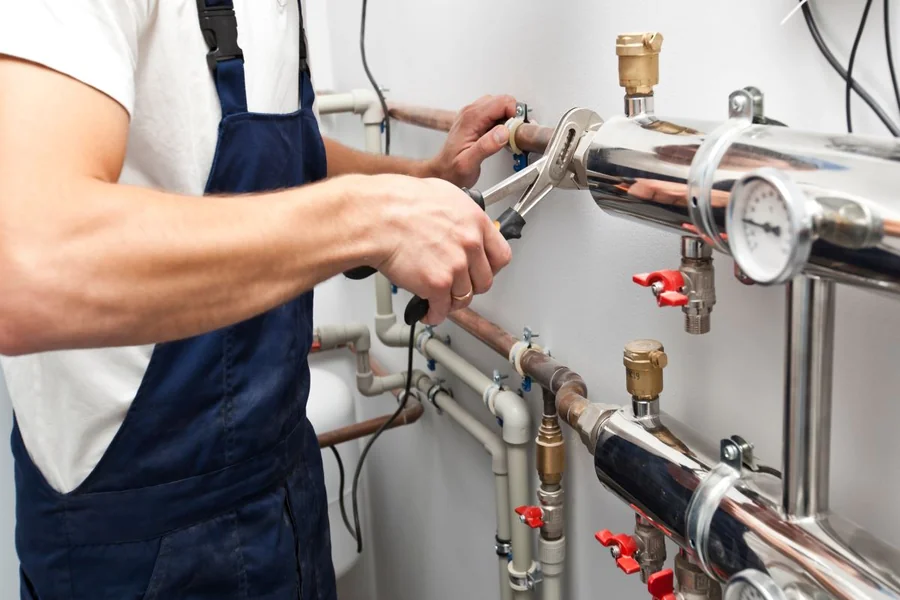
Your morning shower used to be powerful. Now it’s barely a trickle. You’ve replaced the showerhead twice, and nothing changed. That’s the thing about dropping water pressure — the fix you can see is almost never the actual problem.
Low pressure has a short list of real causes, and most of them are hiding inside your walls, your meter box, or your pipes. Getting the diagnosis right the first time saves you a lot of wasted weekends. Here’s what’s actually going on, and how to work through it systematically.
The FLOW Diagnostic: A Simple Way To Think About Pressure Problems
Before you pull any fixtures apart, it helps to think about a home’s water system in four layers. Call it the FLOW check: Fixtures, Lines (pipes), Outside supply, Water controls (valves and regulators). Every low-pressure complaint traces back to one of those four layers. Run through them in order, starting at the fixture and moving out toward the street. Nine times out of ten, you’ll find the culprit before you reach the last layer.
This matters because homeowners typically start at the fixture and stop there, replacing aerators and showerheads indefinitely. Meanwhile the actual failure is in the supply line two rooms over.
Clogged Aerators and Showerheads: The Easy One First
Mineral deposits collect inside aerators and showerhead spray jets faster than most people expect. If only one fixture in your home has weak pressure, start here. Unscrew the aerator from the faucet tip, drop it in white vinegar overnight, and rinse it in the morning. If pressure returns, you’ve solved it in under twelve hours for about fifty cents.
The trickier version is a showerhead clogged from the inside. Spray jets are small, and mineral-rich water leaves deposits that seal them shut one by one. A showerhead that once had 40 spray holes might be down to 15 functional ones within a year. Soak it in vinegar, or replace it if the deposits have hardened past the point of dissolving.
If cleaning the fixture makes no difference, you’re dealing with something further upstream.
Pipe Buildup: The Slow, Invisible Culprit
Mineral scale inside supply pipes is the most common cause of whole-house pressure loss that develops gradually over years. Calcium and magnesium deposits cling to pipe walls with every pass of water, narrowing the interior diameter until pressure at every fixture drops noticeably.
This happens even in areas where the water isn’t classified as extremely hard. According to the U.S. EPA’s WaterSense program, the average family wastes 180 gallons per week — or 9,400 gallons of water annually — from household leaks alone. Add mineral restriction to that and your actual delivered pressure can fall well below what the municipal supply is pushing.
Galvanized steel pipes, common in homes built before 1980, are the worst offenders. Their rough interiors trap scale aggressively. Copper fares better but still accumulates deposits at joints and bends where flow naturally slows. PEX pipe resists buildup the best of the three, but it’s rarely found in houses more than twenty years old.
If your home is older and you’ve never had a pipe inspection, that’s your next call.
Partially Closed Shutoff Valves: The Fix That Takes Thirty Seconds
This is the one most people never think to check. Every home has at least two main shutoff valves: one at the meter and one where the supply line enters the house. If either was partially closed after a repair — even slightly — pressure drops throughout the whole system.
Walk to your main shutoff valve and make sure it’s fully open. On a gate valve (the wheel-style ones), fully open means turned counterclockwise until it stops. On a ball valve, the handle runs parallel to the pipe. A valve sitting at a slight angle from parallel is restricting your flow. Turn it. Check your pressure. That’s it.
Individual fixture valves under sinks and behind toilets can also creep to a partial position over time, especially after anyone has worked under a sink and bumped them. Check those if only one room has the problem.
A Failing Pressure Regulator
Not every home has one, but if yours does and it starts to fail, pressure can swing dramatically or drop to almost nothing. Pressure regulators are brass bell-shaped devices installed near where the main line enters the house. These devices typically last 10 to 15 years before needing replacement, and a failing regulator often causes pressure fluctuations where water flow varies dramatically between uses or produces consistent low pressure throughout the home.
Testing it requires a water pressure gauge threaded onto an outdoor hose bib. A healthy reading sits between 45 and 60 PSI. Anything under 40 PSI and you’re in low-pressure territory. If your gauge shows 30 PSI or less with the regulator in the circuit, replacing that regulator is almost certainly the answer.
Regulator replacement is not a weekend DIY project for most homeowners. It involves cutting into the supply line, soldering or crimping new fittings, and setting the correct outgoing pressure. A professional gets it done in an hour or two and sets it accurately.
Hidden Leaks Inside Walls and Under Slabs
A leak you can’t see bleeds pressure silently. Water diverts out of a crack or corroded joint before it ever reaches your fixtures, and the result is a slow, steady decline in flow that feels identical to pipe buildup until you actually inspect.
The fastest way to test for a hidden leak costs nothing. Turn off every water-using fixture and appliance in the house, then go check your water meter. Write down the reading. Don’t use any water for two hours. Check the meter again. If the number moved, water is going somewhere it shouldn’t.
Slab leaks are the most serious version. Water escaping beneath a concrete foundation can run for weeks before a homeowner notices wet flooring, a warm spot underfoot, or a water bill that suddenly doubled. The EPA notes that the average household’s leaks can account for more than 9,300 gallons of water wasted every year, and nine percent of homes have leaks that waste 50 gallons or more per day. A slab leak at the high end of that range will eat through your water budget fast and cause structural damage if ignored.
Slab leak detection and repair requires specialized equipment: electronic listening devices, thermal cameras, and in some cases ground-penetrating radar. It’s not a job for guesswork.
Municipal Supply Problems: The One You Can’t Fix Yourself
Sometimes the pressure issue has nothing to do with your home. If every neighbor on your block is running water at the same hour — or a main break is being repaired nearby — your municipal supply pressure can drop temporarily. Call your water utility and ask if there are known issues in your service area before you start pulling pipes apart.
This is especially worth checking in communities where aging infrastructure hasn’t kept pace with growth. Hawaii is notable in this context: while the state has one of the lowest hard-water averages nationally, Maui carries the highest water hardness in the state at 110 parts per million, drawing from the Iao Aquifer in the West Maui Mountains and wells in the area. That mineral load, while modest by mainland standards, is enough to accumulate scale in pipes and fixtures over a decade of steady use.
For homeowners in communities like Paia on Maui’s north shore, a combination of aging supply infrastructure and moderate mineral content means pipe inspections every few years are genuinely worthwhile. Calling a plumber in Paia to run a camera inspection through your supply and drain lines gives you a documented baseline instead of a guess.
Your Pressure Troubleshooting Checklist
| Step | What To Check | DIY or Pro?
|
|---|---|---|
| 1 | Clean aerators and showerheads with vinegar | DIY |
| 2 | Confirm all shutoff valves are fully open | DIY |
| 3 | Run the meter test for hidden leaks (2-hour window) | DIY |
| 4 | Test pressure at an outdoor bib with a gauge | DIY |
| 5 | Call the utility for supply-side alerts | DIY |
| 6 | Pipe inspection, regulator replacement, slab leak detection | Pro required |
“Some leaks are sneaky and difficult to detect, especially toilet leaks. We encourage customers to monitor water use on their bills and watch for unexplained changes. When something is off, it’s time to look for leaks.” — Susan Sampson, Communications Manager at Lehigh County Authority, speaking on EPA Fix a Leak Week guidance
When To Stop Troubleshooting and Call Someone
Run through steps one through five on your own. If none of them resolve the problem, or if the meter test confirmed a leak you can’t locate, stop there. Chasing a slab leak or a failing regulator without the right tools wastes time and can make the underlying damage worse. A pipe inspection from a licensed plumber takes under an hour and gives you a concrete answer rather than a theory.
Pressure problems rarely fix themselves. The longer a restricted pipe or a slow slab leak runs, the more it costs to repair. Catching it at the right moment is the whole game.

Passionate about exploring diverse ideas and sharing inspiration, I curate content that sparks curiosity and encourages personal growth. Join me at ElementalNest.com for insights across a wide range of topics.