
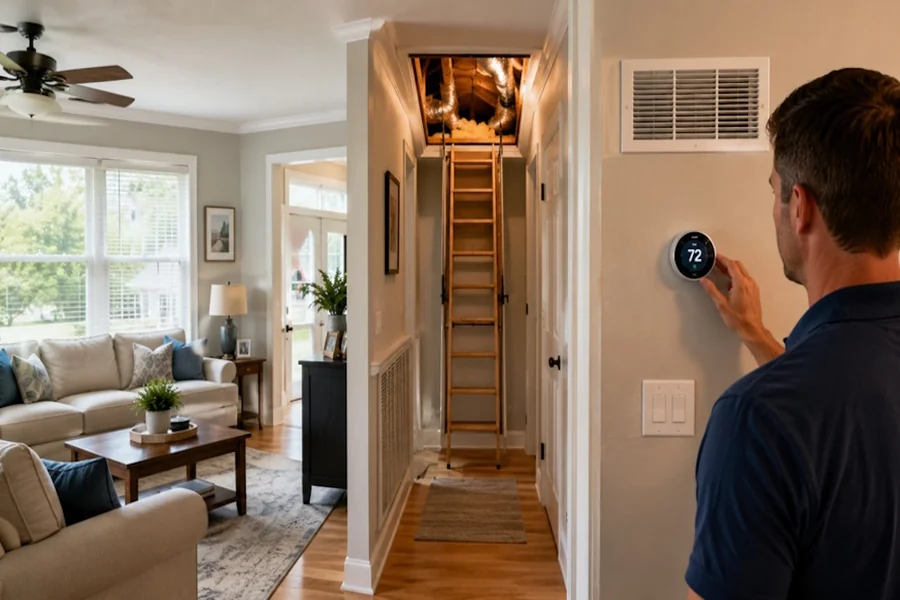
After years of looking through homes around Johns Creek, I’ve noticed a recurring pattern: when energy bills climb, homeowners often look at the most obvious solutions first. They consider replacing the windows, installing a smart thermostat, or buying a newer HVAC system.
Those upgrades can certainly help, but they are not always where I would start.
In many homes, the bigger problems are less visible. Insulation may be thin or uneven in the attic. Ductwork in a crawl space may be leaking conditioned air. An HVAC system may need maintenance, or an older appliance may be running harder than it should.
Before investing in a major upgrade, it makes sense to find out where your home is actually losing energy.
Key Takeaways
- Johns Creek’s long, humid summers make cooling efficiency especially important.
- Check attic insulation and air leakage before assuming you need new windows.
- Leaky ductwork can waste conditioned air before it reaches your living spaces.
- A smart thermostat works best when the home’s basic efficiency problems have already been addressed.
- Appliances that run excessively can contribute to higher electricity use.
- An energy assessment can uncover problems that are easy to miss during a normal walkthrough.
Why Johns Creek Homes Can Lose Energy in Unexpected Places
Windows tend to get the most attention when homeowners think about energy loss. In my experience, they are not always the first place worth spending money.
Johns Creek has long, humid summers, so your air conditioner has two jobs: lowering the indoor temperature and removing moisture from the air. If conditioned air is escaping through gaps in the home’s envelope or through leaky ductwork, the system may have to run longer to maintain a comfortable indoor environment.
The attic and crawl space are particularly important because problems in these areas are easy to overlook. You may never notice missing insulation or a poorly sealed duct while walking through your living room, but your HVAC system can still be affected by them.
That is why I usually start with the basics: insulation, air sealing, ductwork, and equipment condition.
1. Check Attic Insulation Before Replacing Windows
If an older Johns Creek home has unusually high cooling costs, I would look at the attic before assuming the windows are responsible.
Insulation can settle over time, leaving some areas thinner than others. You may also find sections where insulation is missing altogether. Even small gaps can matter when they occur across a large attic floor.
Take a look if your attic is safely accessible. Uneven coverage, exposed areas of attic floor, and noticeably thin insulation are all reasons to have the space evaluated.
Adding insulation may be a relatively simple improvement compared with replacing windows throughout an entire house. However, the right solution depends on what is already in place and whether air leakage or other issues are contributing to the home’s energy loss.
Insulation also should not be viewed in isolation. If air is moving through gaps around penetrations, fixtures, or other parts of the building envelope, sealing those areas may be an important part of the job.
2. Check for Leaky Ductwork in Crawl Spaces
Ductwork is another place where a home can lose conditioned air without the problem being obvious from inside the house.
Many Johns Creek homes have ducts running through crawl spaces. Over time, connections can loosen, sections can become damaged, or existing seals can deteriorate. When that happens, some of the air your HVAC system has already cooled may never reach the rooms that need it.
Uneven temperatures can be one clue. If one bedroom consistently feels warmer than the rest of the house, or your HVAC system seems to run for unusually long periods, the ductwork is worth checking.
Look for visibly damaged or disconnected ducts in any accessible area, but leave repairs to a qualified professional when the ductwork is difficult to access.
For sealing, proper duct mastic or another appropriate professional sealing method is preferable to ordinary household tape.
3. Fix the Home’s Efficiency Problems Before Upgrading the Thermostat
Smart thermostats can be useful. They make scheduling easier and can help you manage your heating and cooling habits.
But they cannot fix an inefficient home.
If your attic is poorly insulated, conditioned air is escaping through leaky ducts, or the HVAC system itself needs attention, installing a smart thermostat will not solve the underlying problem.
Think of the thermostat as a control tool rather than a cure-all. Get the basics in reasonable shape first. Once the home is properly insulated and sealed, and the HVAC system is operating as it should, a smart thermostat can help you manage it more effectively.
4. Don’t Overlook Aging Appliances
Your HVAC system isn’t the only equipment affecting your electricity use.
Refrigerators, freezers, dishwashers, dryers, and other appliances can become less efficient when they are poorly maintained or begin developing mechanical problems. If an appliance is running excessively or behaving differently than normal, getting the problem diagnosed can help you decide whether a repair or replacement makes more sense. For homeowners looking for reliable appliance repair in Johns Creek, professional service can also help identify problems that aren’t obvious during a basic inspection.
One simple thing to check is the condition of the condenser coils. Dust and pet hair can build up around them, making it harder for the refrigerator to release heat. A dirty coil does not automatically mean the appliance needs to be replaced.
Other warning signs include an appliance that is unusually warm, operating almost continuously, or behaving differently from normal.
If you’re unsure whether an appliance needs a simple repair or should be replaced, an appliance repair company, such as Appliance EMT, can help diagnose the problem and determine the most practical next step.
Start with basic maintenance and have a problem evaluated before assuming replacement is your only option. On the other hand, an older appliance with a significant mechanical issue may eventually cost more to keep operating than it is worth.
How Johns Creek’s Climate Affects Energy Use
The local climate is one reason cooling deserves particular attention in Johns Creek.
During the summer, your air conditioner removes both heat and moisture from the indoor air. A home with air leaks, insufficient insulation, or poorly sealed ductwork can put additional demands on the cooling system.
During the summer, your air conditioner removes both heat and moisture from the indoor air. A home with air leaks, insufficient insulation, or poorly sealed ductwork can put additional demands on the cooling system.
Outdoor maintenance matters, too. Pollen and other debris can collect around an outdoor HVAC condenser during spring and early summer. Keeping the area around the unit clear allows air to move freely through the equipment.
Home age is another factor, but it doesn’t tell the whole story.
Johns Creek has homes from different construction periods, including neighborhoods such as St. Marlo, Seven Oaks, and Rivermont. Two houses of similar age can have very different energy-efficiency profiles depending on previous renovations, insulation work, HVAC replacements, and maintenance.
In other words, don’t assume your home’s efficiency based solely on its age or neighborhood. Look at the house itself.
What I Would Check Before Spending Money on Upgrades
The biggest mistake is often choosing the most visible solution instead of finding the underlying problem.
If your electricity bill is high, replacing the windows may seem like an obvious answer. If your HVAC system runs constantly, a smart thermostat may seem like the next logical purchase.
Neither is necessarily wrong. The question is whether either one addresses the reason your energy use increased in the first place.
If I were prioritizing an efficiency check, I’d work through the house in this order:
- Look for obvious air leaks and insulation deficiencies.
- Check accessible ductwork for damage or disconnected sections.
- Make sure the HVAC system is receiving appropriate maintenance.
- Check appliances that seem to be running excessively.
- Consider smart controls and larger efficiency upgrades after the basics have been addressed.
Your utility bill can provide another useful clue. If electricity use suddenly increases without a major change in how your household operates, don’t automatically assume the increase is normal.
A struggling appliance, an HVAC problem, a duct leak, or a change in thermostat settings could be contributing to the difference.
When Should You Schedule an Energy Efficiency Check?
Early spring is a convenient time for Johns Creek homeowners to evaluate their home’s efficiency.
Checking the house in March or April gives you an opportunity to identify problems before the summer cooling season puts your HVAC system under heavier demand. It also gives you time to address issues before several months of higher utility bills add up.
But there is no reason to wait for spring if you are already seeing warning signs.
If your electricity bill has increased unexpectedly, some rooms are consistently warmer than others, or your HVAC system is running much more often than usual, an evaluation can be worthwhile at any time of year.
Frequently Asked Questions
How much can attic insulation save on a Johns Creek utility bill?
There isn’t a single savings figure that applies to every home. The potential improvement depends on the home’s existing insulation, air leakage, HVAC efficiency, size, and household energy use.
A home with significant insulation deficiencies has more room for improvement than one that is already well insulated.
Is a professional energy assessment worth it for a smaller home?
It can be, particularly if you have noticed high utility bills or comfort problems but cannot identify the cause.
An assessment may uncover issues that are difficult to spot during a normal walkthrough, including insulation deficiencies, duct leakage, or problems with airflow and returns.
The purpose should be to identify and prioritize worthwhile improvements, not to guarantee a specific amount of savings.
Can an old refrigerator really affect my whole-home energy bill?
Yes. An appliance that runs excessively because of dirty condenser coils, a damaged door seal, or a mechanical problem can use more electricity than it should.
If a refrigerator or another appliance is running almost continuously or behaving differently than usual, have the problem evaluated before deciding to replace it.
What’s the best time of year to check a Johns Creek home for energy-efficiency problems?
Early spring, particularly March or April, is a practical time because it gives you an opportunity to address problems before the peak summer cooling season.
However, unusual utility bills or HVAC problems are reasons to investigate regardless of the season.
Do smart thermostats work well with Georgia’s humidity?
They can, but the thermostat is only one part of the equation.
Indoor comfort depends on more than temperature. HVAC operation, airflow, and the system’s ability to manage moisture also matter.
A smart thermostat is most useful when the HVAC system and the home’s insulation and air sealing are already in good condition.
Where to Start With Home Energy Efficiency
Improving your Johns Creek home’s energy efficiency doesn’t necessarily require an expensive upgrade.
Before replacing windows or investing in new technology, look at the less visible parts of the house. Check the attic insulation, look for air leakage, have the ductwork evaluated, keep the HVAC system maintained, and pay attention to appliances that aren’t operating normally.
Once those basics are addressed, upgrades such as smart thermostats can make more sense.
The most useful first step is figuring out where your home is actually losing energy. Once you know the problem, you can put your money toward the improvements that are most likely to make the house more comfortable and reduce unnecessary energy use.

Passionate about exploring diverse ideas and sharing inspiration, I curate content that sparks curiosity and encourages personal growth. Join me at ElementalNest.com for insights across a wide range of topics.