
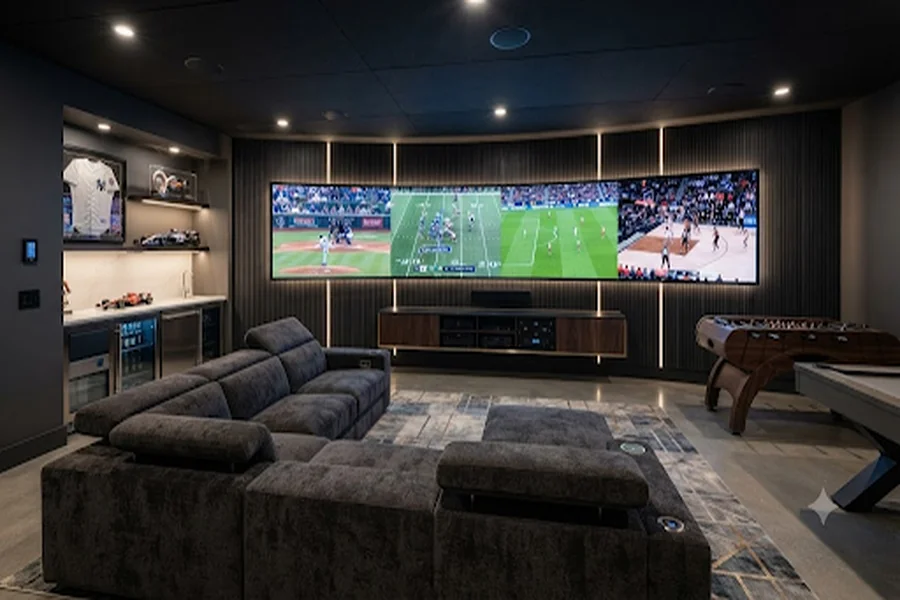
We look down the barrel of a monstrous 2026 sports calendar. Super Bowl LX, a sprawling FIFA World Cup, and a brutal Major League Baseball marathon all demand a proper viewing environment. Frankly, the days of throwing a mismatched sectional into an unfinished basement are entirely dead. Today’s luxury sports den operates as a highly engineered sanctuary where aesthetic restraint meets brutal technological performance. The objective is no longer just mounting a television on drywall; it involves architecting a space that handles high-decibel excitement while looking like an elite hospitality suite.
Curating the Visual Gallery
Spatial zoning dictates how this room breathes. You need distinct areas for intense viewing, casual gaming, and self-contained hospitality. High-end designers toss out chaotic poster walls in favor of curated museum aesthetics. Vintage jerseys now sit behind UV-protective, anti-reflective conservation glass, hit perfectly with high-CRI accent lighting. Forget about cherry red team colors or blinding white trim. We see a massive shift toward hyper-matte, ultra-dark environments. Charcoal, bruised taupe, and absolute black absorb light like a black hole, with maybe a hit of knurled brass on the hardware just to remind guests they aren’t in a bunker. You paint the room this way for optical survival, honestly. Light bounce ruins contrast ratios faster than anything else, and a matte wall physically stops rogue glare from murdering the shadows on your main screen. Walk away from the primary seating ring, and the real flex happens. A ridiculous fifty-thousand-dollar Giorgetti foosball table or a stealth wet bar with medical-grade wine preservation sets an immediate, ruthless standard for the hospitality zones.
The Acoustic Math Nobody Wants to Do
Most homeowners blow fifty grand on video hardware and completely ignore the physics of sound. The reality is that hard surfaces—concrete floors, glass garage partitions, and high-gloss wood paneling—violently degrade broadcast audio. Commentator dialogue turns to an unintelligible mess due to temporal masking when reverberation times spiral out of control. Acousticians measure this energy decay as RT60. Your target for a dynamic sports room sits narrowly between 0.4 and 0.8 seconds. Drop the acoustic decay any lower, and the space feels like a suffocating vocal booth. Let it climb higher, and a roaring stadium crowd becomes a fatiguing, metallic screech.
The solution to this structural flaw requires broadband acoustic absorption, but nobody wants their luxury den looking like a padded recording studio. Industry integrators solve this exact problem with acoustic wood slat panels. You mount these PET felt-backed walnut or smoked larch structures directly behind the primary display array. The porous felt aggressively absorbs mid-range dialogue frequencies to preserve the C50 clarity index. Meanwhile, the convex wooden slats act as one-dimensional diffusers. Sound energy scatters evenly across the room, keeping the ambient crowd noise lively without harsh flutter echoes bouncing off the back wall.
Endurance Ergonomics for the 162-Game Grind
The physical toll of spectator sports is vastly underestimated by amateur designers. You will be sitting in these chairs for three to four hours at a time, multiple days a week. For a baseball fan obsessively tracking shifting World Series odds from Spring Training deep into the October playoffs, endurance ergonomics are critical. Stadium-style tiered platforms with sleek recliners prove highly efficient for deep, narrow rooms. Massive modular sectionals work far better if your space requires a communal, lounge-like layout to accommodate large viewing parties.
Surviving Spills Through Molecular Engineering
The catch? Game day hospitality inevitably involves a hazardous volume of food and spilled beverages. Historically, you had to choose between delicate luxury velvets that stain instantly or synthetic materials that felt like plastic tarps. Molecular engineering eliminates that aesthetic compromise entirely. Performance textiles like Crypton undergo a patented liquid immersion process during manufacturing, which fundamentally alters the fiber structure. Spills bead up instantly on the surface rather than soaking into the cushion. Proprietary EPA-approved antimicrobial technology simultaneously neutralizes odor-causing bacteria before it can embed into the furniture. You get the plush, sophisticated hand-feel of a high-end mohair, but the fabric remains practically bulletproof against a dropped plate of stadium food.
Lumens, Glare, and the MicroLED Reality
Light is the enemy of visual contrast. When you select a primary video display, the ambient light conditions of your specific room dictate the panel technology. QD-OLED panels utilize self-emissive pixels that can turn completely off to generate absolute black. They operate as the undisputed kings of light-controlled, subterranean rooms. Let’s be real, though; many modern fan caves feature massive glass sliding doors or heavy overhead bar lighting. If you plan on watching daytime college football in a sunlit room, a 100-inch Mini LED panel pushes massive luminous output to punch through that glare. Look closer at the apex of the market, however, and the true flex for billionaires is modular direct-view MicroLED. Systems like Samsung’s The Wall deliver the infinite contrast of OLED paired with blinding brightness, scaling to massive custom dimensions without bezels.
AV-Over-IP and Spatial Audio Mastery
Broadcast cameras now capture high-dynamic-range feeds using the Rec. 2020 color space, which covers an absurd 75.8% of the visible color spectrum. Your display needs to physically reproduce those exact mathematical wavelengths—specifically the 630nm red and 532nm green—to show you what the camera lens sees on the field. A single screen is rarely enough for a serious viewer tracking multiple fantasy leagues. Amateur setups rely on television software apps to split the screen, introducing bandwidth latency and shrinking the score ticker beyond readability. Standard HDMI matrix switches handle multi-screen routing in small setups, but they fail catastrophically over long distances in sprawling luxury homes. The insider move utilizes enterprise-grade AV-over-IP networks. High-end integrators run uncompressed 4K video over dedicated fiber optic lines, allowing pristine, instant routing to any display on the property.
Audio processing has evolved equally fast, moving far past static left-and-right channels. The Dolby Atmos protocol treats individual sounds as independent three-dimensional objects, requiring a data pipeline that legacy equipment simply cannot support. HDMI eARC connections are strictly non-negotiable for this tier of audio. Standard ARC ports strip away metadata, leaving you with compressed, lossy surround sound. The enhanced eARC pipeline delivers full-bandwidth, lossless audio to your receiver or a flagship spatial soundbar. Systems like the Sony BRAVIA Theatre Bar 9 analyze your room’s acoustic signature and bounce test tones off the ceiling to synthesize phantom height channels, placing you directly inside the stadium’s acoustic bubble.
The Death of Wi-Fi Switches
None of this heavy iron matters if you must juggle five plastic remotes to turn it all on. Most homeowners try to automate their rooms with cheap 2.4 GHz Wi-Fi switches, which immediately drop offline the moment a network gets congested. Professional integrators strictly deploy proprietary RF ecosystems like Lutron Caseta. Lutron’s Clear Connect protocol operates down on the ultra-reliable 434 MHz band, completely ignoring your crowded Wi-Fi router. We can also layer in active bias lighting, using a Govee AI Sync Box to extend the on-screen colors directly onto the back wall, artificially boosting the perceived contrast of the display.
This rock-solid stability allows for complex, instantaneous environmental macros. You press a single keypad button engraved with “GAME DAY” and watch the room transform. The ambient overhead lights dim to fifteen percent to kill screen glare instantly. Smart blackout shades descend over the windows to block afternoon sunlight. The HVAC system preemptively drops the room temperature by two degrees to counteract the body heat of your incoming guests. The AV-over-IP network simultaneously routes the primary uncompressed video feed to the main display while throwing auxiliary games to the flanking screens.
No Compromises on the Final Whistle
This level of seamless, invisible orchestration separates a slapped-together basement from a legitimate luxury venue. Every individual element—from the molecular structure of the sofa upholstery to the fiber optic cables driving the displays—must operate in total alignment. The upcoming season will quickly expose the weaknesses of any room built on aesthetic compromises or consumer-grade network gear. Anchor the space in the rigorous physics of light and sound, and the resulting environment easily outlasts any single championship run.

Passionate about exploring diverse ideas and sharing inspiration, I curate content that sparks curiosity and encourages personal growth. Join me at ElementalNest.com for insights across a wide range of topics.