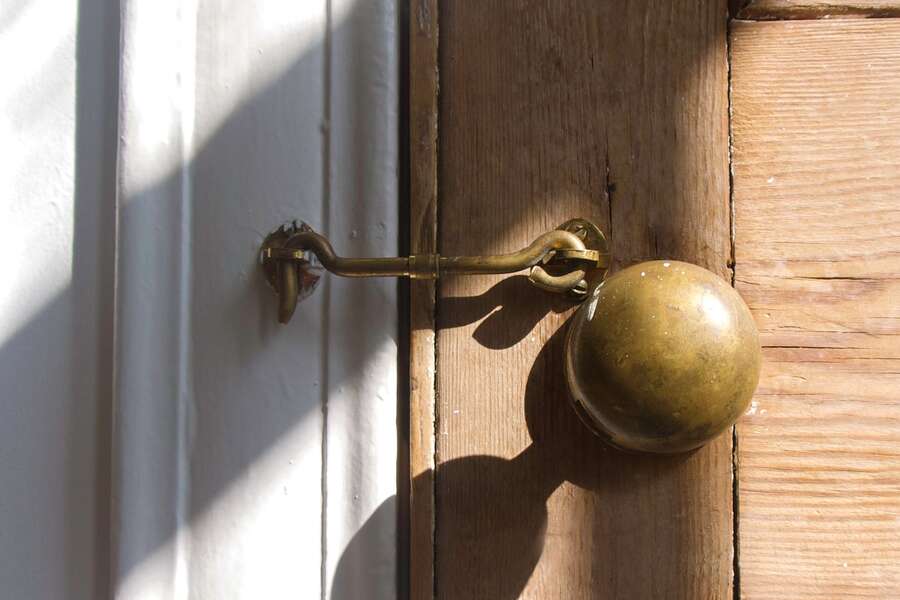
Walk through Laurelhurst, Irvington or Sellwood and the front doors tell the story of the houses behind them. Heavy fir or oak slabs, beveled glass, a brass or bronze plate with a thumb latch above and a keyhole below, and a doorknob worn smooth by a century of hands. The lock inside that door is a mortise lock, a rectangular box set into a pocket cut in the door’s edge, and in many Portland bungalows it is still the original.

New owners face the same decision in their first month: keep the hardware that gives the door its character, or replace it with something that actually secures the house. The answer, in most cases, is that they do not have to choose. Here is how the three options compare, and which one suits which door.
What a mortise lock is, and why it is worth keeping
A mortise lock combines the latch and the deadbolt in one case, operated by the knob and a key or thumbturn, with the whole mechanism protected inside the door rather than bored through it. Well-made examples from the 1900s through the 1930s were built of brass and steel to tolerances that modern budget hardware does not match, and a century later many still work. The trim plates, knobs and escutcheons on the face of the door are often solid bronze or brass that has developed a finish no new product reproduces.
The weaknesses are predictable: worn springs that let the latch sag, a deadbolt with a short throw, a cylinder with a simple keyway that any hardware store can copy, and a strike plate held by short screws into old fir. All four are fixable.
Option one: restore and rekey
For a lock case that still functions, restoration means disassembling the case, cleaning and lubricating the mechanism, replacing broken springs, and fitting a new cylinder in the existing hole, keyed to the household’s new key. The exterior trim stays exactly as it is. A Portland, OR locksmith who works on older homes can usually do this in a single visit, and the result is the original door with hardware that a stranger’s key no longer opens.
The upgrade to make at the same time is the cylinder itself. A modern high-security cylinder in the mortise case resists unauthorized duplication, which matters in a house where keys have circulated for a hundred years.
Option two: replace the case, keep the face
When the case is broken beyond repair or the deadbolt throw is too short to matter, a new mortise lock body can often be fitted into the existing pocket with minor adjustment, behind the original knobs and plates. The door looks the same from the sidewalk and carries a current-grade lock inside. This is the path for a door whose trim is the point and whose mechanism is not.
Option three: replace the whole set
Some doors arrived at the present with mismatched or damaged hardware, or a previous owner already bored the door for a cylindrical lock. Here a full replacement makes sense, and the choice is between a reproduction mortise set in a period style or a modern deadbolt and handleset. Reproductions preserve the look; modern sets are easier to source parts for later. Either way, a solid door and a reinforced strike are what the security actually rests on.
The checklist for any of the three
- Replace the strike plate screws with three-inch screws that reach the framing
- Make sure the deadbolt throws a full inch into the strike
- Add a door viewer or camera doorbell that does not require cutting the original glass
- Rekey or replace the cylinder so old keys are retired
- Check the back door and the basement door, which often got cheaper hardware a century ago too
Portland specifics
Rain and a century of paint are the two local enemies. Swollen doors bind and leave bolts half-seated in November, and layers of paint over the trim plates and the strike make even a restored lock feel stiff. A locksmith will adjust the strike for the wet season and free the hardware without stripping the finish. Wet weather is a common reason doors and windows start misbehaving as the seasons change. If a key breaks or a restored lock seizes in the meantime, the call goes the same way as any lockout, as described in this account of what really happens during an emergency locksmith call in Portland.
Firms such as Locksmith Near You handle both the planned restoration and the unplanned lockout across the city’s older neighborhoods.
Quick answers
Can an original mortise lock be rekeyed? Yes; the cylinder is replaced or re-pinned, and the rest of the lock and trim stays.
Is a 1910s lock secure enough? The case can be, once restored with a long-throw bolt and a quality cylinder; the strike plate and door frame matter as much as the lock.
Should I keep the skeleton key lock on interior doors? Interior mortise locks with skeleton keys are charming and harmless; the exterior doors are where the upgrade belongs.
Locksmith Near You
Portland, OR
Phone: 971-257-4730
Website: locksmithnearyouor.com

Passionate about exploring diverse ideas and sharing inspiration, I curate content that sparks curiosity and encourages personal growth. Join me at ElementalNest.com for insights across a wide range of topics.