
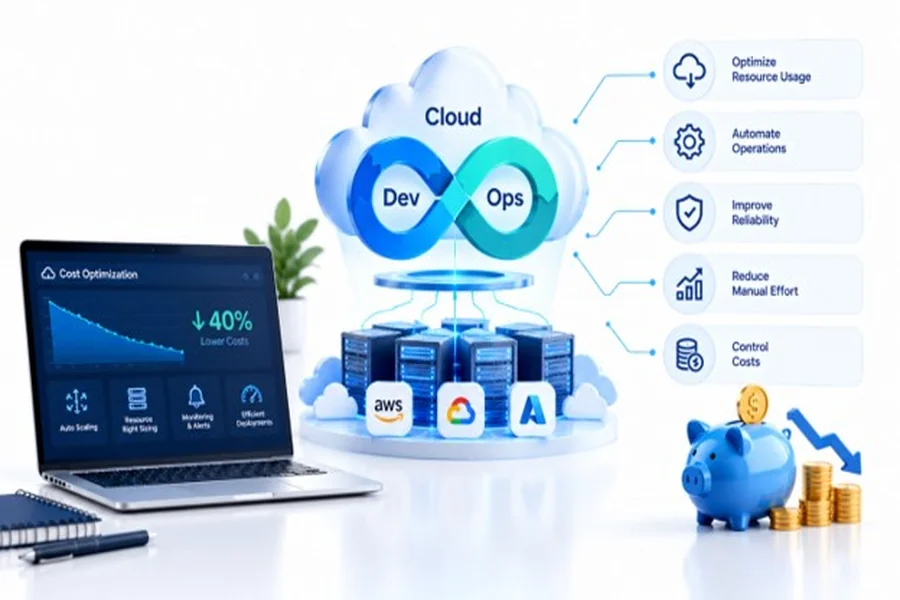
The cloud was supposed to save money. For a lot of teams, it does the opposite. The bill creeps up every month, and nobody can say exactly why. This is the quiet problem good cloud devops services are built to solve. They keep the spend honest while the system keeps growing.
And the pain is real. A single forgotten server can cost more than a salary over a year. Scale that across a messy setup, and the waste adds up fast. Most teams only notice when finance starts asking hard questions about the monthly bill.
What cloud devops services actually do
The short version is simple. They run your software on the cloud in a way that is fast, safe, and affordable. The skill is in keeping all three true at once.
Good cloud devops services automate the boring parts and watch the expensive ones. Deploys happen on their own. Idle resources get shut off. Nothing runs at full size when half size would do.
Where the savings come from
- Infrastructure written as code, so you only run what you actually need.
- Auto-scaling, so you pay for load you have, not load you might get.
- Monitoring that flags waste and trouble before the bill does.
- Automated deploys, so engineers build instead of babysit servers.
Cost is only half the story
Cheap is easy if you do not care whether things work. The hard part is cheap and reliable at the same time.
A strong setup gets both. The same pipeline that trims waste also catches a bad deploy and rolls it back. The same monitoring that spots an idle server spots a failing one. You save money and sleep better. That is the real win.
Why data engineering for AI raises the stakes
Now add AI to the mix, and the cost story gets sharper. AI workloads are hungry. Training a model eats compute. Serving it eats more. And the data pipelines behind it run around the clock.
This is where data engineering for ai meets cloud discipline. It builds the pipelines that feed your models, and those pipelines can burn cash if nobody is watching. Right-sized compute and smart storage keep the spend sane.
So the two go hand in hand. Careful data engineering for ai builds the fuel line, and cloud devops keeps it from leaking money. Skip either, and your AI bill balloons while the results stay flat.
Where the money leaks
Most cloud waste is not dramatic. It is small and constant, which makes it easy to miss.
- Oversized servers running at ten percent load, billed at full price.
- Test environments left on over the weekend, every weekend.
- Data pipelines reprocessing the same records again and again.
- No alerts on spend, so a spike only shows up at invoice time.
None of these are hard to fix once you see them. The trouble is that nobody is looking. A good partner makes looking automatic, so the waste gets caught the day it starts, not the day the invoice lands.
How to choose the right partner
The partner you pick decides whether the cloud saves you money or drains it. A few signals help.
- They treat cost as a first-class metric, not an afterthought.
- They automate scaling, so you never pay for idle capacity.
- They understand AI workloads, including the data side.
- They can show real numbers, like a bill they cut for someone else.
A partner who talks about your invoice as readily as your uptime is the one worth hiring. The rest will happily run up both.
Frequently asked questions
What are cloud devops services?
They run your software on the cloud in a way that is fast, safe, and cost-aware. That covers automated deploys, auto-scaling, monitoring, and infrastructure as code.
How do cloud devops services cut costs?
By running only what you need, when you need it. Auto-scaling, shut-down of idle resources, and spend alerts all trim the bill without hurting reliability.
Why does AI make cloud costs harder?
AI workloads are compute-heavy, and the pipelines behind them run constantly. Good data pipelines, paired with cloud discipline, keep that spend under control.
Can we save money without losing reliability?
Yes. The same automation that trims waste also catches bad deploys and failing servers. Cheap and reliable are not at odds when the setup is right.
How do we start without a big project?
Begin with monitoring and spend alerts on one system. Add auto-scaling where it helps most. Prove the savings, then expand.
The bottom line
The cloud only saves money when someone is minding it. Left alone, it quietly bleeds. Strong cloud devops services keep the spend honest and the system steady at the same time. And once AI enters the picture, with its heavy data pipelines, that discipline matters even more. Watch the cost, automate the scaling, and the cloud finally does what it promised.

Passionate about exploring diverse ideas and sharing inspiration, I curate content that sparks curiosity and encourages personal growth. Join me at ElementalNest.com for insights across a wide range of topics.