
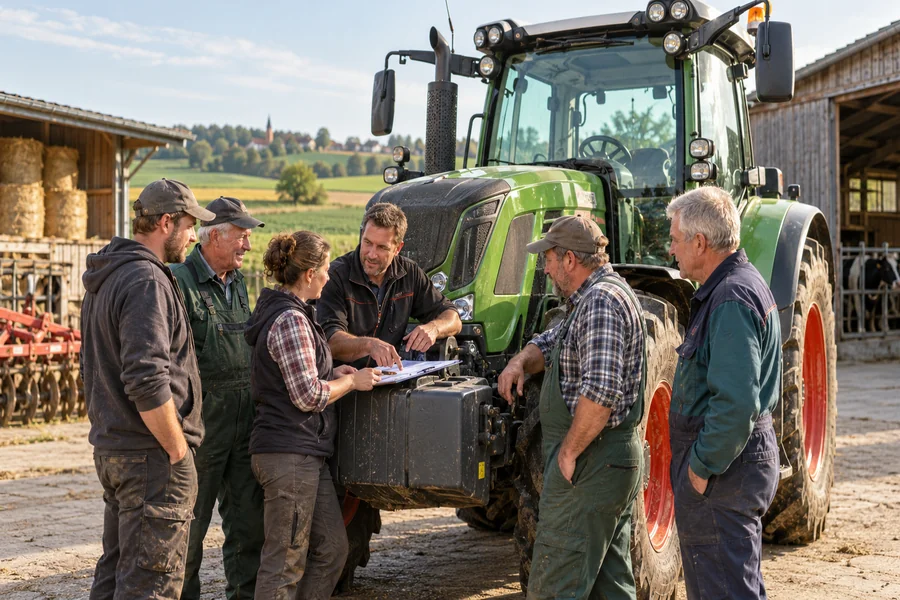
Modern agriculture depends on machinery, but purchasing a tractor can be a major financial commitment for small and medium-sized farmers. Many agricultural businesses need tractors for land preparation, planting, transportation, and other activities, yet individual ownership may not always be financially practical. This challenge has encouraged farmers in some communities to explore shared machinery arrangements, where several agricultural businesses contribute toward equipment ownership and use it according to agreed schedules.
For farming cooperatives and agricultural groups planning to invest in shared equipment, working with an OEM tractor manufacturer can provide opportunities to explore different horsepower ranges and machinery configurations. Selecting a suitable tractor is only one part of the process, however. Successful shared ownership also depends on clear financial agreements, responsible equipment use, organized scheduling, and effective communication between members.
Understanding the Idea of Shared Tractor Ownership
Shared tractor ownership involves two or more farmers purchasing and managing agricultural machinery together. Instead of each farmer investing in a separate tractor, members contribute toward equipment that can serve several farming operations.
This arrangement may be organized through a registered cooperative, a formal partnership, or another legally appropriate agreement.
For example, three neighbouring farmers with relatively small fields might purchase one tractor together. Each member could use the equipment during agreed periods while sharing maintenance and ownership expenses.
The main purpose is to make machinery access more affordable without requiring every participating farmer to own a separate machine.
However, shared ownership works best when members understand their responsibilities and cooperate effectively.
Why Farming Cooperatives Can Benefit From Machinery Sharing
Agricultural machinery represents a considerable investment, particularly for farmers who use tractors only during specific periods.
Sharing ownership can reduce the amount each participating farmer must contribute toward the initial purchase.
It may also allow members to consider equipment that would otherwise be outside their individual budgets.
Potential advantages include:
- Lower individual investment: Members divide the equipment purchase cost according to an agreed arrangement.
- Improved machinery access: Farmers can use equipment without purchasing separate tractors.
- Shared maintenance expenses: Repair and servicing costs can be distributed fairly.
- Better equipment utilization: A tractor may serve several farms rather than remain unused for extended periods.
These benefits depend on realistic scheduling, financial planning, and cooperation between members.
Start by Understanding Every Member’s Requirements
Before purchasing machinery, cooperative members should discuss what they actually need.
One farmer may grow vegetables, another may cultivate grain, and a third may manage a mixed agricultural operation. Their equipment requirements and preferred working periods may be different.
Members should explain the size of their farms, the types of crops they grow, and the agricultural activities they want the tractor to support.
This information helps determine whether one shared machine can meet everyone’s requirements.
It also reveals possible scheduling conflicts before money is invested.
A cooperative should avoid purchasing machinery based only on the preferences of its largest or most influential member.
The equipment needs to provide reasonable value to the wider group.
Create a Written Ownership Agreement
Good relationships between farmers are valuable, but informal promises are not enough when expensive machinery is involved.
A written agreement should explain how the tractor will be owned, financed, operated, maintained, and managed.
Members should agree on important responsibilities before completing the purchase.
The agreement may address ownership percentages, voting rights, permitted equipment use, financial contributions, and procedures for resolving disagreements.
It should also explain what happens if a member wishes to leave the cooperative or cannot meet their financial obligations.
Legal requirements differ between countries and business structures, so professional advice may be necessary.
Clear documentation helps protect both the machinery investment and the working relationships between participating farmers.
Develop a Fair System for Sharing Expenses
Not every cooperative member will necessarily use the tractor for the same number of hours.
A farmer operating a larger agricultural area may require more machine time than someone managing a small field.
For this reason, dividing every expense equally may not always be appropriate.
Some cooperatives may share initial ownership costs according to agreed percentages while charging operating expenses based on actual use.
Fuel and operator expenses can be assigned to individual jobs, while insurance, storage, and scheduled maintenance may be funded through a common account.
The important consideration is transparency.
Every member should understand how charges are calculated, when payments are due, and how unexpected repair costs will be handled.
Choosing a Tractor for Different Cooperative Members
Selecting machinery for shared ownership requires careful consideration because the tractor may perform several different jobs across multiple farms.
Working with an OEM tractor manufacturer can help agricultural organizations investigate available machinery configurations and discuss features suited to their combined requirements.
For example, a cooperative may need a tractor capable of operating cultivation equipment, pulling suitable trailers, and supporting planting activities.
The group should compare horsepower, transmission options, hydraulic capacity, PTO requirements, and implement compatibility.
Equipment customization may offer additional flexibility, depending on the model and manufacturing arrangements.
However, members should avoid selecting a larger or more expensive machine simply because it offers additional features.
The best choice is one that meets genuine shared requirements within an affordable budget.
Establish a Practical Tractor Booking System
Scheduling is one of the biggest challenges in shared machinery ownership.
Several members may need the tractor during the same planting period, especially when their farms grow similar crops.
Without a clear booking system, disagreements can develop and important agricultural work may be delayed.
Cooperatives should establish booking rules before the machinery begins operating.
A shared calendar can help members reserve equipment and understand when it will be available.
The group may also establish priority rules for time-sensitive agricultural activities.
Where possible, members should plan work in advance and allow reasonable time for transport between farms.
A fair booking process helps ensure that machinery access is not controlled by only one member.
Make Operator Training a Shared Responsibility
Purchasing a tractor together does not mean every cooperative member should operate it without preparation.
Different tractors have different controls, handling characteristics, and attachment requirements.
Operators should receive suitable training and understand the manufacturer’s operating instructions.
The cooperative should identify who is authorized to operate the machinery and establish rules for safe equipment use.
Important considerations include proper attachment connections, load limits, field conditions, and appropriate personal protective equipment.
Suitable rollover protection and seat belt use are also essential safety considerations.
If the cooperative employs a dedicated operator, members should clearly define that person’s responsibilities, payment arrangements, and working schedule.
Responsible operation helps protect people, machinery, and the cooperative’s investment.
Organize Maintenance and Equipment Storage
Shared machinery requires consistent maintenance because several people may use the same equipment.
Without a clear system, individual members might assume someone else has already completed important inspections or servicing.
The cooperative should appoint a person or team responsible for coordinating maintenance.
Useful arrangements include:
- Recording tractor operating hours after each job.
- Following the manufacturer’s recommended service intervals.
- Reporting mechanical problems immediately.
- Checking equipment condition when it is collected and returned.
- Storing the tractor in a suitable, secure location.
The group should also decide who can authorize repairs and how urgent maintenance expenses will be approved.
Good maintenance records make responsibilities easier to track.
Prepare for Unexpected Delays and Disagreements
Even a carefully organized cooperative can experience problems.
Bad weather may prevent a member from completing planned work. A mechanical failure could delay several bookings, while changes in planting schedules may create unexpected demand.
These situations should be considered before they occur.
Members can establish rules for rescheduling, reporting equipment problems, and deciding which activities receive priority during busy periods.
It is also useful to agree on how disagreements will be handled.
A designated coordinator or committee may help review complaints and apply established policies.
A cooperative does not need to eliminate every possible problem, but it should have a reasonable process for dealing with difficulties fairly.
Keep Financial and Equipment Records Transparent
Accurate records are essential when several people share an expensive agricultural asset.
Cooperative members should be able to understand how much money has been collected, what expenses have been paid, and how frequently the tractor has been used.
A simple spreadsheet or accounting system may be enough for a small group.
Useful records include membership contributions, equipment operating hours, maintenance expenses, fuel purchases, and outstanding payments.
Regular financial reviews can help identify unexpected costs and determine whether current contributions remain appropriate.
Transparent reporting also reduces the risk of misunderstandings between members.
When everyone has access to reliable information, it becomes easier to make decisions about future repairs, improvements, and equipment replacement.
Review the Arrangement Before Expanding
Successful shared ownership does not automatically mean a cooperative should purchase more machinery.
Before expanding, members should evaluate whether the existing tractor is being used efficiently and whether demand justifies another investment.
They should review scheduling conflicts, maintenance expenses, equipment condition, and each member’s satisfaction with the arrangement.
If the group regularly struggles to meet agricultural deadlines, additional machinery may deserve consideration.
However, changing booking procedures or adjusting existing equipment arrangements could sometimes be more economical.
The cooperative should also consider how new members would affect machinery access and financial responsibilities.
Expansion decisions are strongest when supported by operating records and realistic financial planning.
Conclusion
Shared tractor ownership can provide an alternative for farmers who need agricultural machinery but cannot justify purchasing equipment independently. Successful arrangements depend on cooperation, transparent finances, suitable machinery, and clearly defined responsibilities. For agricultural cooperatives exploring different equipment options, gengjiaagri.com offers information about tractors across various horsepower categories, along with OEM and ODM customization possibilities for different farming applications.
Ultimately, successful machinery sharing is about more than dividing the purchase price of a tractor. Members must work together to organize bookings, maintain equipment, manage costs, and solve problems fairly. With clear agreements and practical planning, farming cooperatives can create shared machinery arrangements that improve equipment accessibility and support their agricultural operations over the long term.

Passionate about exploring diverse ideas and sharing inspiration, I curate content that sparks curiosity and encourages personal growth. Join me at ElementalNest.com for insights across a wide range of topics.