
A Spring Valley homeowner pressed the wall button in early August and the door moved four inches, stopped, and reversed. By evening it would not respond to the remote at all, though the wall button still worked. Nothing had been hit, nothing looked broken, and the opener was only six years old.
That pattern is common in the valley, and it is rarely one dramatic failure. It is heat working on several small components at once, each of which gives up in a predictable order. Knowing that order tells you what to check and what to expect from a repair.
Logic boards: the part the heat reaches first
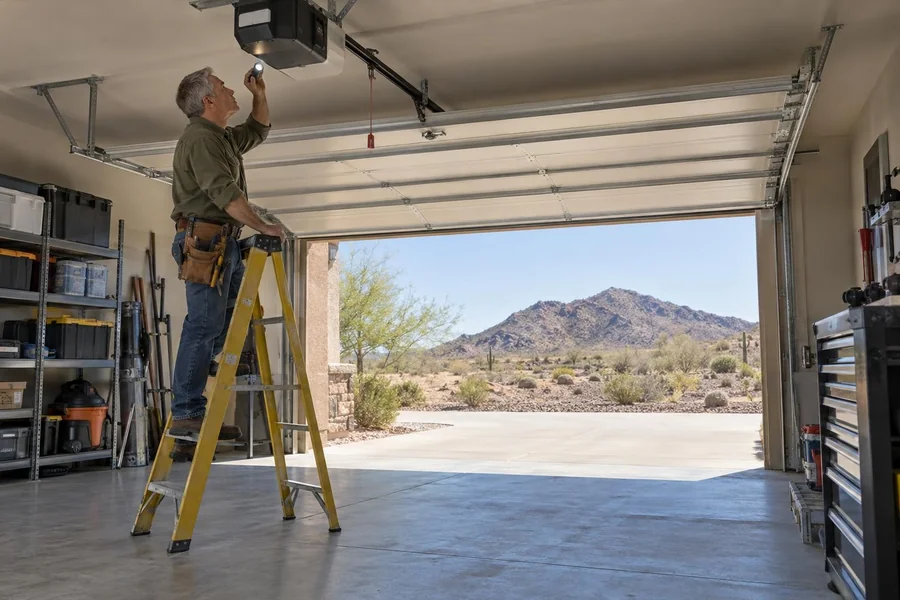
The opener head hangs near the ceiling of an attached garage, which in a Las Vegas summer is the hottest air in the house. Attic heat radiates down, the door itself absorbs afternoon sun, and the board inside that housing spends months at temperatures its capacitors were never happy about.
Failing boards produce strange symptoms rather than clean ones: the light works but the motor does not, the remote is ignored while the wall control functions, travel settings drift, or the unit responds after a rest and then quits again. Intermittent behavior in July and August is a board conversation more often than a motor conversation.
If the symptoms keep moving around, a diagnostic visit is the efficient path, and a technician handling garage door opener repair will usually test the board, the receiver and the safety circuit in the same call rather than guessing at one.
Remotes and keypads: batteries, sun and rubber buttons
Exterior keypads mounted beside the door face direct sun for hours. The membrane over the numbers hardens, cracks and eventually lets dust in, at which point certain digits stop registering while others still work.
Remotes suffer differently. Clipped to a visor, a remote cooks in a parked car all afternoon, and lithium cells lose capacity faster when cycled through that kind of heat. The tell is a remote that works from six feet away but not from the end of the driveway.
Before assuming the opener has failed, run this sequence:
- Replace the remote battery with a fresh one from a sealed package
- Test the wall button; if that works, the motor and board are probably alive
- Watch the opener light for flashing patterns when you press the remote
- Press the keypad in shade after sundown to see if heat is the trigger
- Check whether a second remote behaves the same way
Safety sensors: the two eyes that stop everything
The photo eyes near the floor cause more service calls than any other single part, and in this climate they have three enemies. Sun glare striking the receiver lens directly can wash out the beam in late afternoon. Fine dust settles on the lenses and dims them gradually. Heat cycling loosens the small brackets so the eyes drift out of alignment.
The classic symptom is a door that closes fine in the morning and reverses in the evening, or one that will only close if you hold the wall button down. Wipe both lenses with a dry microfiber cloth and confirm both indicator lights are steady rather than blinking.
If they will not stay aligned, the bracket or the wiring has usually been disturbed. Local companies such as 702 Garage Door see this repeatedly on driveways with a western exposure, where the low evening sun sits almost directly in line with the sensors.
Homeowner checks: ten minutes before you call
Pull the red release cord with the door closed and lift the door by hand. It should move smoothly and hold roughly halfway without slamming down or flying up. If it is heavy or fights you, the problem is spring balance, not the opener, and forcing the motor to compensate is how a good opener dies young.
Then look at the rail. Grease that has thinned in the heat and run down the rail, or a chain with visible slack, both make the motor work harder. Reconnect the carriage by running the opener until it clicks back into place.
Do not adjust spring tension yourself. Torsion springs store enough energy to cause serious injury, and that specific job belongs to someone with the winding bars and the training.
Common questions from valley driveways
How long should an opener last here? Ten to fifteen years is a fair expectation, though attached garages without ventilation tend toward the lower end of that range.
Is it worth repairing an older unit? If the board is the only failure and parts are still made, often yes; once the motor and the board are both marginal, replacement usually wins.
Does insulating the garage help? It helps the whole space, including the opener electronics, and an insulated door plus attic ventilation lowers peak temperatures noticeably.

Passionate about exploring diverse ideas and sharing inspiration, I curate content that sparks curiosity and encourages personal growth. Join me at ElementalNest.com for insights across a wide range of topics.