
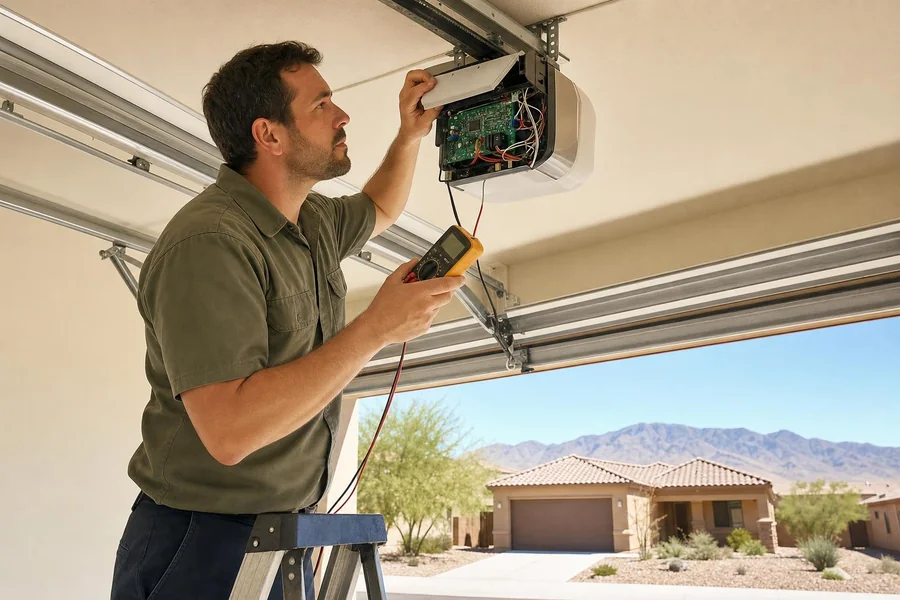
The garage on a west-facing home in Centennial Hills or Summerlin spends the afternoon as an oven. The door is steel, the roof is tile over a vented attic, and the opener hangs from the ceiling in the hottest layer of air in the house. Electronics were never meant to live there, and yet that is where the logic board that runs the door has to survive.
So when an opener starts acting up in a valley home, the question is rarely whether something is wrong but whether the fix is a part, a board or a whole new unit. There is a repeatable way to decide, and it starts with sorting the symptoms.
Symptoms that point to the opener rather than the door
Begin by pulling the release cord and lifting the door by hand. If it rises smoothly, stays put at halfway and closes without slamming, the door itself is balanced and the problem lives in the opener. If it is heavy or crooked, stop here; that is a spring or cable issue, and no opener repair will help.
With a balanced door, the opener’s complaints sort into a few buckets. A motor that hums but does not move points to a stripped drive gear or a worn capacitor. A unit that works from the wall button but not the remote points to the receiver or the remote’s battery. A door that starts, stops and reverses at random, with clean sensors, is the classic sign of a failing logic board.
Random behavior is the one to pay attention to. Boards fail gradually, and a door that reopens by itself once a week will do it once a day by August.
What a valley summer does to a logic board
Three things in a Las Vegas garage shorten an opener’s life. The first is plain heat: capacitors on the board dry out and relays pit faster when the ambient air sits well above what the manufacturer tested for, and a garage ceiling in July is exactly that.
The second is the daily heat cycle. Solder joints expand in the afternoon and contract at night, and after thousands of cycles a hairline crack opens on a joint that carries the motor current. That crack is why an opener works fine at dawn and quits at five in the afternoon.
The third is monsoon season. Lightning over the valley and the grid switching that follows put surges through the outlet the opener hangs from. A basic plug-in surge protector on that outlet is the cheapest insurance a homeowner can buy, and almost nobody installs one.
For the same reasons, a yearly service visit matters more here than in milder climates. What a technician actually checks is laid out in inside a professional garage door tune-up, and the opener is a full third of that inspection.
The three-question repair test
Once the opener is the confirmed culprit, ask three questions in order.
How old is it? Units older than roughly twelve to fifteen years predate today’s security standards and often use boards and gears that are no longer stocked. Any unit installed before 1993 lacks the photo-eye reversal system that has been required since then and should be replaced on safety grounds alone.
What does the fix cost against a new unit? A gear kit, a capacitor or a set of remotes is a clear repair. A logic board on a mid-age unit is a judgment call. A board plus a motor on an old chain drive is usually money better spent on replacement.
Is the failure likely to recur? If the board cooked because the garage runs hot and the outlet has no surge protection, a new board in the same conditions is a countdown. That conversation is one a technician handling garage door opener repair in Las Vegas should have with you on the spot, with numbers for both paths rather than a push toward the pricier one.
The 2026 opener features that justify a new unit
If the answer is replacement, the current generation earns its price with features that matter specifically in this climate.
- Battery backup, so the door still opens during the outages that follow monsoon storms.
- A DC motor with soft start and stop, which runs cooler and quieter than the old AC chain drives.
- Wi-Fi control with an auto-close timer, which ends the open-all-night door that heats the house and invites theft.
- A wall-mounted jackshaft design that frees the ceiling and keeps the electronics off the hottest air.
- Rolling-code remotes and an integrated camera on the premium tiers.
- LED lighting that does not fade in heat the way the old bulbs did.
Installation is typically a half-day job, and NV Pro Garage Doors pairs each new unit with a full door balance and sensor alignment, since a new opener on an unbalanced door burns out just as fast as the old one did.
Questions homeowners ask about openers
Can I just replace the board myself? On some units, yes, but the board must match the exact model and be programmed to the travel limits; a mismatch can disable the safety reversal.
Does a new opener need a new door? No. Any sound, balanced sectional door accepts a new opener.
How long should a modern opener last here? With surge protection and yearly service, ten to fifteen years is a fair expectation even in the valley.
NV Pro Garage Doors
3080 S Durango Dr Ste 110, Las Vegas, NV 89117
Phone: 725-712-8019
Website: nvprogaragedoors.com

Passionate about exploring diverse ideas and sharing inspiration, I curate content that sparks curiosity and encourages personal growth. Join me at ElementalNest.com for insights across a wide range of topics.