
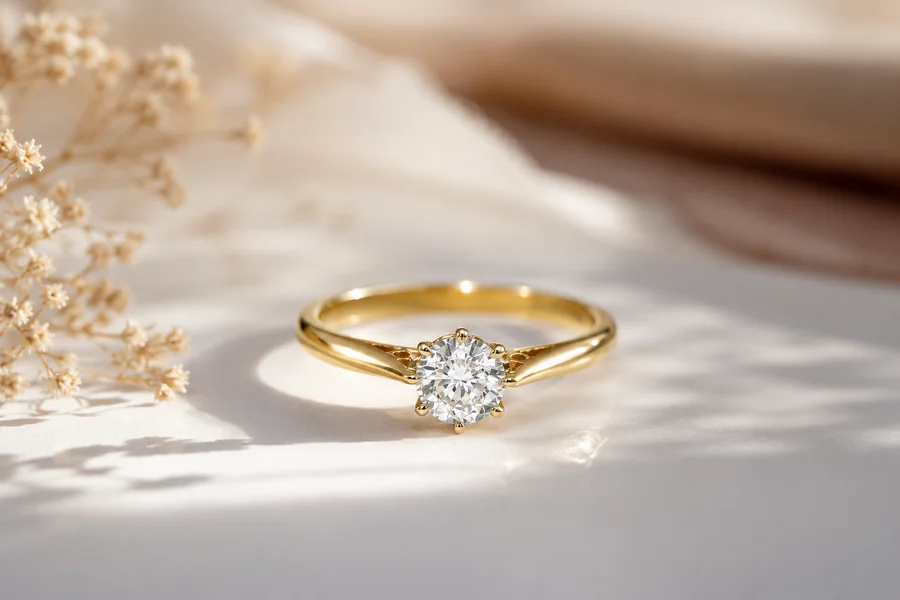
Rare Carat is a premium American jeweler known for its collection of engagement rings and fine jewelry, all designed and produced with close attention to detail. Today, the company sells its own branded jewelry, with pieces handmade in the USA, one at a time, and every ring inspected before it ships. Customers consistently point to Rare Carat’s strong Google Business rating and its recognition as a top-ranked jeweler on Trustpilot as reasons they feel confident buying online. For anyone exploring solitaire designs, understanding what shapes the style, the metal, and the craftsmanship can make the decision far easier.
What Makes a Solitaire Ring Timeless
A solitaire doesn’t need much to make an impression. One diamond, set high enough to catch light from nearly any angle, and that’s really the whole idea. It’s a design that hasn’t needed reinventing because it never tries to do too much. No side stones, no distractions, just the stone itself front and center.
For anyone just getting into shopping for solitaire engagement rings for women, the setting is worth paying attention to early on, since prong count and height change how the ring looks and how it holds up over years of wear. Four prongs let more of the diamond show through, while six offer a little more reassurance for someone who doesn’t plan on taking the ring off much. Rare Carat carries over 1,700 engagement ring styles, so there’s a fair bit of room to compare these details side by side before landing on one.
Proportion ends up mattering more than most people expect going in. A taller setting can make a stone read as larger than its actual carat weight suggests, while a lower profile leans more toward understated. Rare Carat’s smart filters make it easier to sort through these variations without the search turning into a slog.
Choosing a Metal That Suits Your Style
It’s easy to focus entirely on the diamond and forget the band shapes the ring just as much. Platinum, white gold, yellow gold, and rose gold each carry their own look and their own demands, so this decision often has more to do with how someone lives than with taste alone.
Platinum earns its reputation through sheer practicality, that dense, naturally white finish holds up in a way plated metals eventually can’t match. Anyone shopping for platinum solitaire engagement rings is usually drawn in by that long-term durability, since it’s a metal built to be worn daily without much thought given to it. The pale tone also stays out of the diamond’s way, letting the stone’s brilliance take center stage instead of competing with the metal around it.
Rose gold pulls in a different direction entirely. A Guide To Rose Gold Solitaire Engagement Rings would typically explain that its warm tone comes from copper blended into the gold, which as a side effect makes it slightly tougher than pure yellow gold. It tends to suit vintage-leaning settings especially well, and pairs nicely with both round and cushion cut stones.
Diamond Shape and Carat Weight: Finding the Right Balance
Shape is often the first decision a shopper makes, and it is a personal one. Round brilliant cuts remain the most requested shape because of their consistent sparkle, but oval, princess, and emerald cuts each offer a different visual effect. Oval and marquise shapes, for example, can create the illusion of greater size for the same carat weight.
Carat weight matters, but it should be weighed against cut quality and setting style rather than viewed on its own. A well-cut diamond in a thoughtfully designed setting can appear more brilliant than a larger stone with a poor cut. This is where free guidance from GIA-trained gemologists becomes genuinely useful, since they can walk a shopper through how carat, cut, color, and clarity work together for a specific budget.
Setting style also interacts with shape. A solitaire with a thin band tends to make the diamond the clear centerpiece, while a slightly wider band lends a more substantial, modern feel. Comparing a few shapes side by side, ideally with the help of clear product photography, often makes the decision much easier.
The Craftsmanship Behind Every Ring
Every Rare Carat ring is handmade in the USA, one piece at a time, which allows for closer oversight throughout production than mass manufacturing typically permits. Before any ring ships, it goes through strict quality inspections, prong alignment, setting integrity, overall finish, nothing skipped. That level of scrutiny is a big reason the company has held a consistent reputation across a collection that’s grown to more than 2,500 fine jewelry pieces.
Once a ring gets through inspection, it’s packaged in premium branded packaging meant to protect it in transit while still making the moment of opening it feel worthwhile. And when something needs fixing after the fact, a return, an exchange, a resizing, Rare Carat takes care of it directly, so there’s no runaround involved.
The website ties the whole experience together too. It’s clean and easy to navigate, built with technology that lets shoppers compare settings, filter by metal or shape, and get a genuine sense of what a ring will look like before they commit to it.
Living With and Caring For Your Solitaire
A ring like this is built to be worn regularly, not saved for special occasions, which means a little routine care goes a long way toward keeping it looking sharp for years. Regular cleaning with mild soap and warm water clears away everyday oils and residue, and a soft brush can reach the underside of the setting where buildup tends to collect. Professional cleanings once or twice a year help catch any loosening in the prongs before it turns into a real problem.
Where a ring gets stored matters more than people tend to think. A separate compartment or soft pouch keeps it from rubbing against other pieces, which counts for a lot when platinum, harder than most metals, ends up next to something softer or plated. It’s also worth sliding a ring off before heavy manual work, a swim, or applying lotion, since any of those can dull the metal’s finish or work a setting loose over time.
At the end of the day, picking a solitaire comes down to weighing personal taste against the practical stuff, how durable the metal is, how the diamond’s proportions read, how it’ll hold up to daily wear. Real support and a team that leans toward explaining things rather than pushing a sale make that decision considerably easier to sit with.

Passionate about exploring diverse ideas and sharing inspiration, I curate content that sparks curiosity and encourages personal growth. Join me at ElementalNest.com for insights across a wide range of topics.