Ten years ago, if you wanted good caviar in the US you had two options: a specialty food store in a major city, or a restaurant that charged you four times what the tin was worth. That’s changed. A caviar online store now ships the same product, from the same farms, to your door overnight — typically at prices that make the retail channel look like a bad deal for the buyer.
This shift isn’t just about convenience. It’s about how the distribution chain for a perishable luxury product got rebuilt, and why the old model was never actually working in the buyer’s favor.
How caviar used to be sold (and why it was broken)
For most of the 20th century, premium caviar in the US moved through a short chain: importers sold to a handful of specialty distributors, who sold to retail shops and restaurants. At each step, the markup was substantial. By the time a tin reached a consumer, it had passed through three or four hands, each adding 30 to 60 percent. A tin that cost an importer $80 wholesale might retail at $220 or more.
The other problem was inventory. Specialty stores aren’t high-volume caviar operations. A shop in Chicago or Boston might sell 20 tins a month if things went well. That means the tin you bought on a Tuesday could have been sitting in that retail case since the previous month, or longer. Caviar isn’t wine. It doesn’t improve with time on the shelf. A tin that’s been open to ambient retail temperature fluctuations for six weeks is a meaningfully different product from one that was packed last month and shipped cold.
Nobody talked about this openly because nobody in the chain had an incentive to. The importer had already been paid. The retailer moved on to the next product.
What “direct importer” actually means
A direct importer buys caviar from the farm, handles US customs clearance, and sells to the end buyer without a distributor in between. That one removed step changes the economics significantly.
It also changes the accountability. When a direct importer sells you a tin from Karat in Israel or Giaveri in Italy, they know exactly when that tin was processed, when it cleared customs, and how long it’s been in cold storage. They can tell you the harvest date and the grade. A retailer who bought the same tin from a distributor often can’t answer those questions, not because they’re hiding anything, but because that information didn’t travel with the product.
Direct to consumer caviar also means the importer’s reputation is on the line with every order. There’s no retailer to absorb complaints. If the product arrives warm or tastes off, the buyer contacts the importer directly. That dynamic creates a different kind of quality pressure than a retail model where product quality problems get diffused across a long supply chain.
The freshness argument: why overnight shipping beats a retail case
Caviar needs to stay between 28 and 34°F to maintain quality. That’s a narrow window, and it’s easy to break without proper packaging.
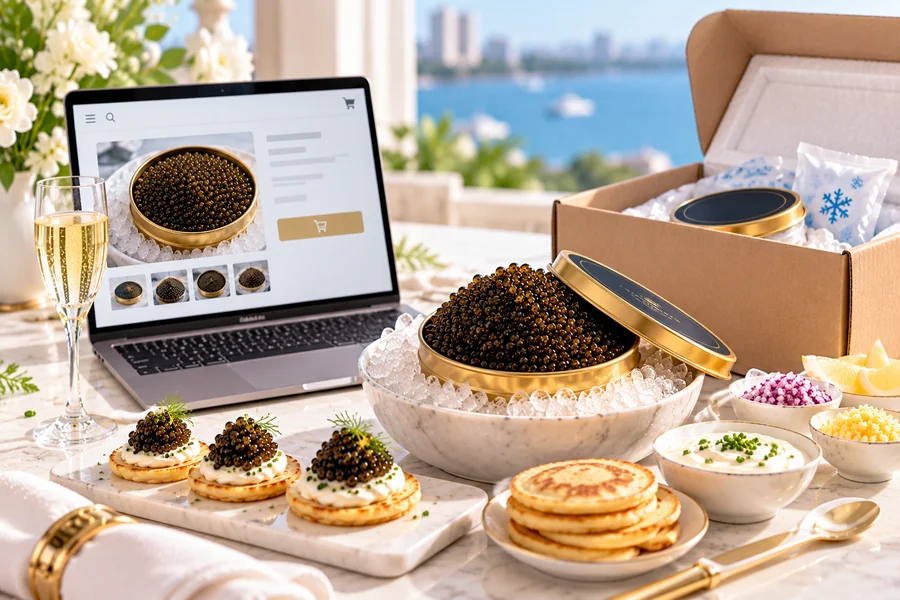
Overnight shipping in a Styrofoam cooler with gel packs keeps a tin in that range for 20 to 30 hours, which is enough to cover next-day delivery anywhere in the continental US. UPS Next Day Air is the standard. When it works, the tin arrives colder than it would have been in a retail display case that’s been opened and closed a hundred times.
The counterintuitive thing is that a tin shipped overnight from a Miami-based importer can arrive fresher than one purchased off a shelf at a store two miles away, if that store has been turning inventory slowly. Cold chain continuity matters more than physical distance.
There’s also the question of what happens before the tin reaches retail. Products sitting in distributor warehouses, waiting for orders to consolidate, can spend days at temperatures that aren’t ideal. Farms and importers who ship direct bypass that warehouse step entirely.
Price comparison: what the same tin costs at different channels
The numbers vary by product, but the general pattern holds across the market.
A 50-gram tin of mid-grade osetra from a recognized European farm typically runs $120 to $150 through a direct importer. The same tin at a specialty grocery in a major US city often sits between $180 and $220. At a restaurant, the same product might be marked up to $60 to $80 per serving, with two servings roughly equaling one tin.
The retail premium exists for real reasons: rent, staff, the experience of walking into a nice store. But if what you want is the tin itself, those overhead costs don’t add anything to what’s inside it. When you buy caviar online from a direct importer, you’re not paying for a retail location you’re never going to visit.
The math gets clearer when you’re buying for a dinner party or an event. A $300 difference on a $400 order is real money, and it doesn’t reflect a quality difference in the product.
How to evaluate an online caviar retailer
Not every online caviar seller is a direct importer. Some are resellers buying from the same distributor chain as your local specialty store, just with a website instead of a physical location. The price tells you something, but it’s not the whole picture.
A few things worth checking before you order. Does the retailer name the farm the caviar comes from? Legitimate importers working directly with farms can tell you whether a tin of osetra came from Karat, Giaveri, Rova, or another named producer. A generic “premium osetra from European farms” description is a sign that the seller doesn’t have that relationship.
Can they tell you the harvest date or processing date? This is a reasonable question, and a direct importer should be able to answer it, at least to the month. If the answer is vague, the seller likely doesn’t have that information.
What’s the shipping method and packaging? Overnight in an insulated cooler with gel packs is the baseline for responsible cold-chain handling. A seller offering two-day ground shipping on fresh caviar is either using a pasteurized product (which has a longer shelf life but different characteristics) or not thinking carefully about what they’re selling.
One practical note: pasteurized caviar and fresh malossol caviar are different products. Pasteurized caviar has been heat-treated, which extends its shelf life to 12 months or more but changes the texture and flavor. Most premium-grade osetra and beluga hybrid sold through serious importers is fresh malossol, not pasteurized. If a website doesn’t specify, ask.
What you lose buying in-store that you probably don’t need
The main thing you lose is the ability to taste before you buy. Some specialty stores offer samples, and that’s genuinely useful if you’re choosing between two products you’re unfamiliar with.
You also lose the immediacy. If you decide at 6pm that you want caviar for dinner, a store is faster than overnight shipping. That’s a real limitation, though it’s easy to plan around with a day’s notice.
What you don’t lose is quality, and in many cases you gain it. The argument for buying in-store used to be that you could trust the retailer to have vetted the product. That’s less compelling when you can read exactly what farm a tin came from, when it was processed, and what grade it is, before clicking purchase. The information available to an online buyer today is better than what most retail staff could tell you five years ago.
The retail model for caviar made sense when information was scarce and distribution was centralized. Neither of those things is true anymore. For most buyers, a direct importer with a clear product sourcing story and reliable cold-chain handling is the better option on every dimension that actually affects what ends up in the tin.

Passionate about exploring diverse ideas and sharing inspiration, I curate content that sparks curiosity and encourages personal growth. Join me at ElementalNest.com for insights across a wide range of topics.