
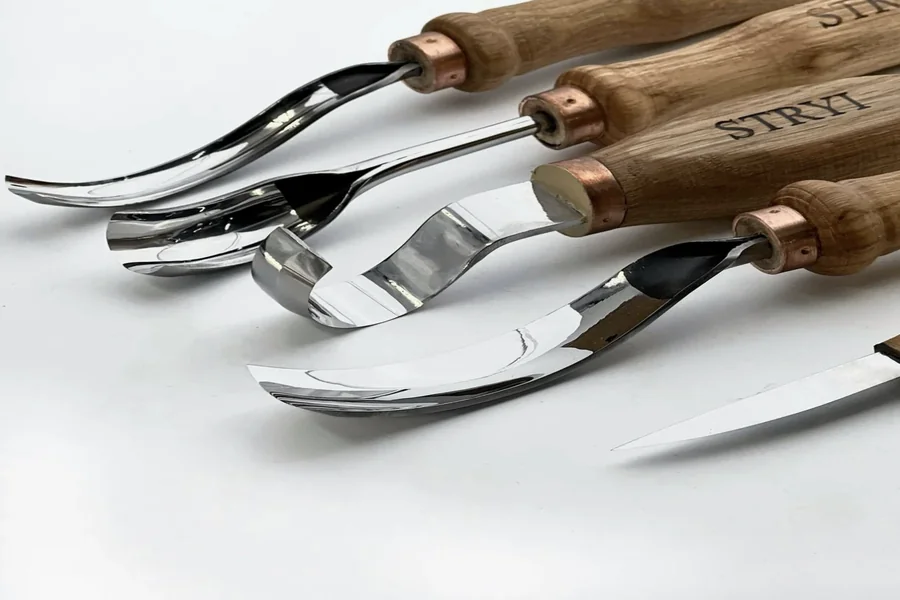
Spoon carving has a low barrier to entry, which is part of why it has become such a popular way into the wider craft of wood carving. A single knife and a block of basswood can produce a usable spoon in an afternoon. But there is a real difference between the spoon someone carves with one all-purpose knife and the spoon someone carves with the three or four tools actually designed for the job, and that gap is where a dedicated spoon carving set earns its cost.
Three Cuts, Three Different Tools
A basic spoon requires three distinct cutting actions, and each one is done poorly by the wrong tool.
- Roughing out the blank: a sturdy sloyd or carving knife that can take firm cuts without flexing
- Shaping the handle and outside of the bowl: the same knife, used with lighter, more controlled strokes
- Hollowing the inside of the bowl: a hook knife, since a straight blade cannot follow a concave curve without leaving flat, faceted cuts
Why Guesswork Hurts Beginners
Buying these tools individually is possible, but it front-loads a beginner with decisions they are not yet equipped to make: what sweep of hook knife, what blade length, left or right-handed. A curated set removes most of that guesswork by pairing tools that are already known to work well together, at a size and sweep suited to typical spoon dimensions. This matters more for beginners than it might seem, because a mismatched or wrong-sized tool is one of the more common reasons people give up on a hobby that otherwise has a short learning curve.
Why Steel Quality Is Part of the Decision
Quality matters just as much as tool selection. A soft, poorly tempered blade dulls within a single project and turns every cut into a wrestling match rather than a clean pass through the wood. High-carbon steel, tempered into the low 60s on the Rockwell hardness scale, holds an edge through a full spoon and beyond, and a set built around consistent steel across all its pieces means a carver is not compensating for one weak link mid-project. Pre-sharpened tools matter even more for beginners, since sharpening a curved hook knife blade from scratch is a skill in its own right that takes time to learn properly.
The Cost Argument for Buying a Set
There is also a practical cost argument.
- Buying a straight knife, hook knife, and finishing tool separately from three sources typically costs more than a matched set
- Three separate shipping charges instead of one
- No guarantee the tools will feel consistent in the hand across different makers
A set built around one maker’s steel, grind, and handle shape gives a beginner a consistent feel across every tool, which shortens the adjustment period considerably.
Storage and Care
A carrying case or roll included with a set is a small detail that pays off over time as well. Loose blades knocking around in a drawer or bag dull faster and are more likely to nick each other, while a fitted roll keeps each edge protected between sessions and makes it obvious at a glance if a tool has gone missing. For anyone carving outdoors, at a workshop bench, or simply moving tools between a garage and a kitchen table, that kind of organization ends up mattering more than most beginners expect when they first buy a set.
Choosing a Set
For anyone deciding to commit to spoon carving as more than a one-off project, a set purpose-built for the craft, such as the spoon carving kits at https://woodcarving-tools.com/collections/spoon-carving-sets, removes most of the early friction: the right tools, matched sizes, and an edge ready to use immediately rather than after an afternoon of sharpening.
Spoon carving rewards repetition more than almost any other entry point into wood carving, since the same handful of cuts show up on nearly every piece. Starting with the right set of tools means those early repetitions build good habits instead of compensating for the wrong blade, and that difference shows up in the first finished spoon, not just the tenth.

Passionate about exploring diverse ideas and sharing inspiration, I curate content that sparks curiosity and encourages personal growth. Join me at ElementalNest.com for insights across a wide range of topics.