
The conversation around digital transformation has totally changed. By 2026, it is no longer enough for a CTO or an IT Director to just build a fast system; that system has to be demonstrably ethical. We have moved past the old “move fast and break things” days. Now, Environmental, Social, and Governance (ESG) targets are part of the core business strategy for every major enterprise. For most companies, the hybrid cloud is where these two worlds clash. It is the engine of the business, but it is also one of the biggest parts of the total corporate carbon footprint.
The challenge for leadership right now is balancing the need for massive compute power with the reality of new, mandatory emissions reporting. You cannot just “greenwash” your way through an annual report anymore. There are real legal risks if your data does not back up your claims about sustainability. That is why so many businesses are shifting toward eco-friendly infrastructure that treats carbon efficiency as just as important as uptime or latency.
The move to Sustainable FinOps
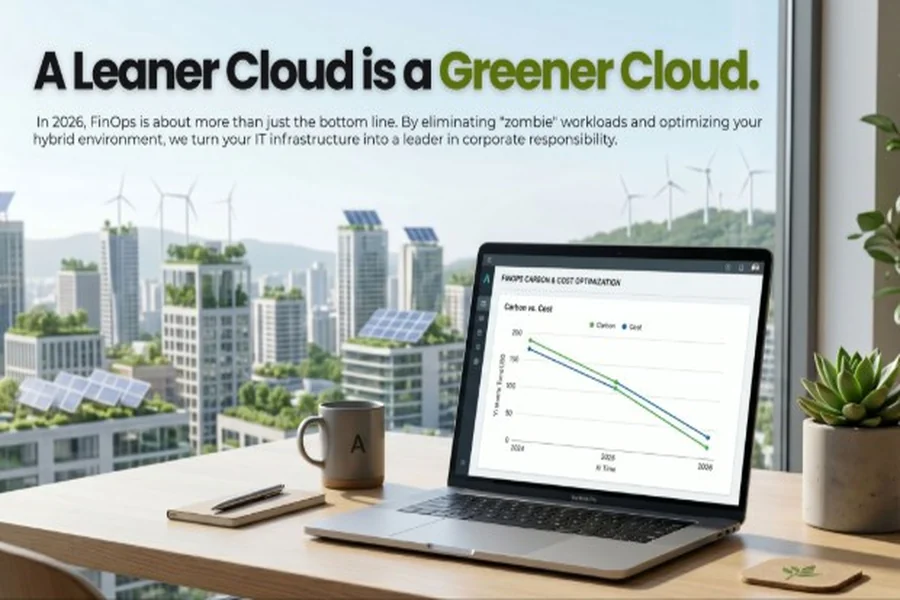
One of the smartest shifts lately is how Financial Operations (FinOps) has evolved into what many are calling “Sustainable FinOps.” It used to just be about cloud cost management—finding unused resources or “orphaned” storage buckets to save a few dollars on the monthly bill. In 2026, those same habits are being used to cut carbon. The logic is simple: a leaner cloud is a greener cloud. Every virtual machine you leave running for no reason is just wasted energy that is still being pulled from the grid.
Sustainable FinOps helps companies find “zombie” workloads that are eating up power without doing any actual work for the business. This creates a cycle where cutting waste saves money and helps the environment at the same time. For a Sustainability Officer, this is a perfect setup because it gives them a clear, data-backed story that shows how digital efficiency is helping the company meet its ESG goals. It turns the IT department from a source of carbon into a leader in corporate responsibility.
Orchestrating multi-cloud for better results
Managing a hybrid environment that stretches across Azure, AWS, and private data centers is a massive job. But that complexity is actually an opportunity to save energy if you have the right visibility. Today, the top managed IT services are using smart orchestration tools to make sure data is stored where it is most efficient. Because of the top managed IT services, a company can move flexible, non-urgent workloads to regions that are currently running on the most renewable energy.
For example, an MSP might set things up so your heavy data processing happens in a Nordic data center that uses natural air for cooling and hydro-power for energy. Meanwhile, your urgent customer data stays local in Australia to meet latency and sovereignty requirements. This “geographic optimization” means you are always using the cleanest part of the grid available. It is not just about picking one cloud provider over another; it is about moving work around to minimize your total carbon impact as the sun sets in one region and rises in another.
Energy-Aware Monitoring is the new standard
A big trend in 2026 is the adoption of “Energy-Aware Monitoring.” It used to be that IT monitoring only looked at CPU usage, memory, or network speed. Now, businesses want monthly reports on their IT-related carbon emissions too. This transparency is huge for IT Directors who need to prove to the board that their tech is following ethical guidelines.
These monthly reports show exactly how much CO2e (carbon equivalent) each department or project is using. It allows for “carbon-aware” decisions. If a development team is writing messy, inefficient code that is spiking energy use for no performance gain, the tools flag it as both a performance problem and an ESG issue. By treating carbon like a budget, companies can start a culture of “green coding” where everyone is responsible for the energy they consume. This level of granularity is what transforms a vague sustainability goal into a measurable business outcome.
Why the private cloud still matters for ESG
Even with the big public clouds getting greener, the private cloud is still a huge part of an ESG strategy. Some data just has to stay private for security, legacy, or legal reasons. In 2026, the focus is on “Modernizing the Core”—getting rid of old, power-hungry servers and replacing them with high-density, energy-efficient gear.
MSPs are helping companies build private clouds that use things like liquid cooling, which cut down on energy waste significantly compared to traditional air-conditioned server rooms. By making these private systems part of a bigger hybrid plan, Sustainability Officers can make sure even the data that cannot go to a public cloud is still being handled as cleanly as possible. Upgrading an on-premise data center to modern standards can often reduce its power consumption by 40% while doubling its processing capacity.
Performance does not have to suffer
There is always a worry that “going green” means things will get slower or that the business will have to compromise on its digital ambitions. But in 2026, we are seeing the opposite. An optimized, energy-aware hybrid cloud is usually faster and more reliable than one that is just left to grow wildly. When you cut out the waste and move work to the most efficient spots, you are building a better business, not just saving the planet.
For a CTO, this is a win-win. You get the high-performance system you need for AI and data analytics, and the Sustainability Officer gets the audit-ready data they need for their targets. It is a shift from seeing ESG as a headache to seeing it as a reason to do better engineering. The discipline required to track carbon also helps track hidden costs, making the entire organization more fiscally responsible.
The human element of ethical IT
While the software and the hardware do the heavy lifting, the human element cannot be ignored. Setting these ESG targets requires a cultural shift within the IT department. It means training developers to think about “carbon per query” and encouraging procurement officers to look at the energy efficiency of every new vendor. In 2026, the most successful companies are those where the IT team and the Sustainability team are in constant communication.
Managed Service Providers act as the bridge here. They provide the expertise that many companies lack internally, helping to translate complex environmental metrics into actionable IT steps. This collaboration ensures that the technology roadmap is not just about what is possible, but what is responsible. As we move deeper into the decade, the ability to manage this balance will be a key differentiator for top-performing companies.
The future of digital transformation
As we go through 2026, the pressure to be ethical with technology is only going to grow. Investors, customers, and even your own employees want to see that you care about your footprint. A hybrid cloud strategy that ignores the environment is quickly becoming a liability for any public company. The introduction of standardized global reporting means there is nowhere to hide inefficient infrastructure.
By working with experts who get both the tech and the ESG rules, companies can stay ahead. The tools—from Sustainable FinOps to Energy-Aware Monitoring—are already here to help IT lead the way in corporate responsibility. Optimizing your cloud for 2026 is not just about speed; it is about making sure your growth does not come with an environmental cost you cannot afford. In the end, the companies that thrive will be the ones that view sustainability not as a cost, but as the ultimate optimization metric.

Passionate about exploring diverse ideas and sharing inspiration, I curate content that sparks curiosity and encourages personal growth. Join me at ElementalNest.com for insights across a wide range of topics.