
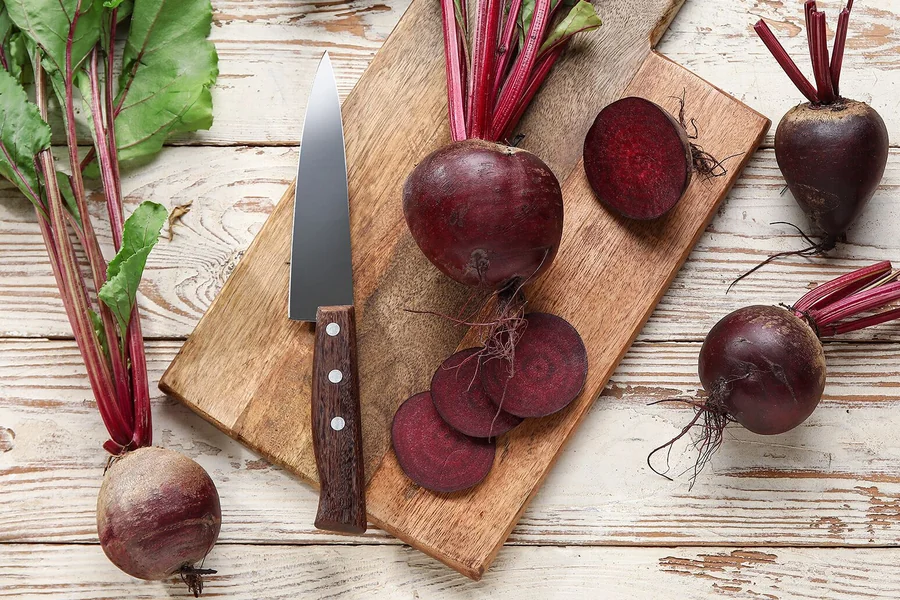
Short answer: yes and no. Beetroot genuinely boosts nitric oxide — that part is well established. But whether it can do it alone, enough to make a meaningful difference for erections, is a different question. The honest answer is: only partway. Here’s what the science actually says, why single-ingredient approaches run out of road, and how dual-pathway formulas like Nitric Boost Ultra are built to close that gap.
Yes — beetroot really does boost nitric oxide
This isn’t a myth. Beetroot is one of the richest dietary sources of nitrates: bacteria in your mouth convert the nitrate into nitrite, and your body turns that into nitric oxide. Nitric oxide is a vasodilator — it relaxes and widens blood vessels so blood flows more freely. And since an erection is fundamentally a blood-flow event, that’s exactly the right lever. Levels typically rise within one to three hours of a glass of beet juice, and regular intake also modestly lowers resting blood pressure, which supports overall blood-vessel (endothelial) health. (One quiet caveat: strong antiseptic mouthwash kills the oral bacteria that start the whole process.)
If the story ended here, beetroot would look like a complete solution. But notice how carefully the credible sources phrase it: beetroot “may support” blood flow; it’s “not a proven standalone treatment.” That hedging points to a real bottleneck.
The limitation: why beetroot alone runs out of road
On its own, beetroot works exactly one pathway to nitric oxide — the nitrate route — and a single lane has clear limits:
- It’s a single-lane road: it depends on consistent, high-nitrate intake day after day.
- Modest magnitude: great for general circulation, but often a gentle boost rather than the robust, reliable response men are actually looking for.
- Sensitive to routine: small disruptions to your daily habits slow the conversion down.
Which raises the real question: what’s the second pathway beetroot leaves completely untouched?
The second pathway: the amino-acid system
Your body actually makes nitric oxide two separate ways. Beetroot feeds the first (the nitrate route). The second is an enzymatic route inside your blood vessels, driven by two amino acids — L-arginine and L-citrulline. It doesn’t depend on nitrate or on the bacteria in your mouth at all.
L-citrulline converts into L-arginine in the body, which then feeds directly into nitric oxide production — so pairing them works the route from both ends. This matters most for men over 40: as natural enzyme efficiency declines with age, relying on a single route leaves your system running below capacity. Beetroot and the amino acids aren’t competitors — they’re complementary systems, and covering both is far more reliable than betting everything on one.
Single pathway vs. dual-pathway: side by side
| Beetroot alone (NITRATE PATHWAY ) | Beetroot + L-citrulline / L-arginine (ENZYMATIC PATHWAY ) | |
|---|---|---|
| Mechanisms used | Nitrate route only | Nitrate route + enzymatic route |
| Speed of action | Fast spike (1–3 hours) | Fast spike + sustained enzymatic support |
| Age resilience | Fades as enzymes decline | Helps compensate for age-related decline |
| For erections | General circulation support | The combination has been studied for nighttime erection quality |
What the science says about combining them
This isn’t just theory — the combination has been evaluated for erections specifically. In one published study, a supplement pairing L-citrulline with concentrated beet root extract improved the intensity and duration of nighttime erections (though not their frequency), with no side effects reported.*
Read that as good news, especially past 40. As your body’s own nitric-oxide production naturally winds down with age, keeping both pathways supported becomes a genuinely worthwhile measure — a way to work with your body on the blood-flow side of performance instead of letting it fade. The effect is gradual and builds over weeks, and it works best alongside a healthy routine. No natural formula acts like a prescription, and none is a cure — but as an everyday support that only gets more valuable the older you get, the science is firmly on its side.
So what does a well-built dual-pathway formula look like?
Knowing the combination beats beetroot alone is one thing; finding it done right is another. The power isn’t in the names on the label — it’s in the forms and doses, and whether the ingredients are built to work as one system rather than a trio tossed in a capsule. When we looked at the dual-pathway options out there, the ones actually worth considering shared the same fundamentals:
- Beetroot in two forms — concentrated extract plus whole-root powder — for both fast and steady nitrate delivery.
- L-citrulline in its DL-malate form — the better-absorbed version, so it converts efficiently into L-arginine.
- L-arginine at a real, functional dose — enough to actively support the vascular enzyme system.
Of the formulas we analyzed, a solid and safe pick that ticks all three is Nitric Boost Ultra — it pairs both beetroot forms with clinical-grade amino acids in a single daily serving. If you want the ingredient-by-ingredient detail, we broke the whole formula down in this full review of Nitric Boost Ultra.
Where to buy it — and keep the guarantee
Two practical notes if you go the formula route. First, cost: you can check the current pricing and package options here. Second, and more important: order from the manufacturer’s official store, not a marketplace reseller — direct-sold supplements attract third-party listings whose stock age and authenticity can’t be verified, and those purchases fall outside the money-back guarantee. Buying from the source is the only way to keep that guarantee intact.
The bottom line: what the science says
So — what does the science say? Beetroot alone genuinely raises nitric oxide, and that counts for something. But the research keeps pointing past beetroot on its own: the two-pathway approach — nitrate plus the amino acids — is where the measurable, more consistent, age-resilient improvements actually show up.
You can chase both pathways from the kitchen — beet juice for the nitrate side, watermelon and nuts for the amino acids — and diet genuinely matters. But hitting the right forms and doses every single day, consistently, is hard to manage with food alone. That’s why, for anyone serious about getting the most out of nitric oxide, targeted supplementation is the key lever: not a replacement for eating well, but the reliable way to complement it and actually reach that level. Beetroot is a great start — the dual-pathway combination, done properly, is the smarter finish.
Frequently asked questions
How much beetroot per day for vascular support?
Studies on cardiovascular and vascular benefits typically use about 70–250 mL of beet juice, or 300–600 mg of dietary nitrate, taken consistently. Standardized extracts are usually preferred over raw food for dosage consistency.
Is beetroot a natural replacement for prescription drugs?
No. Beetroot gently supports your body’s own nitric-oxide pathways over time; prescription options work through a completely different, immediate mechanism. They also act on the same blood-pressure system, which is why they shouldn’t be combined without medical advice.
Can you take beetroot and amino-acid supplements (L-citrulline / L-arginine) together?
Yes — and that’s the ideal, because they activate two entirely separate pathways to produce nitric oxide.
Does beetroot increase testosterone?
There’s no solid evidence that it does. Beetroot works on the blood-flow and nitric-oxide side of things, not on hormones.
How long does it take to notice benefits?
Nitric oxide rises within one to three hours of a dose, but steady, day-to-day benefits build over several weeks of consistent use — often around four to eight.
Is there anything to check before trying it?
For most healthy adults, beetroot and nitric-oxide support are well tolerated. One sensible bit of advice: because they gently lower blood pressure, have a quick word with your doctor first if you take blood-pressure or ED medication, since those act the same way. And if erectile changes come on suddenly, it’s worth mentioning at your next check-up — a useful signal, not just an inconvenience.

Passionate about exploring diverse ideas and sharing inspiration, I curate content that sparks curiosity and encourages personal growth. Join me at ElementalNest.com for insights across a wide range of topics.