
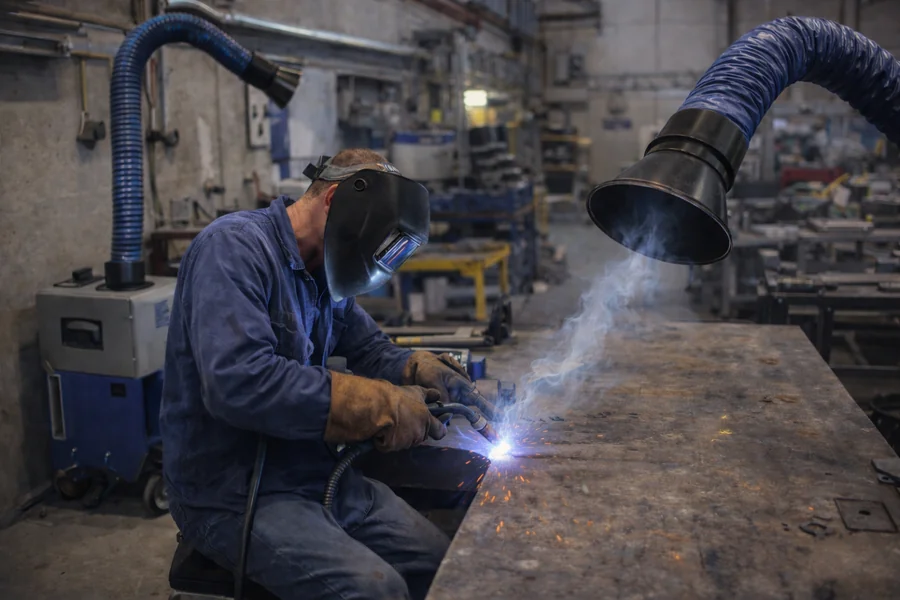
Your garage gets hot in summer, so you installed a couple of box fans and called it ventilation. Then you started welding on weekends, and suddenly those fans feel like they’re pushing fumes around instead of clearing them out. The difference between cooling a space and extracting welding fumes is the difference between opening a window and installing a system designed to capture and filter toxic particulates at the source. When choosing welding fume filters for a home workshop, most DIYers realize too late that casual ventilation cannot replace extraction equipment designed for industrial-grade air quality.
Key Takeaways
- Standard garage ventilation moves air around but does not capture welding fumes or metal particulates at the source
- Home welders face unique challenges: compact spaces, shared living areas, and lack of dedicated ductwork make portable extraction systems essential
- Fume extraction filters must match your welding process and workshop size, not just your budget
- Portable extraction arms and wall-mounted systems deliver better air quality than overhead fans or open doors
- Proper extraction protects your long-term health and resale value of your home
Why It Matters
Welding fumes contain hexavalent chromium, manganese, and nickel. These are not particles that dissipate when you crack open a door. They linger in the air, settle on surfaces, and accumulate in your lungs over months of weekend projects. A homeowner who welds two hours per week in an uncontrolled space absorbs the same cumulative exposure as a shop worker on a compressed timeline. The difference is that the shop worker has compliance audits, air quality monitoring, and equipment maintenance schedules. The home fabricator has a habit, a torch, and hope.
The second issue is space. Industrial welding shops have cubic footage to spare. Your garage has 400 square feet shared with your car, your workbench, and possibly a furnace. General exhaust fans designed for temperature control do not move fumes fast enough at the point of generation. A portable fume extraction system specifically designed for welding captures fumes at the weld pool itself, preventing them from spreading throughout your entire home.
Welding Fumes Are Not Generic Smoke
This is the core misconception that derails home workshop air quality. Most homeowners lump welding fumes into the same category as dust or sawdust and assume any exhaust fan will solve it. Welding fumes are metal oxides, gases, and ultra-fine particulates suspended in air. A standard workshop fan moves volume. A welding fume extraction arm captures at the source using suction and filtration designed specifically for metal particulates.
When you run a stick or MIG welder without extraction, you are creating a plume that rises from the weld pool. That plume contains particles smaller than 1 micron. A typical garage fan does not create enough negative pressure at the arc to draw those particles into a duct. Instead, the plume disperses into your breathing zone and the rest of the workshop. Over time, these particles accumulate in your lungs, sinuses, and on every surface in your shop.
Portable extraction systems with articulated arms or wall-mounted brackets create localized suction that actually pulls the plume away from your face and body before it has a chance to spread. The filter captures particles down to 0.3 microns, protecting both your immediate air and your long-term respiratory health.
Space Constraints and Portable Solutions
Industrial shops install fixed ventilation during construction. They run ductwork through walls, install ceiling-mounted systems, and design the entire space around air handling. A home workshop does not have that luxury. You rent or own a house. You cannot cut holes in load-bearing walls or run ductwork through your neighbor’s foundation. This is why portable fume extraction systems exist.
A portable unit with an articulated arm can sit on wheels in the corner of your workshop. You roll it to your welding station, position the arm to capture fumes at the source, and turn it on. When you are done welding, you roll it back. This flexibility is not a downside; it is exactly what home welders need. The extraction happens where the fumes are generated, not somewhere else in the building.
Wall-mounted extraction systems are another option if you have a dedicated welding corner. These systems mount to your workshop wall or ceiling, draw fumes through a flexible hose or articulated arm, and vent the filtered air outside or back into the shop depending on the system design. They occupy no floor space and deliver the same extraction performance as portable units.
Filter Types Matter More Than You Think
Once you decide on portable or wall-mounted extraction, you face a second decision: what type of filter. Not all fume filters capture the same particles. Fiberglass filters do basic dust removal. Pleated cellulose filters capture finer particles but clog faster. Nano-fiber filters capture ultra-fine metal oxides and last longer between replacements.
For welding specifically, you need a filter designed to handle metal particulates. A filter meant for general workshop dust will clog within hours of active welding. A nano-fiber filter designed for welding fumes will perform for weeks or months depending on your duty cycle and can be cleaned (in some cases) to extend life before eventual replacement.
The filter you choose affects how often you maintain the system, how much your energy costs climb as the filter restricts airflow, and ultimately how well the system protects your air quality over time. Cheaper filters may reduce your upfront cost by 30 percent but force you to replace them four times as often, erasing any savings while leaving you with weeks of degraded extraction performance between changes.
A Real Workshop Scenario
Consider a homeowner in a suburban garage who builds custom gates and decorative metal work on weekends. His space is roughly 30 by 20 feet, heated but not climate-controlled, with no built-in ventilation beyond a single overhead garage door. He runs a 220-volt MIG welder on Friday and Saturday evenings, typically working for two to three hours per session.
For his first year, he opened the garage door and used a box fan pointed at the open space. His wife complained about fume smell in the house adjacent to the garage. His lungs felt tight after long sessions. He attributed it to lack of fitness and the exertion of the work itself.
In year two, he installed a portable extraction arm with a nano-fiber filter and positioned it to capture fumes right at his welding table. He still opens the garage door for general air circulation, but the extraction arm handles the active plume. His wife stops complaining about smell. His breathing feels easier. Cleanup takes less time because particulates are not settling on every surface. His filter requires replacement every three months instead of the constant struggle with clogged box fans.
The equipment cost was under $1,500, a one-time expense. His electricity cost rises by perhaps $30 per month during welding season. Over time, the protection for his lungs and the improvement to his workshop environment pay for themselves in comfort and safety.
Actionable Takeaways
- Stop relying on general ventilation for welding. Box fans, garage doors, and ceiling fans move volume but do not capture fumes at the source. Install a system designed specifically for welding fume extraction.
- Measure your workspace before buying equipment. A small portable extractor is enough for a 20-by-30-foot garage. A larger shop requires a higher-volume system. Check the cubic footage and the extraction rate (measured in CFM, cubic feet per minute) of any system you consider.
- Choose a filter designed for metal particulates. Generic dust filters clog too fast and do not capture ultra-fine welding fumes. Specify a nano-fiber or similar filter rated for welding applications.
- Plan for filter replacement. Your extraction system is only as good as its filter. Set a calendar reminder to inspect and replace filters on schedule. A degraded filter undermines the entire point of having extraction.
- Invest in an articulated arm or flexible hose. Fixed-position extraction requires you to position your work in one spot. An articulated arm lets you pull fumes from wherever you are welding, giving you flexibility without sacrificing air quality.
- Vent outside whenever possible. If your workshop is adjacent to living space, run ducting to an exterior wall so filtered air exits the house entirely, not back into your garage and home.
Conclusion
A home workshop welding space is not a toy. It is a small fabrication environment that generates the same fumes as any professional shop, just in a much tighter space. The difference between a safe, pleasant workshop and one that makes you cough and smell like burned metal is not luck or fresh air. It is intentional fume extraction designed for your specific space and welding process.
Start with a clear assessment of your welding duty cycle, your space size, and your proximity to living areas. Then select an extraction system and filter that match those conditions. Maintain it on a schedule. Your lungs, your family, and your resale value will thank you.
FAQ
What’s the difference between ventilation and fume extraction?
Ventilation moves air through a space to manage temperature and general comfort. Fume extraction captures welding fumes at the source before they spread throughout the workshop. Ventilation alone does not remove the toxic metal particulates in welding fumes; extraction equipment with proper filtration does. Most home workshops need both, but extraction is the critical component for health protection.
Can I use a standard dust collector for welding fumes?
Not effectively. Dust collectors are designed to handle sawdust and larger particles and typically use filters that clog quickly under welding fume loads. Welding fumes contain ultra-fine metal oxides that require specialized nano-fiber or HEPA-class filters. Using a dust collector for welding can actually make things worse because the filter clogs so fast that you get poor extraction and frequent maintenance.
How much does a portable welding fume extraction system cost?
Portable systems range from around $800 to $3,000 depending on extraction volume (CFM), filter type, and whether the system includes an articulated arm or hose. Wall-mounted systems are often in a similar range. Filter replacement costs typically run $150 to $400 per filter, with replacement intervals ranging from three months to a year depending on usage and filter quality.
Do I need to vent fumes outside or can they go back into the garage?
If your garage is your only exit and you need to return filtered air to the space, yes, that works. However, if your garage is adjacent to your house or connected via an interior door, venting outside is strongly preferred. External venting prevents any residual particulates from entering living spaces and keeps your workspace consistently cleaner.
How often do I need to replace the filter in my extraction system?
Filter life depends on usage intensity, filter quality, and system design. A nano-fiber filter with light weekend use might last three to six months. Heavy daily use can reduce that to four to eight weeks. Regular inspections help; when the filter looks gray or airflow feels reduced, it is time for replacement. Some filters can be cleaned with compressed air to extend life, but they still require eventual replacement.
Can a small portable extractor handle continuous MIG or stick welding?
Small portable extractors (under 300 CFM) work well for light to moderate intermittent welding, typical of hobby shops. Heavy continuous welding or multiple stations require larger systems with higher CFM ratings and more robust filters. Match the system capacity to your actual usage pattern; undersizing leads to poor air quality and rapid filter clogging.

Passionate about exploring diverse ideas and sharing inspiration, I curate content that sparks curiosity and encourages personal growth. Join me at ElementalNest.com for insights across a wide range of topics.