
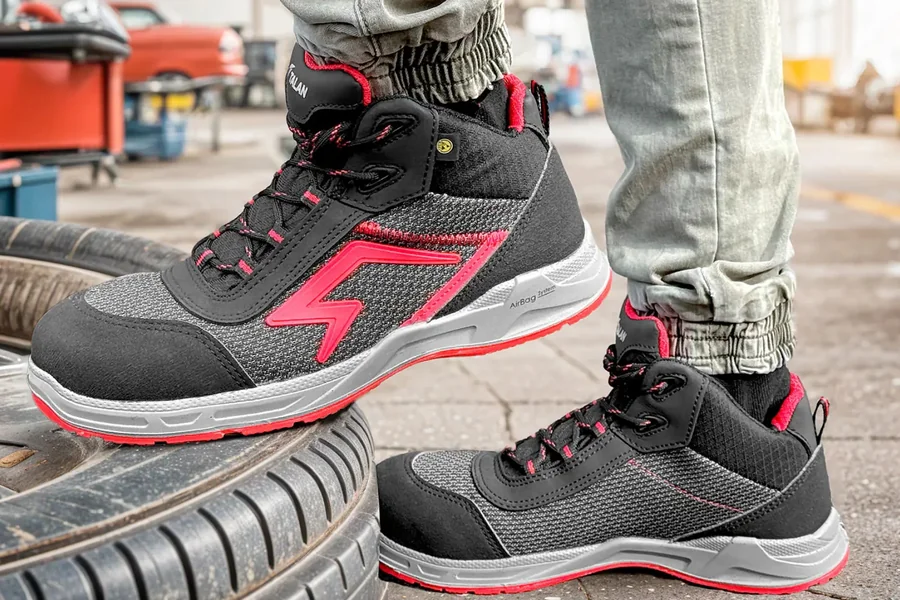
When selecting safety footwear, companies in the UAE tend to focus primarily on price. However, in conditions of heat, construction dust, sand and heavy use, it is the materials that determine the actual lifespan of work footwear. Choosing the wrong leather, textile or sole can reduce a pair’s lifespan by several times and lead to additional costs for replacing PPE. Understanding which materials truly perform well in the Middle Eastern climate is becoming a key task for procurement and health and safety specialists.
Upper materials: a balance of durability and comfort
The upper part of the shoe is the first to be exposed to abrasive dust, sand and mechanical stress. That is why high-quality genuine leather remains one of the most sought-after options.
Leather with a thickness of 2.0–2.2 mm, used in professional safety footwear, has proven particularly effective. Materials in the strongProtection or CrazyHorse range are highly tear-resistant and can withstand loads significantly exceeding the requirements of EN ISO standards. An additional advantage is the leather’s ability to gradually adapt to the shape of the foot, enhancing comfort during prolonged wear.
In recent years, modern textile materials with a polyurethane coating have been gaining popularity. One example is PU Tek technology safety boots. This material combines light weight, good breathability and exceptional abrasion resistance.
By way of comparison, the standard requires a minimum of 51,000 abrasion cycles, whereas modern PU Tek-grade materials can withstand up to 1,000,000 cycles. For companies that regularly buy shoes for work for large teams of employees, this difference has direct economic implications. Greater wear resistance helps to reduce the frequency of shoe replacement and lower the total cost of ownership of personal protective equipment.
The sole: where the durability of safety footwear begins
Even the most durable upper cannot compensate for the shortcomings of a poor-quality sole. It is the sole that is responsible for shock absorption, stability and the lifespan of the footwear. The most common solution for the industrial sector remains the two-layer PU/PU polyurethane sole. This construction allows for a combination of:
- A soft inner layer for cushioning.
- Wear-resistant outer layer.
- High resistance to daily wear and tear.
- Effective shock absorption when working on concrete.
The quality of the raw materials plays a key role. Using components from global manufacturers such as BASF® helps to maintain the sole’s elasticity even after prolonged use. For this reason, BASF soles in safety footwear are regarded as the benchmark for companies seeking to reduce the total cost of ownership of personal protective equipment.
For environments involving high temperatures and contact with oils, nitrile rubber is also used in the soles of safety footwear. Nitrile rubber provides a high level of slip resistance (SRC) and retains its properties in demanding industrial conditions.
Lining and insole: hidden comfort features
In the UAE climate, air temperatures exceed 40°C. In such conditions, the internal microclimate of footwear becomes just as important as the durability of the materials. Modern linings, such as airSurf Fabric, are made from multi-layered breathable textiles that effectively wick away moisture and help the inside of the shoe to dry quickly. Such solutions help maintain comfort and prevent the growth of bacteria.
Insoles play a key role. Modern materials such as Vildona act as a kind of climate buffer: they actively absorb moisture throughout the day and dry quickly during rest periods between shifts. It is precisely these features that make modern Breathable work shoes Middle East more comfortable for prolonged use.
What materials should you look out for in safety footwear?
| Safety shoes component | Premium content | The main advantage in the UAE |
| Upper | 2.2 mm leather / PU Tek | Resistance to sand and tears |
| Sole | Two-layer PU based on BASF® raw materials | Wear and tear and durability |
| Tray | Композит fiberCap / алюминий | Doesn’t heat up in the sun |
| Lining | airSurf Fabric | Rapid moisture wicking |
Why skimping on materials ends up costing more
When assessing safety footwear, it is important to consider its lifespan, employee comfort and replacement costs. Cheap materials may seem attractive at the time of purchase, but often lead to higher costs in the long run.
That is why leading manufacturers, including TALAN, adopt a comprehensive approach to material selection, combining solutions from BASF®, PU Tek and Vildona within a single design. Thanks to the official distributor, Verona Shoes FZE, based in Sharjah, companies in the region can obtain professional advice and select models that best suit the specific requirements of their production processes.

Passionate about exploring diverse ideas and sharing inspiration, I curate content that sparks curiosity and encourages personal growth. Join me at ElementalNest.com for insights across a wide range of topics.